

CIE Syllabus focus:
'Know that giant lattices occur in ionic solids, giant covalent substances such as diamond, graphite and silicon dioxide, and solid metals.'
Many solid substances are built from repeating arrangements rather than separate molecules. Recognizing giant lattices lets you classify ionic solids, giant covalent substances, and solid metals accurately and avoid confusing them with molecular substances.
Giant lattice: A very large repeating structure containing huge numbers of particles held together by strong attractions or bonds throughout the solid.
Recognizing giant lattices
A giant lattice is not a single molecule. It is an extended structure that repeats in a regular pattern across the whole solid. The particles present depend on the type of substance, but the key idea is always the same: the structure is continuous.
In giant lattices, the attractive forces are not limited to small, separate units. Instead, the bonding or electrostatic attraction extends through the sample. This is why these substances are described by their structure type rather than as collections of individual molecules.
The word giant does not mean the crystal is physically large enough to see. It means the structure contains an extremely large number of particles linked together in a repeating arrangement.
The particles involved can be:
ions in an ionic solid
atoms in a giant covalent substance
positive metal ions with delocalized electrons in a solid metal
Giant ionic lattices
Ionic solids form giant ionic lattices. In these solids, positive ions and negative ions are arranged in a regular repeating pattern throughout the crystal.
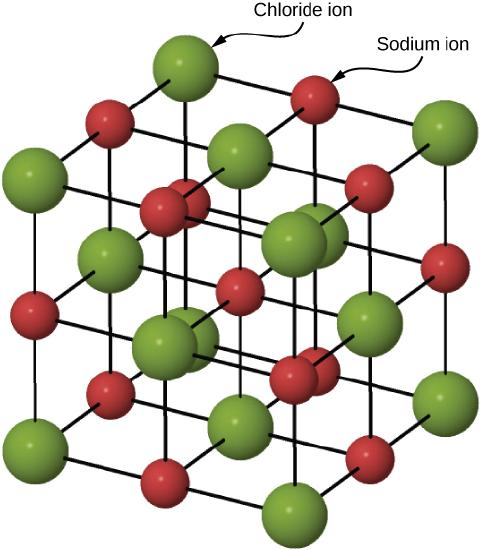
Sodium chloride’s ionic lattice shown as a repeating 3D unit cell within the extended crystal. The color-coding distinguishes and ions, emphasizing that the solid is a continuous array rather than separate “NaCl molecules.” Source
Each ion is attracted to ions of the opposite charge in all directions. This means the electrostatic attraction is spread through the entire solid rather than existing inside separate particles. A crystal of an ionic substance is therefore one extended ionic arrangement.
For example, a substance such as sodium chloride is not made of separate sodium chloride molecules. Its formula shows the simplest whole-number ratio of ions present in the lattice. The same idea applies to other ionic solids such as magnesium oxide.
A giant ionic lattice is recognized by two main features:
the solid contains oppositely charged ions
the ions are arranged in a repeating crystal structure
This category applies specifically to ionic solids. The giant lattice description refers to the fixed arrangement present in the solid state.
Giant covalent lattices
Some covalently bonded substances are not made of small molecules. Instead, they form giant covalent lattices, where atoms are joined by covalent bonds across a very large structure.
For this specification, the key examples are diamond, graphite, and silicon dioxide. These all count as giant lattices because the covalent bonding is extensive and continuous.
Diamond
In diamond, each carbon atom is covalently bonded to four other carbon atoms. This creates a rigid three-dimensional network that continues throughout the crystal.
There are no separate diamond molecules. The whole solid is one continuous covalent structure. That is why diamond is classified as giant covalent.
Graphite
Graphite is also giant covalent, but its arrangement is different from diamond. In graphite, each carbon atom is covalently bonded to three other carbon atoms, forming large layers.
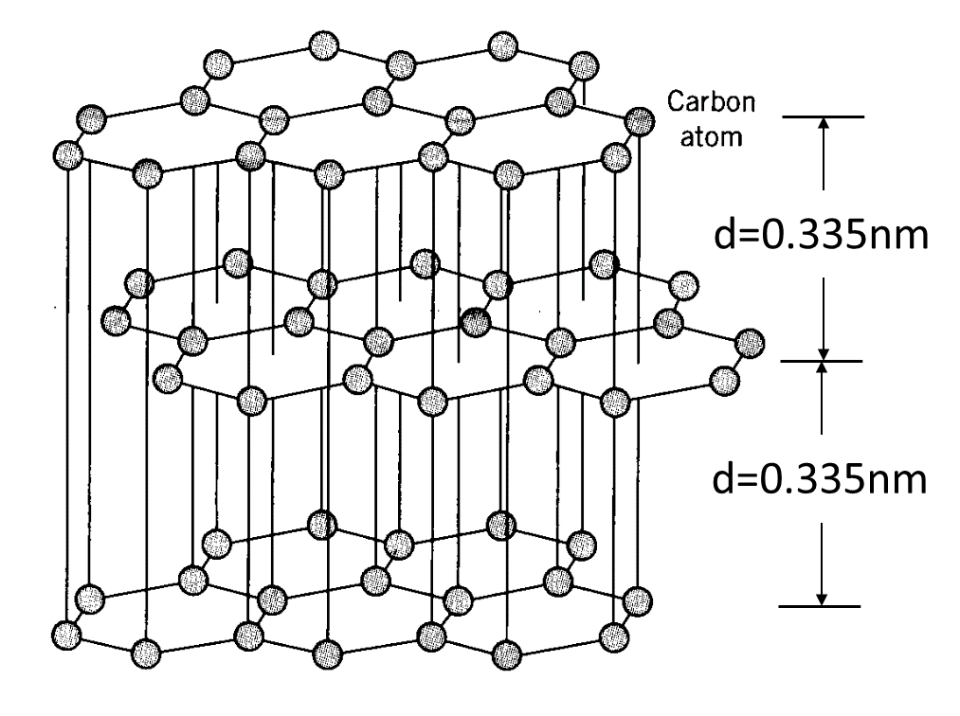
Ball-and-stick diagram of graphite layers stacked in an ABAB pattern, illustrating the layered nature of graphite’s giant covalent structure. The labeled spacing highlights that strong covalent bonding is within layers, while layers are separated by a larger gap (consistent with weaker interlayer attractions). Source
These layers stack together to form the solid. Graphite still counts as giant covalent because the carbon atoms are linked in extended bonding networks rather than existing as small, separate molecules.
Graphite is a useful reminder that giant covalent structures do not all look the same. The detailed arrangement can vary, but the important feature is the presence of extensive covalent bonding.
Silicon dioxide
Silicon dioxide is another giant covalent substance. Its silicon and oxygen atoms are linked in a continuous network across the solid.
The formula does not represent a small molecule. Instead, it shows the ratio of silicon atoms to oxygen atoms in the giant structure. This is an important distinction: a covalent formula does not always mean a simple molecular substance.
Giant metallic lattices
Solid metals form giant metallic lattices. In these substances, positive metal ions are arranged in a regular structure, and delocalized electrons are present throughout the solid.
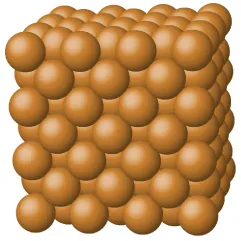
Textbook schematic of metallic bonding, depicting a regular array of metal nuclei/ions surrounded by delocalized electrons. This visualization supports the idea that solid metals are extended lattices with bonding spread throughout the structure, not collections of separate molecules. Source
A piece of solid copper, iron, or magnesium is not made of molecules. It is one extended metallic structure containing vast numbers of particles. This repeating arrangement is what makes it a giant lattice.
The word solid is important. The fixed lattice arrangement applies to metals in the solid state. When a metal melts, the regular lattice is no longer present in the same way because the ions are no longer held in fixed positions.
When identifying a giant metallic lattice, look for:
a metal in the solid state
a regular repeating arrangement
no separate molecules
What all giant lattices have in common
Although giant ionic, giant covalent, and giant metallic lattices contain different particles, they share several important features:
they contain huge numbers of particles
they have a repeating arrangement
they are extended structures, not collections of small molecules
the attraction or bonding acts throughout the solid
The main difference between the three types is the nature of the particles and the bonding involved. Ionic lattices contain ions, giant covalent lattices contain atoms joined by covalent bonds, and metallic lattices occur in solid metals.
A good way to classify a substance is to ask whether the solid is made of separate molecules or of one continuous structure. If it is continuous throughout the sample, it belongs to a giant lattice category.
Practice Questions
Name the three classes of substance that form giant lattices.
(3 marks)
1 mark for ionic solids
1 mark for giant covalent substances
1 mark for solid metals
For each of the following substances, state the type of giant lattice present: sodium chloride, diamond, graphite, silicon dioxide, and solid copper.
Then explain why graphite is still described as giant covalent.
(6 marks)
1 mark for sodium chloride: giant ionic lattice
1 mark for diamond: giant covalent lattice
1 mark for graphite: giant covalent lattice
1 mark for silicon dioxide: giant covalent lattice
1 mark for solid copper: giant metallic lattice
1 mark for an explanation such as:
graphite has extensive covalent bonding across large layers
it is not made of small separate molecules
FAQ
A unit cell is the smallest repeating section of a crystal structure.
A giant lattice is the entire extended structure formed when that repeating unit continues in all directions through the solid.
So, the unit cell is a model of the pattern, while the giant lattice is the full repeating arrangement in the real substance.
A molecular formula describes the actual number of atoms in one molecule.
Giant lattices do not contain separate molecules, so a molecular formula is not appropriate. Instead, the formula usually gives the simplest ratio of particles present, such as the ratio of ions in an ionic lattice or atoms in a network solid.
Yes. Some network covalent substances can exist in less ordered forms.
For example, glass is based on a silicon-oxygen network but is amorphous, meaning it lacks long-range crystal order. It is still network covalent in bonding, even though it is not a perfect lattice in the strict crystal sense.
Metal atoms do not all pack in exactly the same way.
Differences in atomic size and electronic structure can lead to different packing patterns, such as body-centered cubic or face-centered cubic arrangements. These are all still giant metallic structures because the metal remains an extended lattice in the solid state.
One important method is X-ray diffraction.
A giant lattice gives a regular diffraction pattern because its particles are arranged in a repeating way over long distances. By analyzing the pattern, scientists can work out whether the solid has a regular crystal structure and how the particles are arranged within it.

