

CIE Syllabus focus:
'Know that covalently bonded substances such as iodine and ice can have simple molecular structures with intermolecular forces between molecules.'
Simple molecular substances are made of discrete molecules. Strong covalent bonds hold atoms together within each molecule, while weaker attractions between molecules control many of the substance’s physical properties.
Simple molecular structures
Molecules and forces
A simple molecular structure contains separate molecules rather than a continuous network of atoms.
Simple molecular structure: A structure made of separate covalent molecules, with strong covalent bonds within each molecule and intermolecular forces between molecules.
In these substances, atoms inside each molecule are joined by covalent bonds. The molecules themselves are then held together by intermolecular forces.
Intermolecular forces: Attractive forces that act between molecules.
This distinction is essential.
A covalent bond acts within a molecule, but an intermolecular force acts between one molecule and another. In a molecular solid, both are present, but they play different roles.
When a simple molecular substance melts or boils, molecules usually stay chemically unchanged. The process mostly involves overcoming attractions between molecules, not breaking the covalent bonds inside them.
How the molecules are arranged
Simple molecular substances consist of individual molecules packed together. In the solid state, these molecules occupy regular positions in a crystal. The arrangement depends on molecular shape and on the type and strength of intermolecular forces. Because the forces between molecules are weaker than covalent bonds, these solids usually melt at lower temperatures than substances with strong bonding extending throughout the whole solid.
Iodine as a simple molecular solid
Solid iodine is made of I2 molecules.
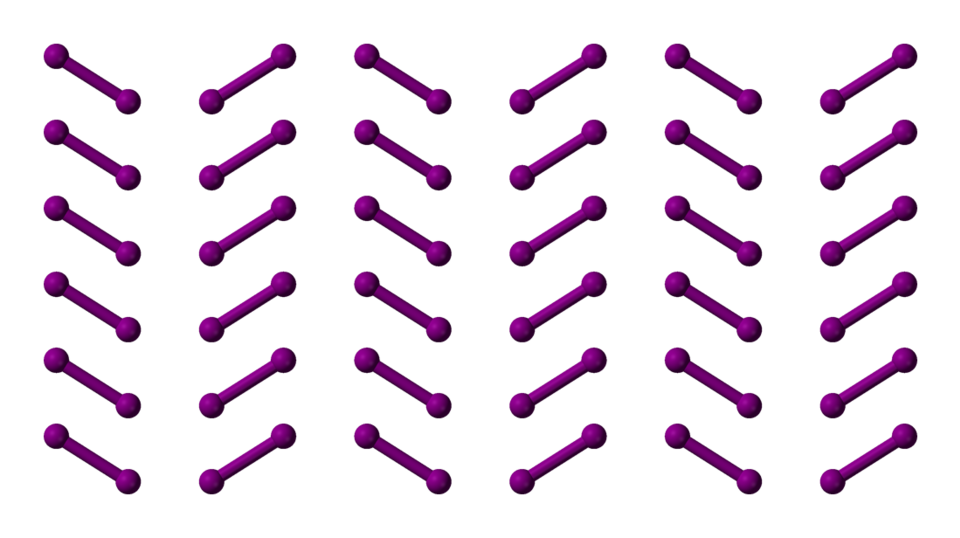
Ball-and-stick view of part of the crystal structure of solid iodine, showing that the solid is built from discrete diatomic molecules rather than a continuous covalent network. The close packing highlights how many weak intermolecular attractions, acting collectively, can stabilize a molecular crystal. Source
Each molecule contains two iodine atoms joined by a single covalent bond. That bond is strong and keeps the molecule intact.
In the crystal, one I2 molecule does not form covalent bonds to all its neighbors. Instead, the molecules are held together by London forces. These arise from temporary uneven distributions of electrons that create short-lived attractions between nearby molecules.
Although iodine is a solid at room temperature, it is still molecular. The solid exists because many weak attractions acting together can hold the molecules in an ordered arrangement.
When iodine is heated, the attraction between I2 molecules can be overcome without breaking the I-I covalent bond. The particles leaving the solid are still I2 molecules.
Ice as a simple molecular solid
Solid ice is also a simple molecular structure. It consists of separate H2O molecules. Inside each water molecule, oxygen is covalently bonded to hydrogen atoms.
In solid ice, neighboring H2O molecules are connected by hydrogen bonds. These are intermolecular forces, not covalent bonds. The hydrogen bonds hold the molecules in a regular three-dimensional arrangement.
This means ice is molecular even though it is rigid and crystalline. The key idea is that each water molecule remains a separate unit. The forces between molecules are important enough to produce a solid, but the molecules themselves are not joined into one continuous covalent structure.
Ice is a useful example because it shows that a simple molecular solid does not always have very weak intermolecular forces. Hydrogen bonds are stronger than the London forces in iodine, so they have a greater effect on the behavior of the solid.
Using correct particle language
In descriptions of simple molecular substances, the particle is a molecule. Using the wrong particle word can make an answer inaccurate. Do not say iodine is made of atoms in the structure if you are referring to the solid as a whole; the solid contains molecules of I2. Similarly, ice contains water molecules, not ions. This matters in changes of state: solid, liquid, and gas can all contain the same molecules. Only chemical reactions change the identity of the molecules themselves.
Properties explained by the structure
The structure of simple molecular substances explains several common properties.
Low to moderate melting and boiling temperatures compared with substances where strong bonding extends throughout the whole structure. This is because heating mainly separates molecules from one another.
Poor electrical conductivity in the solid and liquid states, because there are no mobile charged particles moving through the substance.
Softness or brittleness in many cases, since molecules can sometimes be separated when intermolecular forces are overcome.
It is important to describe the change correctly:
Melting iodine does not break the covalent bond in I2.
Melting ice does not break the covalent O-H bonds in H2O.
In both cases, the change mainly involves weakening or overcoming intermolecular forces between molecules.
Exam wording to use
Students often lose marks by mixing up the bonds inside molecules with the forces between molecules. For iodine and ice, the clearest descriptions are:
Iodine: simple molecular; covalent bond within each I2 molecule; London forces between molecules.
Ice: simple molecular; covalent bonds within each H2O molecule; hydrogen bonds between molecules.
If a question asks why these are called simple molecular structures, the essential idea is that the solid is built from separate molecules. If a question asks what holds the solid together, the answer must refer to intermolecular forces between those molecules, not just “covalent bonding.”
Practice Questions
Explain what is meant by a simple molecular structure, and name the intermolecular force between molecules in solid iodine. (2 marks)
A simple molecular structure contains separate molecules / discrete covalent molecules. (1)
Molecules in solid iodine are held together by London forces. (1)
Ice is a solid made from H2O molecules.
Describe and explain how ice can be a simple molecular structure. In your answer, distinguish clearly between the bonds within a water molecule and the forces between water molecules. (5 marks)
Ice contains separate H2O molecules. (1)
There are covalent bonds within each H2O molecule. (1)
There are hydrogen bonds / intermolecular forces between H2O molecules. (1)
The intermolecular forces are weaker than the covalent bonds within the molecules. (1)
On melting, the intermolecular forces are overcome but the covalent O-H bonds remain intact. (1)
FAQ
Solid iodine is made of separate I2 molecules, so heating does not need to break the covalent bond inside each molecule.
It only needs to overcome the London forces between molecules. That allows whole I2 molecules to leave the solid directly as vapor.
Iodine molecules contain large electron clouds, and the crystal interacts strongly with visible light. Some wavelengths are absorbed and others are reflected, giving iodine its dark color and noticeable luster.
This appearance does not mean metallic bonding is present. It is still a molecular solid made of neutral I2 molecules.
Yes. A substance is often described by its strongest or most important intermolecular force, but weaker ones may also be present.
For example:
Ice has hydrogen bonding, but water molecules also experience London forces.
A polar molecular solid may have permanent dipole attractions as well as London forces.
At different temperatures and pressures, H2O molecules can pack in different regular arrangements. The hydrogen-bond network changes shape.
Even so, the particles are still individual H2O molecules. That means each form is still molecular rather than a continuous covalent structure.
Evidence can come from methods such as mass spectrometry or gas-density measurements. These show particle masses that match I2 rather than single iodine atoms.
This supports the idea that a change of state usually leaves the molecules intact. The intermolecular forces are overcome, but the covalent bond inside each I2 molecule remains.

