

IB Syllabus focus: 'Homeostasis is a self-regulating biological process that maintains a relatively stable internal environment. It generally occurs through negative feedback mechanisms that reverse changes back towards controlled conditions.'
Homeostasis keeps internal conditions within narrow limits even when the outside environment or activity level changes. This principle underpins normal function and explains how the body remains stable during rest, movement, and recovery.
Understanding homeostasis
The body is constantly exposed to change. Muscles use energy, cells produce waste, and external conditions shift. Despite this, the internal environment must stay within limits that allow enzymes, cells, and organs to function effectively.
Homeostasis is the self-regulating process that maintains a relatively stable internal environment.
“Relatively stable” does not mean perfectly constant. Conditions can rise or fall slightly around a target level, often called a set point or normal range. The key idea is control: the body detects change and responds before that change becomes too large.
In SEHS, homeostasis matters because performance depends on stability inside the body. If internal conditions drift too far from their controlled range, movement becomes less efficient and normal body function can be disrupted.
Controlled conditions
A controlled condition is any internal factor that is monitored and adjusted to support normal body function. These conditions are kept within acceptable limits rather than at one exact value at all times.
Common features of controlled conditions are:
they can change due to internal activity or the external environment
they are monitored by the body
responses are triggered when they move away from the desired range
the response aims to reduce the size of the disturbance
Negative feedback as the main control mechanism
Most homeostatic control works through negative feedback. The word “negative” refers to the effect on the original change, not to something harmful. The response opposes the disturbance.
Negative feedback is a regulatory mechanism in which a change in a controlled condition triggers responses that reverse that change back toward the normal range.
A negative feedback loop usually follows a general pattern.
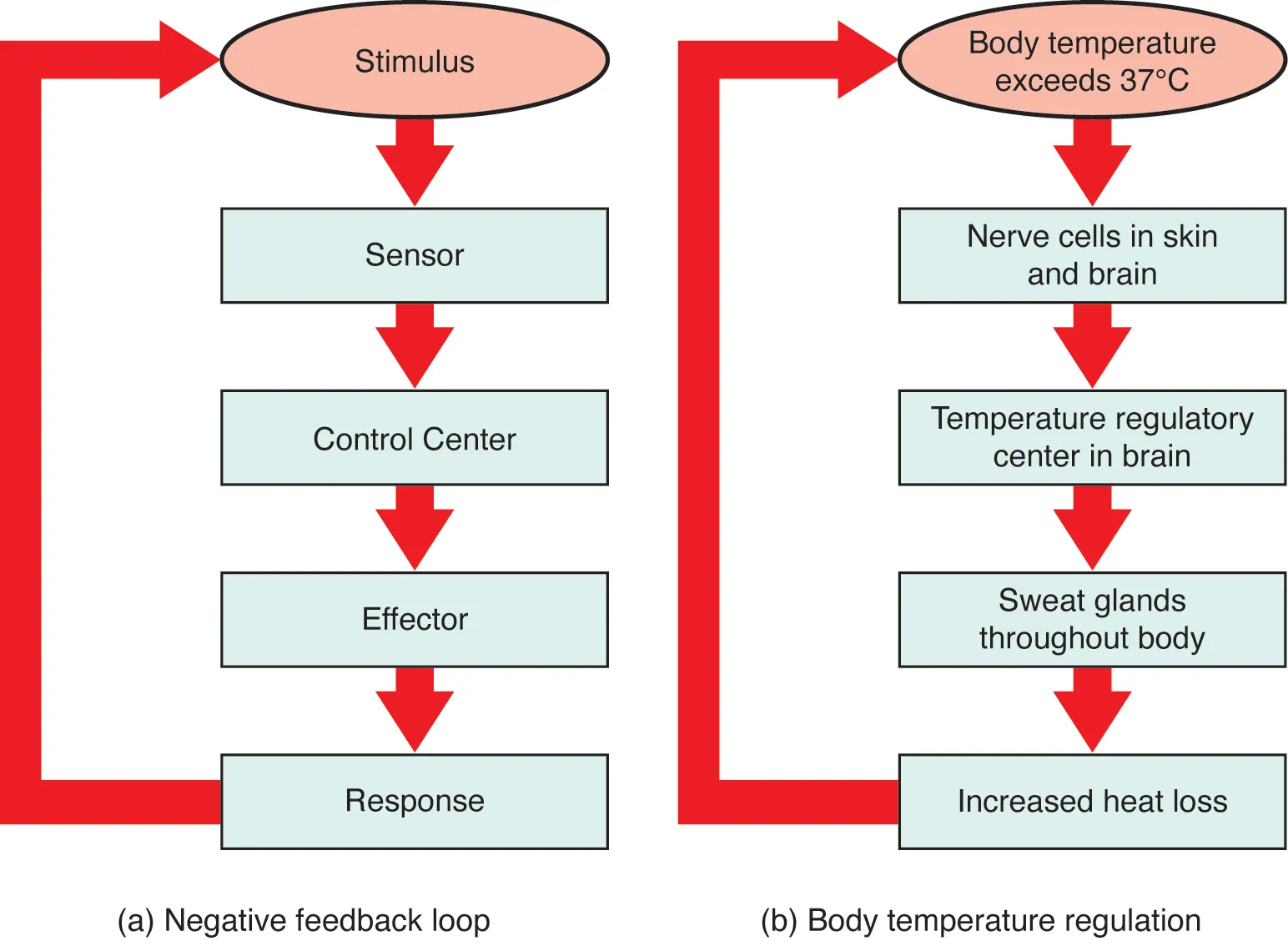
Diagram of a standard negative feedback loop showing the information pathway from stimulus to receptor (sensor), then to a control center, and finally to effectors that generate a response that reduces the original disturbance. The included thermoregulation example reinforces that feedback is continuous: as body temperature returns toward the normal range, the corrective drive diminishes. Source
A stimulus causes a deviation from the normal range. This deviation is detected, information is processed, and effectors produce a corrective response. As the condition moves back toward its controlled level, the stimulus for correction becomes smaller.
Parts of a negative feedback loop
Although exact structures vary, the same basic roles appear repeatedly:
Stimulus: a change pushes an internal condition away from its normal range
Receptor: a detector senses the change
Control center: information is interpreted and a response is organized
Effector: a tissue, organ, or gland carries out the response
Response: the change is reduced and stability is improved
This loop is continuous rather than one-time. The body repeatedly monitors conditions and adjusts its responses as needed.
Why negative feedback is effective
Negative feedback helps prevent small disturbances from becoming large ones. It allows the body to:
maintain conditions suitable for cell function
adapt quickly to changing demands
conserve stability during physical activity
return toward baseline after a disturbance
Because correction is linked to the size of the disturbance, the response can increase when change is large and decrease as balance is restored. This makes control flexible rather than all-or-nothing.
Homeostasis is dynamic, not static
A common misunderstanding is that homeostasis means no change. In reality, healthy function involves constant small adjustments. Activity in body systems changes from moment to moment, but regulation prevents those changes from becoming excessive.
This is why homeostasis is often described as a dynamic equilibrium.
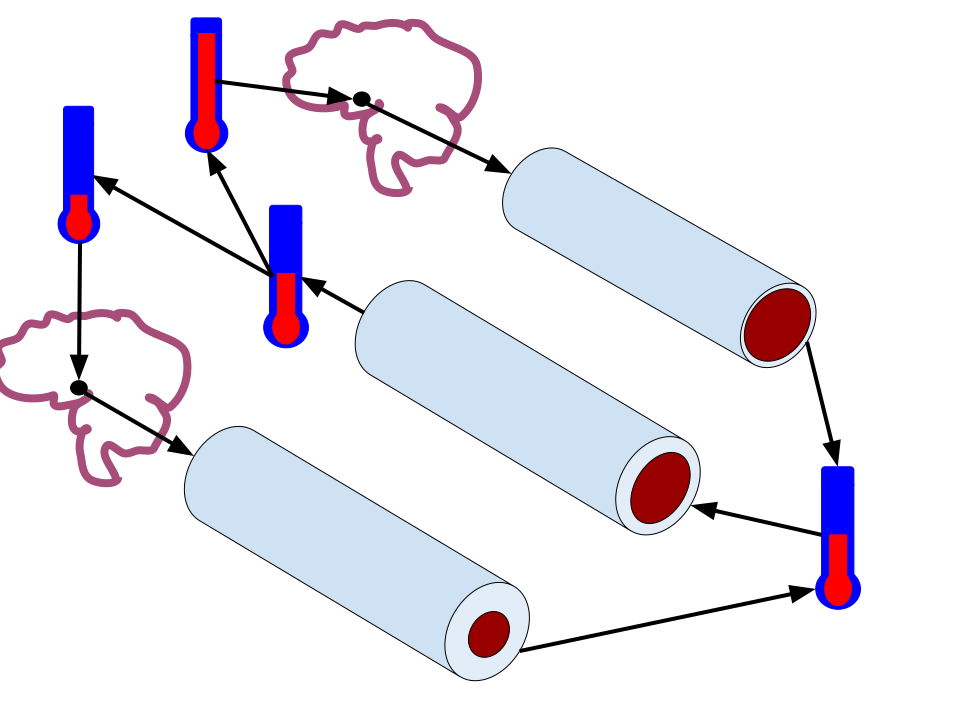
Negative feedback loop for human thermoregulation showing how deviations above or below normal temperature are detected (hypothalamus-centered control) and corrected through effectors such as changes in skin blood vessel diameter. The figure emphasizes the defining feature of negative feedback: responses counteract the initial change, moving the controlled condition back toward the normal range. Source
Inputs and outputs are continuously changing, yet the internal environment stays within workable limits. During exercise, internal conditions are challenged more strongly than at rest. Homeostatic mechanisms do not stop change entirely; instead, they limit the deviation and support a return toward the normal range.
Relationship between disturbance and response
Negative feedback depends on a clear cause-and-effect relationship. The larger the deviation from the normal range, the stronger the corrective drive usually becomes. As the condition approaches its target range, the corrective response is reduced. This prevents overcorrection and supports smoother regulation.
If the body did not reduce the response as balance returned, the corrected variable could move too far in the opposite direction. Effective homeostatic control therefore involves both activation and restraint.
Why homeostasis matters in SEHS
For sport, exercise, and health science, homeostasis explains why the body can tolerate changing workloads while still supporting movement and essential cellular function. Exercise creates repeated disturbances inside the body. The ability to detect and correct these disturbances is essential for both safe participation and sustained performance.
Homeostasis also helps explain recovery. Once a challenge becomes smaller, negative feedback continues to operate until conditions move back toward resting levels. Recovery is therefore part of the same regulatory principle.
Limits of homeostatic control
Homeostasis is powerful, but it is not unlimited. If a disturbance is too intense, lasts too long, or occurs too quickly, the body may struggle to restore normal conditions. In those situations, performance can decline and the risk of harm increases.
Key limits include:
the sensitivity of receptors
the speed of communication
the ability of effectors to respond
the size and duration of the disturbance
When these limits are exceeded, a relatively stable internal environment becomes harder to maintain, and the effectiveness of negative feedback is reduced.
Practice Questions
State what is meant by homeostasis and identify the role of negative feedback.
1 mark: Homeostasis is the maintenance of a relatively stable internal environment.
1 mark: Negative feedback reverses a change or deviation back toward normal or controlled conditions.
Explain how a negative feedback mechanism helps maintain homeostasis when an internal condition changes during exercise.
1 mark: Exercise causes an internal condition to move away from its normal range.
1 mark: Receptors detect the change.
1 mark: A control center processes the information and coordinates a response.
1 mark: Effectors produce a response that opposes the original change.
1 mark: As the condition returns toward normal, the corrective response is reduced, helping restore stability.
FAQ
Perfect constancy would be unrealistic and inefficient. Biological systems always show small fluctuations because:
cells are continuously active
responses take time to begin
effectors do not act with perfect precision
Homeostasis is therefore about keeping conditions within a safe functional range, not fixing them at a single unchanging value.
Yes. A normal range is not always identical in every situation.
It can shift because of factors such as:
time of day
sleep-wake cycles
anticipation of activity
illness
This means homeostasis can regulate around a temporarily adjusted target, not only around one fixed level for life.
Negative feedback is not instantaneous. A delay can happen at several stages:
detecting the change
sending information
activating effectors
producing a measurable response
If the disturbance is rapid, the body may lag behind briefly. That does not mean regulation has failed; it means biological control systems need time to respond.
Some corrective responses create sensations that are unpleasant but protective. Discomfort can encourage behavior that supports regulation, such as resting, drinking, or moving away from stress.
In this way, sensation is sometimes part of the broader regulatory process, helping behavior work alongside automatic negative feedback.
Often, yes. Regular training can make regulation more efficient by improving how quickly the body detects and responds to disturbances.
Possible effects include:
faster adjustment to changing demands
reduced size of some disturbances during the same workload
quicker return toward resting conditions after exercise
This does not remove the need for homeostasis; it improves how effectively the body manages it.
