

IB Syllabus focus: 'Blood pH is influenced by carbon dioxide concentration. It is monitored through the respiratory control centre of the brain and by chemoreceptors throughout the body.'
Precise control of blood pH is essential for normal enzyme function, muscle contraction, and nerve signaling. Respiration helps stabilize pH by altering how much carbon dioxide is retained or exhaled.
Blood pH and why it matters
Blood must remain within a narrow pH range for cells to function normally. In healthy arterial blood, pH is usually about 7.35 to 7.45. If pH falls too far, blood becomes more acidic; if it rises too far, blood becomes more alkaline. Even small shifts can change protein shape, interfere with enzyme activity, and reduce the efficiency of excitable tissues such as muscles and nerves.
Blood pH: A measure of the hydrogen ion concentration of blood; lower pH means more acidic, while higher pH means more alkaline.
Because pH is linked to hydrogen ion concentration, regulation of blood pH is really regulation of how much is present in the blood at a given time.
How carbon dioxide affects blood pH
Carbon dioxide is produced continuously during aerobic metabolism. Once it enters the blood, much of it participates in a reversible reaction with water. If blood concentration rises, the reaction shifts toward the production of more hydrogen ions. This lowers pH. If blood concentration falls, the reaction shifts back in the opposite direction, hydrogen ion concentration decreases, and pH rises.

This diagram illustrates the reversible carbonic acid–bicarbonate buffer system that couples respiration to blood pH. It shows how dissolved can be converted to carbonic acid and then to and , and how the reaction can run in reverse when is removed by the lungs. The arrows emphasize equilibrium shifting as concentrations change. Source
= Carbon dioxide in blood
= Water
= Carbonic acid
= Hydrogen ion; increasing lowers pH
= Bicarbonate ion
This relationship makes respiration a major short-term regulator of blood pH. The body can change pH quickly by changing how much is removed from the lungs. Faster or deeper breathing removes more from the blood. Slower or shallower breathing removes less, allowing to build back up.
Monitoring and control by the brain
The respiratory control center in the brain stem coordinates automatic changes in ventilation. It receives sensory information about chemical conditions in the body and then adjusts the activity of the breathing muscles. This control is continuous, even at rest.
If rising causes blood pH to fall, the respiratory control center increases the drive to breathe.
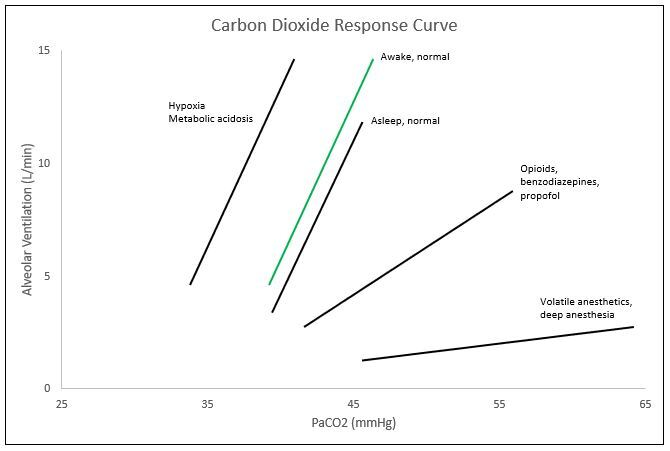
This figure plots the carbon dioxide ventilatory response curve: ventilation increases as rises, reflecting chemoreceptor-driven respiratory drive. It helps connect a chemical change (increased ) to the physiological response (increased ventilation). The curve also highlights that changes in sensitivity or threshold can shift the response, which is clinically relevant when interpreting ventilation control. Source
Both breathing rate and breathing depth can increase, which raises ventilation and helps remove more . If falls too low and pH rises, the respiratory drive decreases, so less is lost. In this way, breathing acts as a negative feedback mechanism, opposing the initial disturbance.
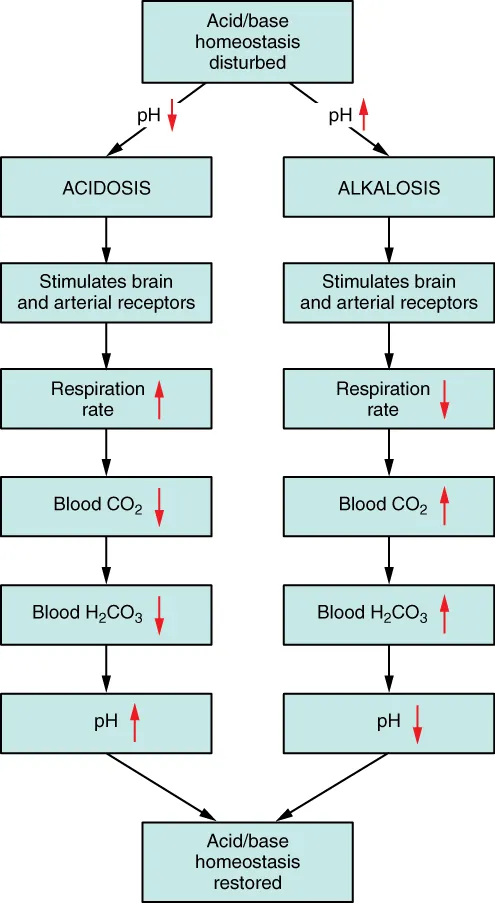
This flowchart summarizes respiratory negative feedback in acid–base homeostasis. When blood pH falls (acidosis), chemoreceptor input increases respiratory drive to lower blood and reduce carbonic acid, moving pH back toward normal; the reverse occurs in alkalosis. It visually links the stimulus (pH change) to the effector (ventilation change) and the corrective outcome (pH normalization). Source
Chemoreceptors and their role
Chemoreceptors provide the sensory input needed for this regulation. They detect chemical changes related to , , and pH and send signals to the respiratory control center.
Chemoreceptors: Specialized receptors that detect chemical changes, especially changes related to , , and pH, and send information to the respiratory control center.
Central chemoreceptors
Central chemoreceptors are located near the respiratory control center in the brain. They are especially sensitive to pH changes in the fluid surrounding the brain. Because diffuses readily into this fluid, a rise in blood strongly stimulates these receptors indirectly. They are therefore very important in controlling ventilation when carbon dioxide levels change.
Peripheral chemoreceptors
Peripheral chemoreceptors are found in major blood vessels, especially in the carotid and aortic bodies. They monitor arterial blood and respond rapidly when pH falls or when rises. Their signals travel to the brain and help produce a quick ventilatory adjustment. Together, central and peripheral chemoreceptors provide continuous monitoring of the body’s acid-base status.
Regulation during increased metabolic demand
During exercise or any rise in metabolic activity, cells produce more . If this extra were not removed, hydrogen ion concentration would increase and blood pH would drop. Regulation follows a clear sequence:
metabolic activity increases, so more enters the blood
the reversible reaction produces more
blood pH falls
chemoreceptors detect the chemical change
signals are sent to the respiratory control center
ventilation increases to remove the excess
As more is exhaled, the reaction shifts back, hydrogen ion concentration falls, and pH moves toward normal again. The reverse also occurs when drops below normal: chemoreceptor stimulation decreases, breathing is reduced, and is retained until pH returns toward its normal range. The key point is that respiration regulates blood pH mainly through control of carbon dioxide concentration.
Practice Questions
State how an increase in blood affects blood pH. [2]
Increased leads to increased formation of / carbonic acid in the blood. (1)
Increased lowers blood pH / makes the blood more acidic. (1)
Explain how chemoreceptors and the respiratory control center regulate blood pH when blood rises during exercise. [6]
Exercise increases metabolic production of . (1)
Increased causes an increase in and a fall in blood pH. (1)
Chemoreceptors detect the rise in and/or fall in pH. (1)
Signals are sent to the respiratory control center in the brain. (1)
The respiratory control center increases ventilation by increasing breathing rate and/or depth. (1)
More is exhaled, so decreases and blood pH returns toward normal. (1)
FAQ
$CO_2$ crosses the blood-brain barrier much more easily than hydrogen ions do.
Once $CO_2$ enters the fluid around the brain, it forms hydrogen ions there. Central chemoreceptors respond to that local pH change, which is why they are highly sensitive to changes in blood $CO_2$.
Respiratory acidosis happens when ventilation is too low to remove enough $CO_2$.
As $CO_2$ accumulates, more $H^+$ is formed and blood pH falls. Causes can include severe lung disease, airway obstruction, or depressed breathing from drugs. The key problem is inadequate removal of carbon dioxide.
Respiratory alkalosis happens when ventilation is too high and too much $CO_2$ is removed.
This reduces hydrogen ion concentration and raises blood pH. It can occur during anxiety-driven overbreathing, pain, or inappropriate mechanical ventilation. Symptoms may include light-headedness, tingling, and feelings of weakness.
Bicarbonate, $HCO_3^-$, is part of the main buffering system linked to carbon dioxide in the blood.
It helps the reaction remain reversible, so the body can shift between storing chemical products and releasing $CO_2$ for exhalation. Without bicarbonate, blood pH would change more sharply when carbon dioxide production increased.
During breath-holding, $CO_2$ continues to be produced by metabolism but cannot be exhaled effectively.
As blood $CO_2$ rises, pH falls and chemoreceptors become more strongly stimulated. This increasing sensory input reaches the respiratory control center and produces the growing urge to breathe, often before oxygen falls to very low levels.
