

IB Syllabus focus: 'Thermoregulation relies on the cardiovascular, muscular, nervous and integumentary systems to maintain core body temperature at 37 ± 1°C through sweating, vasodilation, vasoconstriction, shivering and non-shivering thermogenesis.'
Thermoregulation keeps internal conditions within a narrow safe range despite metabolic heat production and external temperature change. Effective temperature control is essential for enzyme function, performance, and survival.
Thermoregulation as coordinated control
Thermoregulation is the process by which the body balances heat gain and heat loss. Human core body temperature is normally kept close to 37°C, with only a small normal variation. If core temperature rises too far, body systems become less efficient and heat illness can develop. If it falls too far, metabolic reactions slow and normal movement becomes more difficult.
Thermoregulation: The control of body temperature by balancing heat gain and heat loss to keep internal conditions within a narrow range.
The body gains heat from normal metabolism and, during exercise, from working muscles. It loses heat mainly through the skin. Temperature control therefore depends on several systems working together rather than one organ acting alone.
Core and skin temperature
Core temperature describes the temperature of the deep tissues and organs. This is the temperature the body tries hardest to protect. Skin temperature changes more quickly because the skin is directly exposed to the environment. Thermoregulation aims to keep the core stable even when the skin becomes warmer or cooler.
Core temperature: The temperature of the body’s deep tissues and organs, usually maintained close to 37 ± 1°C.
A small rise in core temperature during exercise is normal because active muscles produce large amounts of heat. The problem occurs when heat production becomes greater than heat loss for too long.
Systems involved in body temperature control
Nervous system
The nervous system coordinates thermoregulation. Temperature sensors in the body detect change and send information to the brain. The brain then activates responses that either increase heat loss or increase heat production. This control is rapid, allowing the body to respond quickly to changing conditions.
Integumentary system
The integumentary system includes the skin and sweat glands. It is the main surface for heat exchange. Sweat glands release sweat onto the skin, and the skin’s blood vessels can change diameter to alter how much heat reaches the surface.
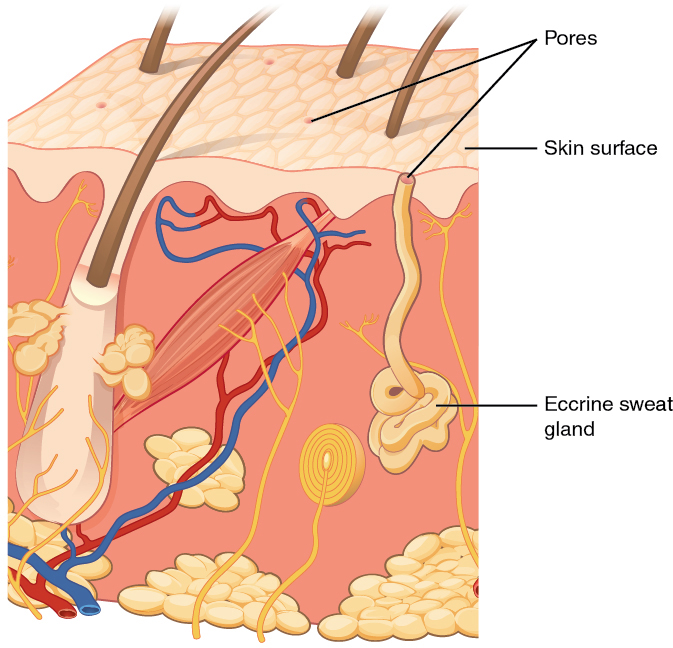
Cross-section of skin showing an eccrine (merocrine) sweat gland: a coiled secretory portion in the dermis connected to a duct that opens at a surface pore. This anatomy underpins evaporative heat loss because sweat must be delivered to the skin surface before it can evaporate and remove thermal energy. Source
Cardiovascular system
The cardiovascular system helps distribute heat around the body. Blood carries heat from active tissues to the skin. By increasing or decreasing blood flow near the skin, the body can change how much heat is lost to the surroundings.
Muscular system
The muscular system contributes when heat production needs to increase. Involuntary muscle activity can generate heat rapidly when body temperature falls below the normal range.
Mechanisms that reduce body temperature
Sweating
When body temperature rises, sweat glands produce sweat. If this sweat evaporates from the skin surface, heat is removed from the body. Evaporation is a major cooling mechanism, especially during exercise. Sweat that stays on the skin or drips off without evaporating provides much less cooling.
Vasodilation
Vasodilation is the widening of blood vessels. In thermoregulation, blood vessels near the skin widen so that more warm blood reaches the body surface. This increases heat transfer from the blood to the environment. Vasodilation works effectively alongside sweating because it brings more heat to the skin, where evaporation can remove it.
Mechanisms that conserve or produce heat
Vasoconstriction
When body temperature falls, the body reduces heat loss through vasoconstriction, which is the narrowing of blood vessels near the skin. Less warm blood reaches the surface, so more heat is retained in the core.
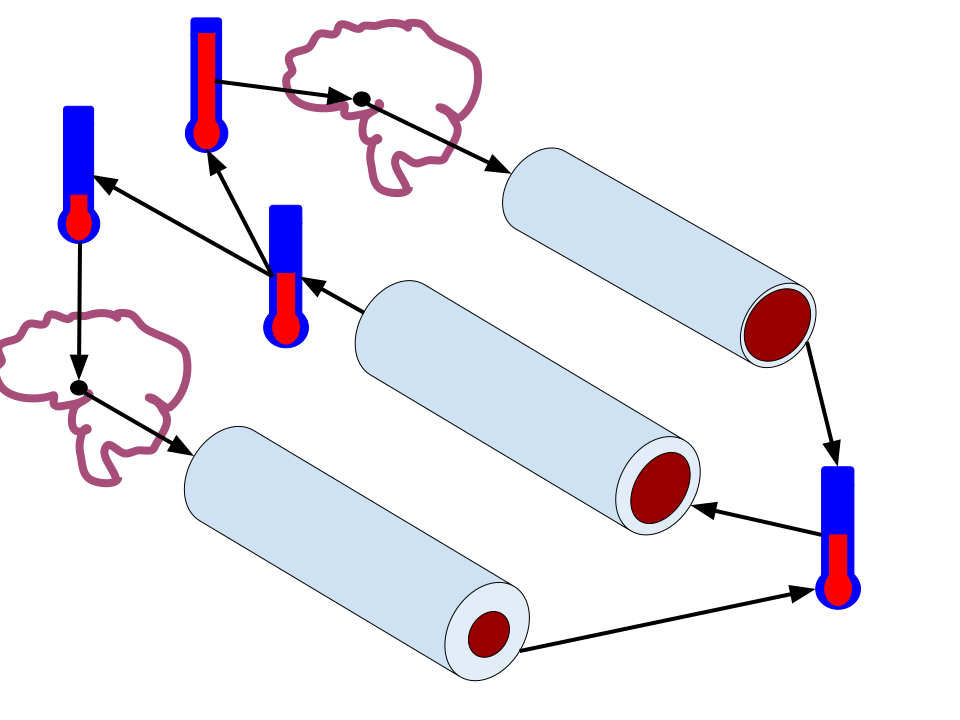
Negative-feedback thermoregulation diagram highlighting vascular effectors: vasodilation increases skin blood flow to promote heat loss, while vasoconstriction reduces skin blood flow to conserve core heat. The figure emphasizes how the cardiovascular and nervous systems coordinate to stabilize core temperature around the set point. Source
This is why the skin may feel cool when the body is trying to conserve heat.
Shivering
Shivering is a rapid, involuntary series of skeletal muscle contractions. These contractions increase energy use and produce heat. Shivering is an effective short-term response when the body becomes too cold, but it also increases fatigue and can reduce movement efficiency.
Non-shivering thermogenesis
The body can also increase heat production without visible muscle contractions.
Non-shivering thermogenesis: Heat production caused by an increase in metabolic activity without shivering.
This mechanism raises heat production through increased metabolic activity in body tissues. It is slower than shivering, but it still helps the body defend core temperature when heat must be generated.
How the systems work together
Thermoregulation is a coordinated response. When body temperature rises, the nervous system activates sweating and vasodilation, increasing heat loss from the skin. When body temperature falls, the nervous system activates vasoconstriction, shivering, and non-shivering thermogenesis, reducing heat loss and increasing heat production.
These responses show clear links between systems:
Nervous system: detects temperature change and sends control signals
Integumentary system: provides sweat glands and the skin surface for heat exchange
Cardiovascular system: changes skin blood flow through vasodilation and vasoconstriction
Muscular system: produces heat during shivering
Thermoregulation is therefore a continuous balancing process. The body is constantly adjusting sweat rate, blood flow to the skin, and heat production so that internal temperature stays within a narrow safe range.
Practice Questions
Identify two mechanisms the body uses to lower core body temperature.
1 mark for sweating
1 mark for vasodilation
Accept equivalent wording such as increased sweat production or widening of skin blood vessels
Explain how the cardiovascular, muscular, nervous, and integumentary systems work together to maintain core body temperature near 37 ± 1°C.
1 mark for stating that the nervous system detects temperature change and coordinates the response
1 mark for explaining that the integumentary system produces sweat, which cools the body when it evaporates
1 mark for explaining that the cardiovascular system causes vasodilation to increase heat loss at the skin
1 mark for explaining that the cardiovascular system causes vasoconstriction to reduce heat loss from the skin
1 mark for explaining that the muscular system produces heat through shivering
1 mark for explaining that non-shivering thermogenesis increases metabolic heat production without muscle contractions
Award max 6 marks
FAQ
Humans have a large number of eccrine sweat glands, and much of the body surface has relatively little fur. This makes evaporation from the skin an effective way to remove heat.
Many other mammals lose more heat by panting because thick fur limits evaporative cooling from the skin. Human sweating is especially useful during prolonged exercise, when internal heat production stays high.
In fever, the brain temporarily raises the body’s temperature target, usually because of infection or inflammation. The body then actively generates and conserves heat until it reaches that higher target.
In hyperthermia, body temperature rises above normal without a raised target. Heat production or heat gain becomes greater than heat loss, so the body overheats despite trying to cool itself.
Goosebumps happen when tiny muscles attached to hair follicles contract and pull the hairs upright. In furry animals, this traps a thicker layer of insulating air near the skin.
Humans have much less body hair, so the insulating effect is very small. Goosebumps are therefore more of a leftover evolutionary response than a major heat-conservation mechanism.
Infants cannot shiver as effectively as older children or adults, so they rely more on non-shivering thermogenesis for heat production.
They also have a larger surface area relative to body mass, which means they lose heat quickly. Specialized tissues, especially brown adipose tissue, help them generate heat without the large muscular effort of shivering.
In heat stroke, core temperature rises to a dangerous level and normal cooling mechanisms are no longer enough. Sweating may become ineffective or may stop, and the nervous system can become impaired.
This can lead to confusion, collapse, organ stress, and severe cardiovascular strain. Heat stroke is a medical emergency because high temperature can quickly damage cells, proteins, and vital organs.
