
Bias
· Bias = a limitation in objective thinking; a tendency to perceive information through a cognitive filter shaped by experience and preference.
· In IB Psychology, bias appears in research design, data collection, analysis, interpretation, clinical psychology, psychological perspectives, and everyday decision-making.
· High-scoring answers should go beyond naming a bias: explain how it affects validity, credibility, generalizability, diagnosis, treatment, or decision-making.
· Psychology aims for objectivity, while recognizing that much psychological data is subjective and bias may be implicit or explicit.
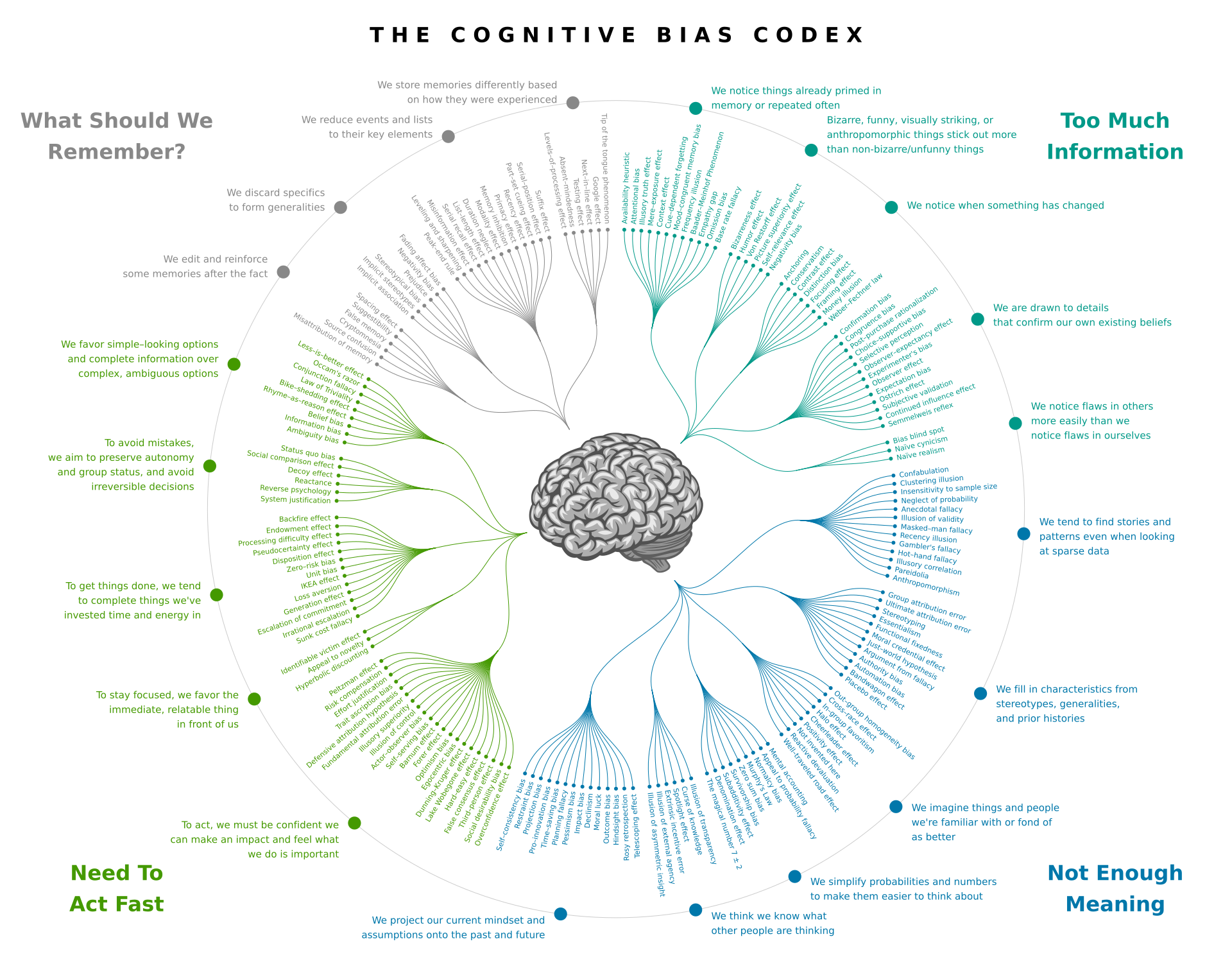
This diagram shows the breadth of cognitive biases that can affect human thinking. It is useful as an overview, but students should focus on IB-relevant examples such as anchoring, availability, representativeness, and confirmation bias rather than memorising the whole chart. Source
Bias in the research process
· Researcher bias = the researcher’s expectations, values or assumptions influence the way a study is designed, conducted, analysed or interpreted.
· Participant bias = participants change their behaviour because they know they are being studied; includes demand characteristics and social desirability bias.
· Sampling bias = the sample does not accurately represent the target population, reducing generalizability.
· Confirmation bias = researchers or participants favour evidence that supports existing beliefs or hypotheses.
· Publication bias = studies with significant or positive findings are more likely to be published than null or negative results.
· Exam focus: explain how bias may reduce internal validity, external validity, credibility, reliability, or transferability depending on the method used.
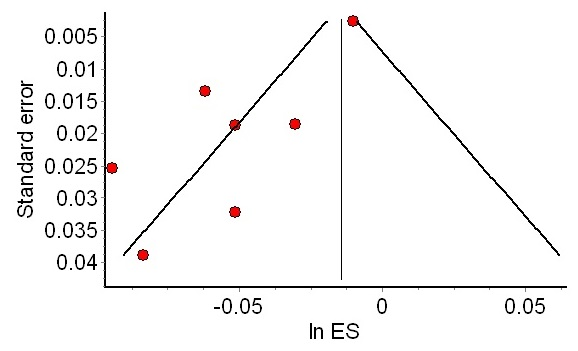
This image helps students understand why publication bias matters: if small or non-significant studies are missing, the evidence base can appear stronger than it really is. In exam answers, link this to distorted conclusions and reduced confidence in psychological claims. Source
Controlling bias in research
· Controls for bias are a key part of the research process because they improve objectivity and strengthen conclusions.
· Use random sampling or stratified sampling to reduce sampling bias where appropriate.
· Use standardized procedures to reduce researcher influence and improve reliability.
· Use single-blind or double-blind procedures to reduce participant bias and researcher expectancy effects.
· Use inter-rater reliability when coding observations, interviews or qualitative data to reduce subjectivity.
· Use reflexivity in qualitative research: researchers reflect on how their own assumptions may influence data collection and interpretation.
· Use triangulation to improve credibility by checking findings through multiple methods, data sources or perspectives.
Bias in clinical psychology
· Gender bias may affect diagnosis, prevalence statistics and treatment decisions if symptoms are interpreted differently across genders.
· Cultural bias may occur when diagnostic criteria, theories or treatments developed in one culture are applied uncritically to another.
· Bias in clinical contexts can distort diagnosis, prevalence rates, treatment access, and treatment effectiveness.
· Exam link: use bias to evaluate whether psychological explanations and treatments are valid across populations.
· Strong evaluation should consider emic approaches and cultural sensitivity as ways to reduce cultural bias.
Bias in psychological perspectives
· Bias can occur when psychologists favour one perspective too strongly, such as a purely biological, cognitive, or sociocultural explanation.
· Reductionism = explaining complex behaviour using only one level of explanation; this may ignore interaction between biological, cognitive and sociocultural factors.
· Biological determinism = assuming behaviour is mainly caused by biological factors such as genes, hormones or neurotransmitters.
· Environmental determinism = assuming behaviour is mainly caused by external or sociocultural influences.
· High-scoring evaluation: explain that one perspective may be useful but incomplete; a holistic explanation often gives a more balanced account of behaviour.
Cognitive biases in decision-making
· Cognitive biases often occur when people lack enough time, information, or motivation to make a fully rational decision.
· Anchoring bias = relying too heavily on the first piece of information encountered when making a judgment.
· Representativeness bias = judging probability based on how similar something is to a mental prototype, rather than using base-rate information.
· Availability bias = judging likelihood based on how easily examples come to mind.
· Confirmation bias = seeking, interpreting or remembering information in ways that support existing beliefs.
· Exam link: cognitive biases are especially relevant to thinking, decision-making, dual processing theory, and schema theory.
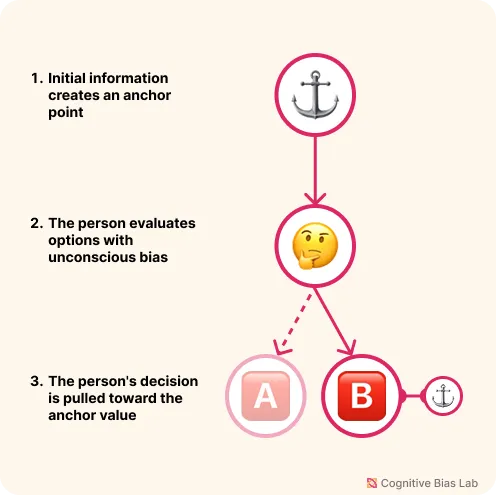
This diagram shows the process of anchoring bias in a simple decision-making sequence. It is useful for explaining how an arbitrary starting value can influence later judgments even when better information is available. Source
Bias and dual processing theory
· Dual processing theory suggests decision-making involves two broad systems: fast, automatic thinking and slow, controlled thinking.
· Fast thinking is efficient but more vulnerable to heuristics and cognitive biases.
· Slow thinking requires effort and attention, and can help check or correct biased judgments.
· Bias is not always random error; many biases are systematic patterns in thinking.
· Exam link: use dual processing theory to explain why cognitive biases occur in everyday choices and why people may not notice them.
Exam application: how to use bias in answers
· Define the relevant bias clearly using psychological terminology.
· Link the bias to a specific example: research design, sampling, analysis, diagnosis, treatment, or decision-making.
· Explain the consequence: reduced validity, credibility, generalizability, or objectivity.
· Add a control or solution where relevant, such as standardization, random sampling, double-blind procedures, inter-rater reliability, reflexivity, or triangulation.
· Evaluate: bias does not automatically make research useless, but it affects the strength of conclusions and must be considered when judging evidence.
Checklist: can you do this?
· Define bias as a limitation in objective thinking and apply it to psychological research or behaviour.
· Identify researcher, participant, sampling, confirmation, publication, gender, cultural and cognitive biases.
· Explain effects of bias on research quality, diagnosis, treatment, prevalence statistics and decision-making.
· Suggest controls such as standardization, blinding, sampling techniques, reflexivity and inter-rater reliability.
· Evaluate studies or claims by linking bias to validity, credibility, generalizability or reductionism.
Key exam terms to remember
· Researcher bias
· Participant bias
· Sampling bias
· Confirmation bias
· Publication bias
· Gender bias
· Cultural bias
· Cognitive bias
· Anchoring bias
· Representativeness bias
· Availability bias
· Reflexivity
· Inter-rater reliability
· Credibility
· Reductionism vs holism
· Implicit vs explicit bias