
Measurement: core idea
· Measurement = how psychologists study, observe and collect data about behaviour in a way that is as reliable, valid and appropriate as possible.
· Key challenge: human behaviour is difficult to observe and objectively measure, especially when studying internal processes such as memory, motivation, attitudes, emotion or mental health.
· Measurement depends on the context being studied and the theory guiding the research.
· Psychologists must choose appropriate research methods and data collection methods for the behaviour being investigated.
· In exams, link measurement to how researchers turn abstract psychological ideas into evidence that can be analysed, interpreted and evaluated.
Constructs, variables and operationalization
· Constructs = abstract psychological concepts that cannot be directly observed, such as intelligence, stress, depression, attachment, aggression or cognitive load.
· Variables = measurable parts of a study that can change or vary, such as test scores, reaction time, self-reported stress rating or number of aggressive acts observed.
· Operationalization = defining a construct or variable in a specific, measurable way so it can be studied reliably.
· Example: stress could be operationalized as score on a stress questionnaire, heart rate, cortisol level or number of reported stressful life events.
· Strong operationalization improves reliability because other researchers can repeat the measurement in the same way.
· Strong operationalization improves validity when the measure genuinely represents the behaviour or construct being studied.
· Weak operationalization can reduce construct validity if the measure does not fully capture the psychological concept.
Direct and indirect measurement
· Direct measurement = behaviour or data is measured more directly, such as reaction time, number of words recalled, frequency of helping behaviour or number of errors.
· Indirect measurement = researchers infer a psychological process from another measure, such as using brain activity to infer the role of a neurotransmitter or cognitive process.
· The syllabus highlights brain imaging techniques as an example of indirect measurement, such as using MRI scanning to investigate brain structure or activity.
· Indirect measures can be valuable when the target process cannot be directly observed, but they require careful interpretation.
· In evaluation, ask: Does this measure actually capture the behaviour or process claimed by the researcher?
Quantitative, qualitative and mixed data
· Quantitative data = numerical data, such as scores, ratings, percentages, reaction times, brain activity measures or questionnaire totals.
· Strength: easier to compare, summarise statistically and test for statistical significance.
· Limitation: may oversimplify complex human experience and miss individual meaning.
· Qualitative data = non-numerical data, such as interview responses, observational notes, case study material or written accounts.
· Strength: provides rich detail and insight into subjective experience, especially in complex contexts.
· Limitation: can be harder to generalise and may require interpretation through methods such as content analysis or thematic analysis.
· Mixed methods = using both quantitative and qualitative data to give a broader understanding of behaviour.
Triangulation and credibility
· Triangulation = using more than one method, data source, researcher or theory to strengthen the credibility of findings.
· In IB Psychology, triangulation helps researchers check whether findings are supported across different forms of evidence.
· Example: a study on stress could combine questionnaires, interviews and physiological measures.
· Triangulation is especially useful when studying complex behaviours where one measure may be incomplete or biased.
· In evaluation, use the phrase: triangulation can increase credibility by cross-checking findings through multiple forms of evidence.
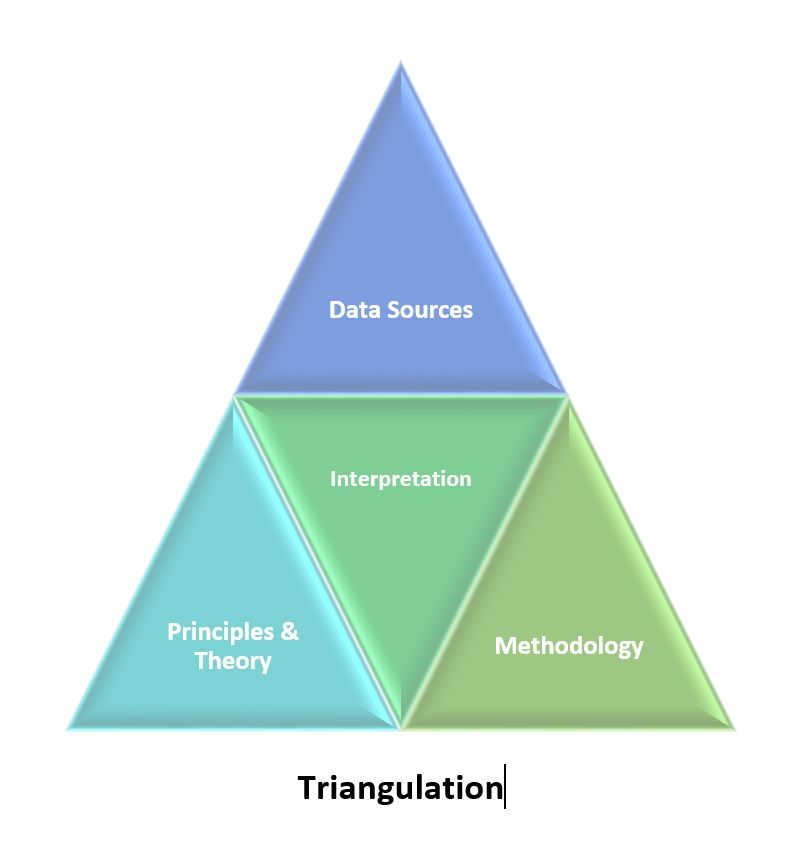
This image shows triangulation as the combination of different sources, theories and methods to support interpretation. It helps students visualise why researchers may use more than one type of evidence to increase credibility. Source
Reliability and validity in measurement
· Reliability = whether a measure is consistent and produces similar results when repeated under similar conditions.
· Validity = whether a measure actually measures what it claims to measure.
· Internal validity = whether the study accurately tests the relationship between variables without uncontrolled confounding influences.
· External validity = whether findings can be applied beyond the study setting, sample or procedure.
· Construct validity = whether the operationalized measure accurately represents the psychological construct.
· Face validity = whether the measure appears, on the surface, to measure what it should.
· Content validity = whether the measure covers the full range of the construct being assessed.
· Exam tip: a measure can be reliable but not valid; consistent results do not guarantee that the correct construct is being measured.
Research methods and measurement choices
· The choice of research method affects what kind of measurement is possible.
· Experiments can measure cause-and-effect more clearly by controlling variables, but may have lower ecological validity.
· Correlational studies measure relationships between variables, but correlation does not prove causation.
· Surveys/questionnaires measure self-reported attitudes, behaviours or symptoms, but may be affected by demand characteristics, social desirability bias or inaccurate memory.
· Interviews can produce detailed qualitative data, but may be influenced by interviewer effects and interpretation.
· Observations can measure visible behaviour in natural or controlled settings, but behaviour may change if participants know they are being observed.
· Case studies allow detailed measurement of an individual or small group, but findings may not generalise widely.
Examples of measurement techniques in psychology
· Brain imaging techniques = used to investigate brain structure or activity linked to behaviour.
· Twin studies = used to estimate the role of genetic inheritance and environmental influences in behaviour.
· Virtual reality simulations = can measure behaviour in controlled but realistic-seeming environments.
· Questionnaires = used to measure self-reported attitudes, symptoms, personality traits or behaviours.
· Behavioural tasks = used to measure performance, such as reaction time, accuracy, recall or decision-making.
· For top marks, evaluate the strengths and limitations of the measurement technique used in a specific study.
Statistical significance and measurement error
· Statistical significance = whether a result is unlikely to have occurred by chance, often judged using a p-value.
· Type I error = a false positive; the researcher concludes there is an effect when there is not.
· Type II error = a false negative; the researcher fails to detect an effect that actually exists.
· Measurement can be affected by random error, such as inconsistent participant attention or equipment variation.
· Measurement can also be affected by systematic error, such as a biased questionnaire or flawed operational definition.
· In exams, statistical findings should be interpreted alongside validity, reliability, sample, method and context.
Measurement across time and study design
· Prospective approaches = follow participants forward in time to measure later outcomes.
· Retrospective approaches = look back at past experiences or records to explain current behaviour.
· Longitudinal designs = measure the same participants over time, useful for studying development, change and long-term outcomes.
· Cross-sectional designs = compare different groups at one point in time, often quicker but less able to show individual change.
· Repeated measures designs = the same participants are measured in more than one condition, reducing participant differences but risking order effects.
· Measurement over time can strengthen understanding of change, but may involve attrition, participant reactivity or practical difficulties.
Measurement in exam evaluation
· Always ask whether the measure is appropriate for the behaviour being studied.
· Consider whether the study uses objective measures, self-reported data, observations or indirect indicators.
· Link measurement to bias, especially participant bias, researcher bias, sampling bias and confirmation bias.
· Link measurement to causality by explaining whether the method allows researchers to infer cause-and-effect or only association.
· Link measurement to responsibility by considering whether measurement methods are ethical, respectful and protective of participants.
· A strong evaluation explains both what the measure allows psychologists to know and what it may fail to capture.
High-scoring sentence starters
· “The construct was operationalized as…”
· “This strengthens reliability because…”
· “However, the validity of this measure may be limited because…”
· “The study relies on self-reported data, which may be affected by…”
· “Triangulation could improve credibility by…”
· “Because the measure is indirect, researchers must be cautious when interpreting…”
· “The measurement choice is appropriate because the behaviour being studied…”
Checklist: can you do this?
· Explain why human behaviour is difficult to measure objectively.
· Define and apply constructs, variables and operationalization to a study.
· Distinguish between direct/indirect measurement and quantitative/qualitative data.
· Evaluate a measure using reliability, validity, bias and credibility.
· Use triangulation as an evaluation point for improving research quality.
Mini exam focus: what to remember
· Measurement is not just data collection; it is about how psychologists make behaviour measurable.
· The best answers connect measurement to operationalization, research method, validity, reliability and interpretation.
· For SAQs, define the term and apply it to one clear research example.
· For ERQs, evaluate how measurement choices affect the strength of conclusions about behaviour.
· For Paper 3 or research methods questions, focus on how data is collected, represented, analysed and interpreted.