

OCR Specification focus:
‘Use online and offline research skills, including textbooks and scientific sources; correctly cite sources of information.’
Introduction
Developing research skills and referencing is essential for practical chemistry. These skills ensure accuracy, credibility, and ethical use of information in planning, executing, and reporting investigations.
Understanding Research in Chemistry
The Role of Research Skills
In practical chemistry, research skills allow students to identify reliable information sources, interpret data, and apply scientific knowledge to support experimental work.
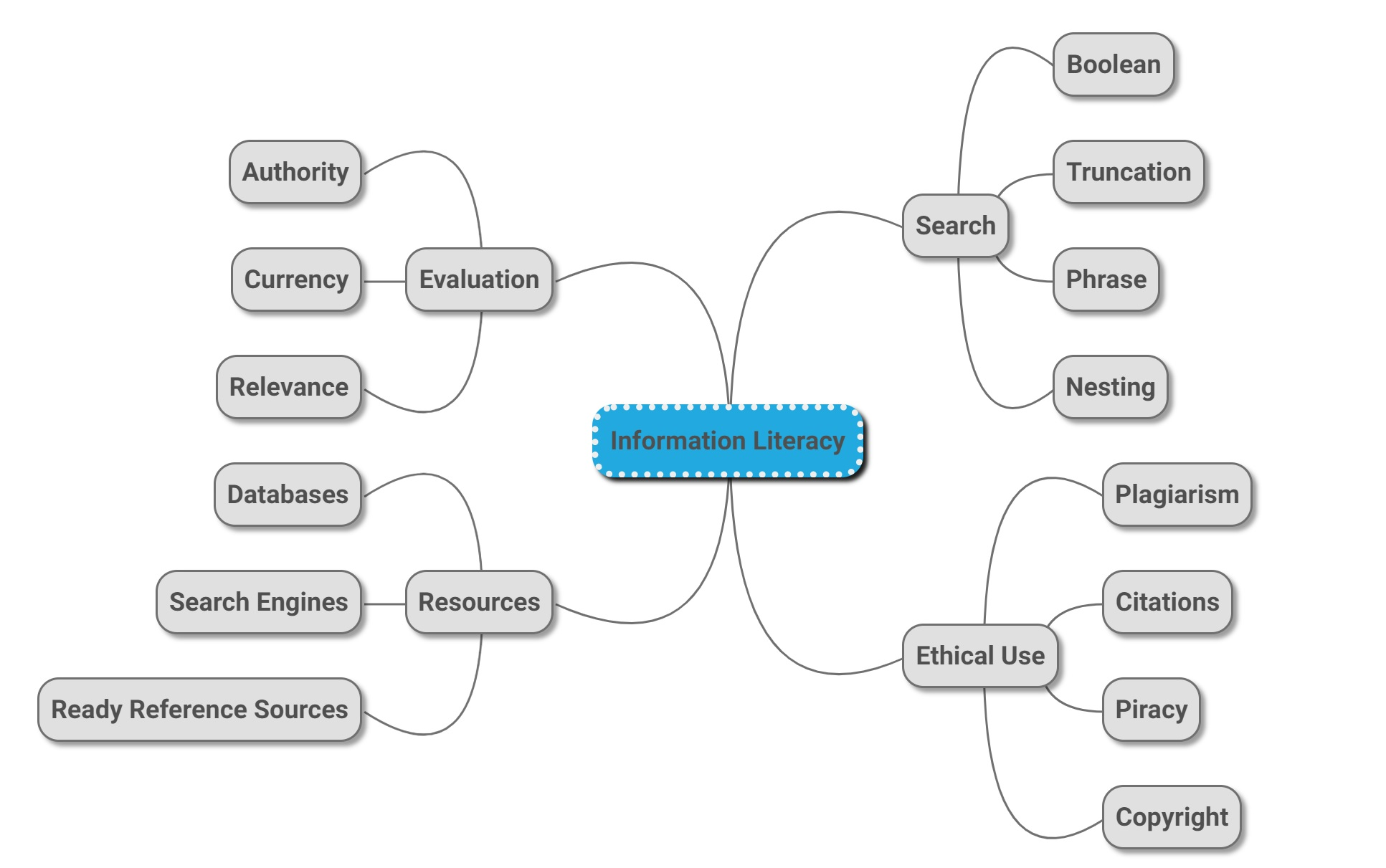
Concept map of information literacy showing evaluation, resources, search strategies, and ethical use. This visual supports assessment of sources and proper attribution, including an extra reference to piracy that reinforces ethical practice. Source
Effective research helps you:
Design experiments based on established theory.
Understand previous findings and scientific context.
Avoid errors and duplication of existing work.
Communicate results using correct academic conventions.
Types of Research Sources
Primary Sources
Primary sources provide first-hand information or data obtained through original experiments or observations.
Examples include:
Published research articles in peer-reviewed journals.
Original laboratory reports and experimental results.
Data obtained directly from chemical experiments.
Secondary Sources
Secondary sources interpret or summarise findings from primary research.
Examples include:
Textbooks, review papers, and online encyclopaedias.
Educational websites such as the Royal Society of Chemistry (RSC).
Teacher guides or technical manuals.
Evaluating Reliability of Sources
When conducting research, always assess whether a source is:
Accurate – supported by evidence and consistent with known chemistry principles.
Authoritative – written by qualified chemists or reputable organisations.
Current – up-to-date with modern techniques and data.
Objective – free from bias or unsupported claims.
Conducting Research Effectively
Online Research
Use scientific databases and search engines such as:
Google Scholar – for peer-reviewed scientific articles.
PubChem – for chemical properties and reactions.
ScienceDirect or JSTOR – for journal access.
Tips for effective online research:
Use specific keywords, e.g., “enthalpy change of neutralisation OCR Chemistry.”
Check the domain (.edu, .ac.uk, .org) for academic reliability.
Always cross-check data between multiple sources.
Offline Research
Offline research still plays an important role in developing deep understanding.
Use:
Chemistry textbooks such as Atkins’ Physical Chemistry or Organic Chemistry by Clayden et al.
Laboratory manuals to confirm techniques and procedures.
Libraries for journals and archived papers unavailable online.
Referencing in Scientific Work
Importance of Referencing
Accurate referencing ensures academic integrity, giving credit to original authors and allowing verification of sources. It also prevents plagiarism, which is the unethical use of someone else’s work without proper acknowledgment.
Plagiarism: The act of presenting another person’s work, ideas, or data as your own without appropriate citation.
Common Referencing Styles
Harvard Referencing
The Harvard system is widely used in science subjects, including chemistry.
Key features:
In-text citations show the author and year (e.g., Brown, 2021).
A reference list at the end provides full details of sources.
Example (textbook):
In-text: The oxidation of ethanol involves potassium dichromate (Smith, 2019).
Reference list: Smith, J. (2019). Organic Chemistry: Reactions and Mechanisms. Oxford University Press.
Example (journal article):
In-text: Research on equilibrium constants supports this model (Nguyen and Lee, 2020).
Reference list: Nguyen, A. and Lee, T. (2020). ‘Applications of Le Chatelier’s Principle in Modern Chemistry’, Journal of Chemical Education, 97(4), pp. 542–549.
Alternative Styles
Some institutions or publications may use:
APA (American Psychological Association) – common in multidisciplinary studies.
Royal Society of Chemistry (RSC) style – used in professional chemistry journals, using numbered superscripts (e.g., “as shown previously¹”).
Always confirm which style is required before starting your report or coursework.
Managing References and Research Data
Using Reference Management Tools
Digital tools simplify citation and research organisation:
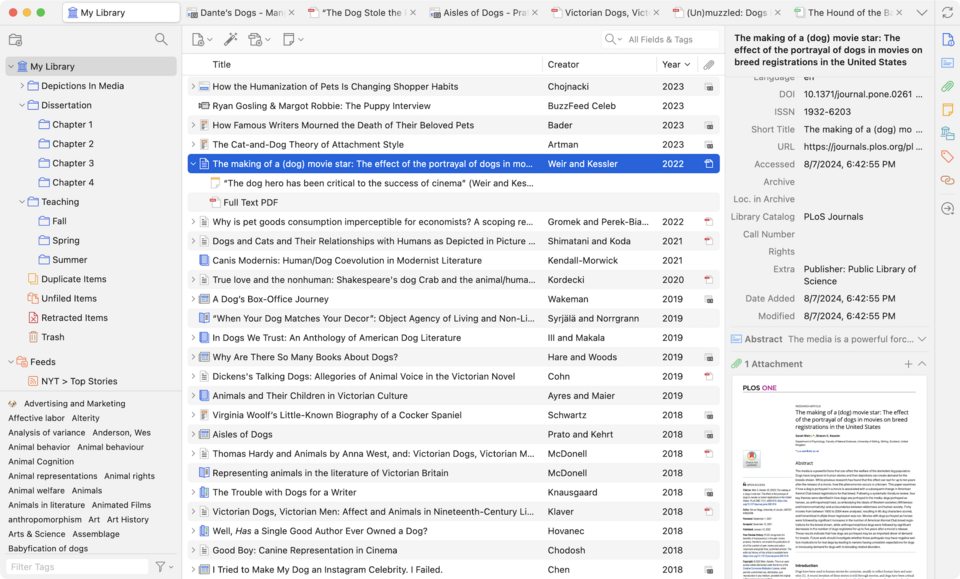
Screenshot of Zotero showing a structured library, item metadata, and citation controls for generating Harvard-style reference lists. This demonstrates digital referencing tools as discussed in the notes. Source
Zotero and Mendeley automatically generate reference lists.
EndNote integrates with word processors for seamless citation formatting.
Google Docs and Microsoft Word have built-in citation functions.
Keeping Records of Research
In practical chemistry, maintaining an accurate research logbook is crucial. It should contain:
All references consulted, with full details.
Notes on relevant equations, constants, or experimental techniques.
Dates of when information was gathered.
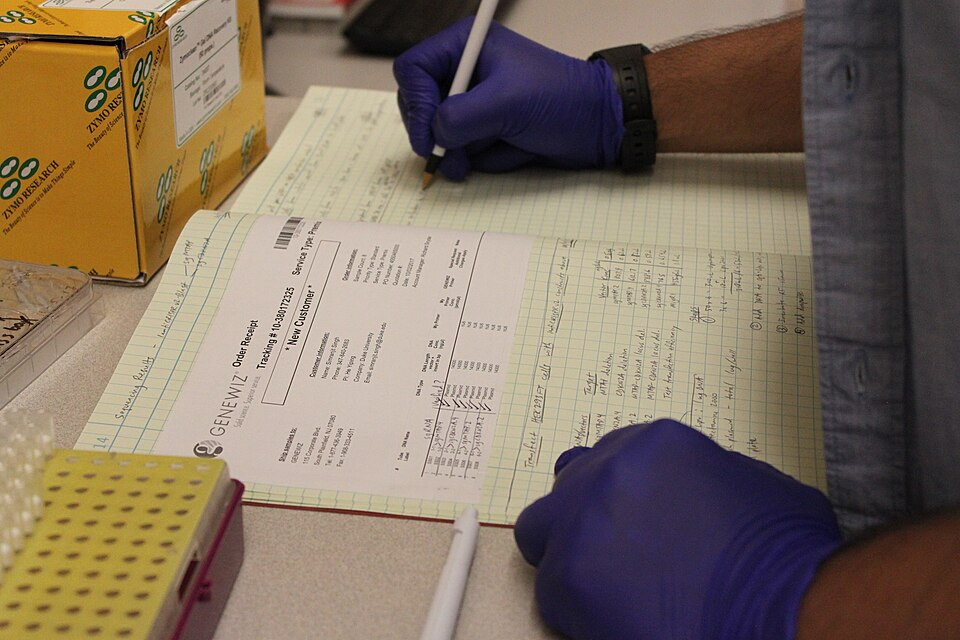
A scientist writing contemporaneous entries in a laboratory notebook. Such records document literature consulted, procedural choices, and data provenance, supporting transparency and reproducibility. Source
Ethical and Legal Considerations in Research
Avoiding Plagiarism and Misconduct
Good research practice includes:
Paraphrasing ideas in your own words rather than copying text directly.
Quoting sparingly and always enclosing direct quotations in quotation marks.
Acknowledging all sources of data, even graphs or tables adapted from others.
Intellectual Property in Science
Intellectual Property (IP): Legal rights that protect original work, such as publications, inventions, or chemical discoveries.
In chemistry, respect for intellectual property extends to respecting data ownership, patented compounds, and licensed software used for data analysis.
Using Scientific Sources Correctly
Interpreting Experimental Data
Students should understand how to:
Extract quantitative and qualitative data from literature.
Compare experimental results to published values (e.g., molar enthalpy changes).
Identify limitations and uncertainties in reported methods.
Citing Data from Experiments
When data are taken directly from published work, the source must be clearly cited in tables or graphs. For example:
“Data adapted from Jones et al. (2018).”
Citing Digital Tools and Software
If you use digital tools such as data loggers, simulation programs, or spectral databases, include them in your references.
Example: ChemDraw (Version 22.0, 2023). PerkinElmer Informatics.
Research and Referencing in the Practical Endorsement
Application in OCR A-Level Chemistry
The Practical Endorsement requires students to:
Use both online and offline research to support practical investigations.
Apply correct referencing conventions in written reports.
Integrate scientific sources when planning experiments, such as selecting appropriate reagents, equipment, or analytical methods.
For example, before performing a titration or spectroscopy experiment, students should research:
The most suitable indicator or wavelength range.
Standard procedures published in verified laboratory manuals.
Safety data sheets (SDS) for chemicals involved.
Integrating Research into Practical Reports
A well-researched practical report should include:
A background section summarising literature findings.
Properly cited theoretical justification for methods.
References formatted consistently and listed in full.
Digital Literacy and Responsible Research Practice
Using Technology for Research
Modern research demands digital literacy — the ability to evaluate and use information technology responsibly.
Students should:
Use data analysis software like Excel or Logger Pro for processing results.
Conduct scientific literature searches through databases.
Avoid unreliable sources, including personal blogs or unverified forums.
Responsible Research
Being an ethical chemist means respecting both safety and academic honesty. Proper research and referencing are vital in upholding scientific integrity and ensuring that experimental conclusions are credible, reproducible, and verifiable.
Practice Questions
State two reasons why accurate referencing is essential when writing a chemistry practical report. (2 marks)
1 mark for each valid point:
Ensures academic integrity by giving credit to original authors.
Allows others to verify or locate the original source of information.
Prevents plagiarism and maintains ethical research standards.
A student conducts background research before a titration experiment. Describe how the student should identify reliable sources and record information correctly. Include reference to both online and offline research. (5 marks)
Award marks for each of the following points (maximum 5):
Identifies the need to check authority, accuracy, currency, and objectivity of sources (1 mark).
Uses reputable online databases such as Google Scholar or RSC for peer-reviewed articles (1 mark).
Refers to offline sources such as textbooks or laboratory manuals (1 mark).
Maintains a research logbook with full citation details and notes on findings (1 mark).
Applies a consistent referencing style (e.g., Harvard) throughout the report (1 mark).
FAQ
Check for the author’s credentials, the domain name (.edu, .ac.uk, .org), and whether the information is supported by verifiable data. Reliable chemistry resources usually cite peer-reviewed research, include publication dates, and provide clear references. Avoid websites with commercial bias or unsubstantiated claims.
Include the chemical name, the company providing the SDS, the version or issue date, and the access link if online. For example:
Sigma-Aldrich (2023). Safety Data Sheet: Sulphuric Acid. Retrieved from www.sigmaaldrich.com.
Always use the same referencing style as the rest of your report.
Online resources offer up-to-date findings and access to current journals, while offline materials like textbooks and printed journals provide verified, peer-reviewed background information. Combining both ensures depth, accuracy, and contextual understanding in chemical research.
A well-maintained logbook should record:
Research questions or objectives.
Key data, graphs, and observations from sources.
Dates of research activities.
Notes on experimental design or method changes.
Comments on source reliability or limitations.
Software like Zotero or EndNote automatically formats references and prevents citation errors. It saves time when adding multiple sources, ensures consistent Harvard-style referencing, and allows quick generation of bibliographies directly from your research notes.
These tools also store PDFs, tags, and annotations, helping students manage complex projects effectively.


