

OCR Specification focus:
‘Group 2 oxides with water give alkaline solutions with increasing pH down the group; bases used in agriculture and indigestion treatments with appropriate equations.’
Group 2 hydroxides display increasing alkalinity down the group, arising from trends in solubility and ionic character, and they play important roles in agriculture and medicine.
Group 2 Hydroxides: Formation and Basic Behaviour
Formation of Group 2 Hydroxides
Group 2 metals react with water or their oxides react with water to form metal hydroxides, all of which release hydroxide ions, OH⁻, into solution, giving alkaline conditions. These hydroxides become more soluble and more strongly alkaline as you descend the group from magnesium to barium.
Magnesium hydroxide is only sparingly soluble, producing a weakly alkaline suspension.
Calcium hydroxide forms a moderately alkaline solution often known as limewater.
Strontium and barium hydroxides dissolve more readily, giving highly alkaline, strongly basic solutions.
Alkaline: A solution with a pH greater than 7 due to the presence of aqueous hydroxide ions.
These hydroxides are central to understanding increasing reactivity and solubility patterns across Group 2.
Reactions Producing Group 2 Hydroxides
Both direct metal–water reactions and oxide–water reactions can produce hydroxides. The patterns of reactivity and solubility provide insight into the increasing basic strength observed down the group.
Metal + water reactions become more vigorous down the group.
Oxide + water reactions produce hydroxides with different solubilities depending on ionic radius and lattice enthalpy.
Group 2 Oxide–Water Reaction: MO(s) + H₂O(l) → M(OH)₂(aq/s)
MO = Group 2 oxide (solid)
M(OH)₂ = Group 2 hydroxide; solid or aqueous depending on solubility
This reaction accounts for the pH increases characteristic of the group.
Trend in Alkalinity Down Group 2
Solubility Trend and Its Effect on pH
As you descend Group 2 from Mg(OH)₂ to Ba(OH)₂, hydroxide solubility increases substantially due to decreasing lattice enthalpy and increasing ionic radius of the metal cation. This trend governs the increasing alkalinity of their solutions:
Mg(OH)₂: Very low solubility → limited OH⁻ release → mild alkalinity
Ca(OH)₂: Higher solubility → more OH⁻ release → moderate alkalinity
Sr(OH)₂ and Ba(OH)₂: High solubility → extensive OH⁻ release → strong alkalinity
The increasing concentration of hydroxide ions produces progressively higher pH values in solution.
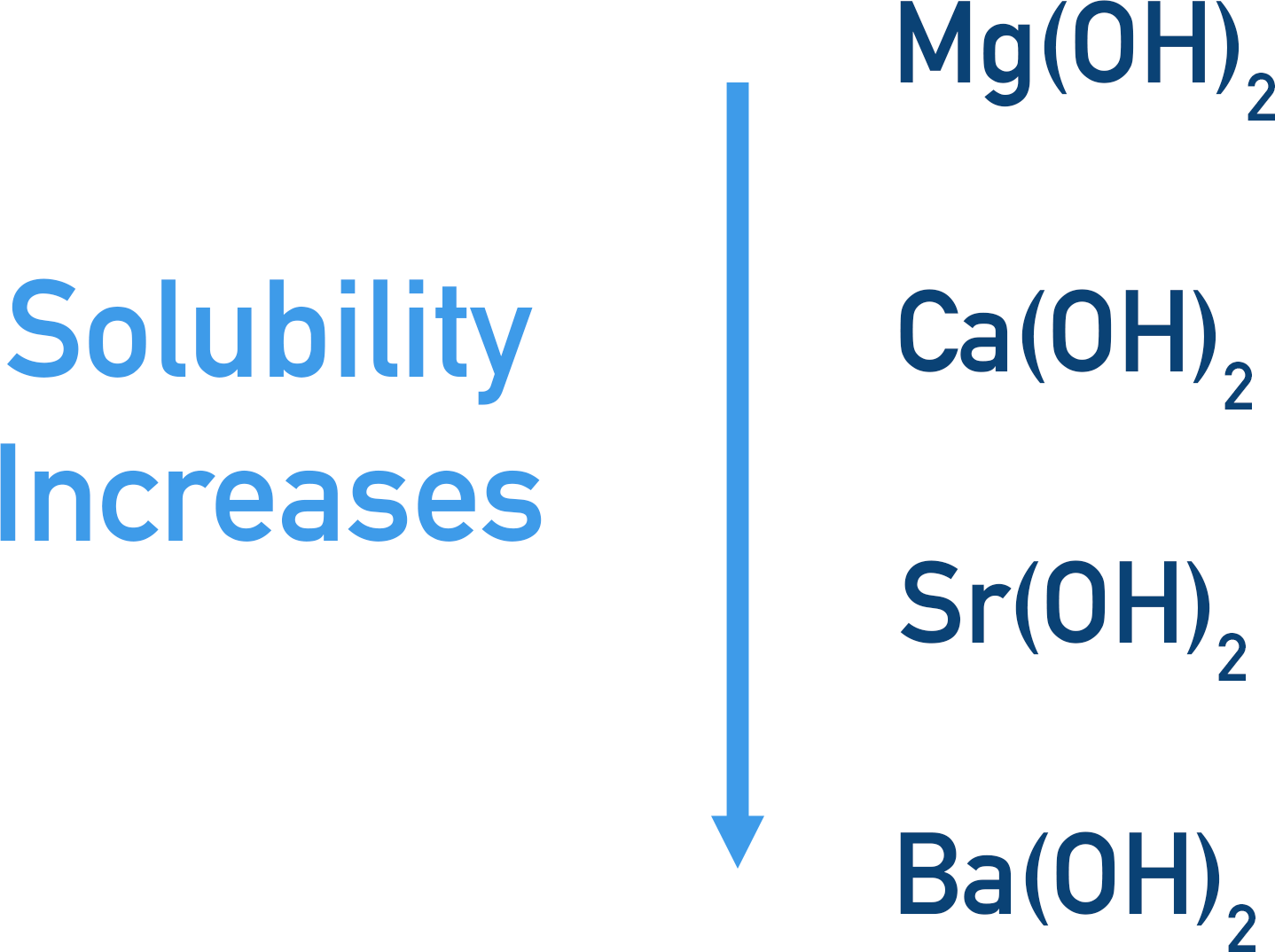
Solubility of Group 2 hydroxides increases from magnesium to barium, releasing more hydroxide ions and producing more alkaline solutions. The diagram summarises this trend in a clean, exam-focused format. Source
Explanation of the Trend
The increase in ionic radius down the group reduces the attraction between the metal cation and the hydroxide anion. As a result:
Lattice enthalpy decreases
Hydration enthalpy decreases, but not as significantly
Overall solubility increases
Resulting solutions contain higher concentrations of OH⁻
This contributes directly to the rising alkalinity and allows the heavier Group 2 hydroxides to act as more effective bases.
Uses of Group 2 Hydroxides as Bases
Agricultural Uses
Group 2 hydroxides are important bases in soil treatment, especially calcium hydroxide, which is commonly used to reduce soil acidity. Because it provides moderate alkalinity without excessive corrosiveness, Ca(OH)₂ is suitable for maintaining nutrient availability and improving soil structure.
Key agricultural applications include:
Neutralising acidic agricultural soils
Enhancing crop growth by adjusting pH
Supporting nutrient uptake through pH regulation

A tractor spreader distributes lime to neutralise acidic soil. Calcium compounds such as calcium hydroxide raise soil pH and improve agricultural conditions, reflecting practical Group 2 hydroxide applications. Source
Medical Uses: Treatment of Indigestion
Magnesium hydroxide is widely used as an antacid due to its very low solubility and correspondingly mild alkalinity. It neutralises excess stomach acid without causing harm to the digestive tract.
Antacid: A basic substance that neutralises excess stomach acid, relieving symptoms of indigestion.
A simplified representation of its neutralisation reaction is appropriate for OCR-level study.
Neutralisation by Magnesium Hydroxide: Mg(OH)₂(s) + 2HCl(aq) → MgCl₂(aq) + 2H₂O(l)
Mg(OH)₂ = Magnesium hydroxide (solid suspension)
HCl = Hydrochloric acid present in gastric acid
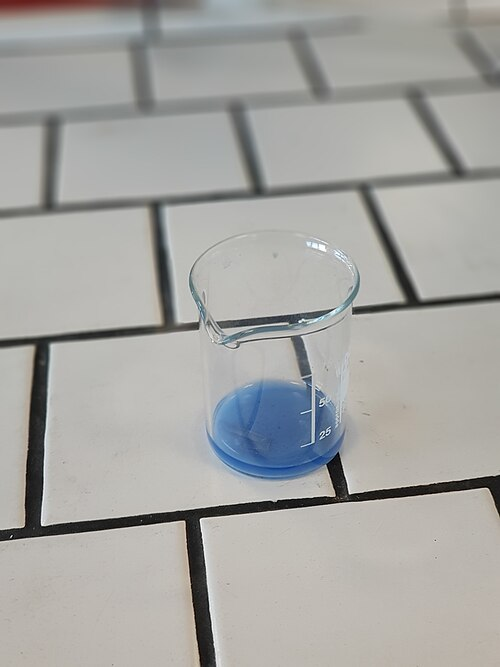
A suspension of magnesium hydroxide produces an alkaline solution shown by the indicator. Even limited solubility generates sufficient hydroxide ions for its role as an antacid. Source
This reaction illustrates how Group 2 hydroxides act as bases in practical biological contexts.
Industrial and Environmental Uses
Group 2 hydroxides, particularly Ca(OH)₂ and Ba(OH)₂, have additional uses related to their basic properties:
Calcium hydroxide: used in flue-gas desulfurisation, where it reacts with acidic sulfur dioxide gases.
Barium hydroxide: used in analytical chemistry as a strong base in titrations involving weak acids.
Strontium hydroxide: applied in some industrial processes requiring strong alkaline conditions.
These applications demonstrate the practical importance of understanding hydroxide strength and solubility.
Importance of Understanding Alkalinity Trends
The behaviour of Group 2 hydroxides illustrates general periodic trends involving ionic size, lattice enthalpy, hydration effects and solubility. An understanding of these properties helps explain:
Why heavier Group 2 hydroxides form stronger alkaline solutions
How basic strength informs their suitability in agriculture and medicine
Why Group 2 compounds behave predictably based on their position in the periodic table
Practice Questions
Explain why the alkalinity of Group 2 hydroxide solutions increases down the group from magnesium to barium.
(2 marks)
Solubility of Group 2 hydroxides increases down the group. (1)
More hydroxide ions are released into solution, giving higher pH / stronger alkalinity. (1)
A farmer adds calcium hydroxide to an acidic field.
(a) State the type of reaction that occurs when calcium hydroxide neutralises soil acidity.
(b) Write a balanced chemical equation for the neutralisation of excess hydrogen ions in the soil by calcium hydroxide.
(c) Explain why calcium hydroxide is preferred over magnesium hydroxide for agricultural treatment.
(d) Suggest why barium hydroxide is not used for soil treatment despite being strongly alkaline.
(5 marks)
(a) Neutralisation reaction. (1)
(b) Correct balanced equation, e.g.:
Ca(OH)2 + 2H+ → Ca2+ + 2H2O (or equivalent using soil acids). (1)
(c) Any two of the following (2 marks total):
Calcium hydroxide is more soluble than magnesium hydroxide. (1)
Therefore produces more hydroxide ions to raise soil pH effectively. (1)
Provides sufficient alkalinity without being excessively corrosive. (1)
(d) Barium compounds are toxic / pose environmental hazards, making them unsuitable for agricultural use. (1)
FAQ
The balance between lattice enthalpy and hydration enthalpy determines solubility. Down Group 2, decreasing lattice enthalpy outweighs decreasing hydration enthalpy, making dissolution more energetically favourable.
As the cation becomes larger, the ionic attraction in the lattice weakens. This allows hydroxides of heavier Group 2 metals to dissociate more fully in water, increasing their solubility and alkalinity.
Smaller particle sizes increase surface area, allowing water or acids to react more readily with the solid hydroxide.
This leads to faster dissolution and quicker release of hydroxide ions, improving neutralisation efficiency. Finely powdered calcium hydroxide, for example, adjusts soil pH more rapidly than coarse granules.
Even with moderate solubility, the small concentration of dissolved OH− ions readily reacts with CO2.
The formation of insoluble calcium carbonate makes the reaction visibly detectable. The low solubility also prevents excessive alkalinity, which would hinder the clarity of the precipitate.
Environmental considerations depend on solubility, toxicity, and the behaviour of the resulting salts.
Calcium hydroxide is preferred due to its low toxicity and manageable alkalinity.
Strontium hydroxide produces soluble strontium salts, which may need additional treatment.
Barium hydroxide is generally avoided because barium ions are hazardous to ecosystems.
Choice of form depends on required alkalinity, safety, and process conditions.
Solid form: used when storage stability and ease of transport are priorities.
Slurry: chosen when moderate alkalinity and controlled dosing are needed.
Solution: used for rapid neutralisation, provided the hydroxide is sufficiently soluble and safe to handle.
Temperature, purity needs, and equipment compatibility also influence selection.


