

AP Syllabus focus:
‘Explain how fats provide energy storage, support cell function, and sometimes insulate mammals to help maintain body temperature.’
Fats (mainly triacylglycerols) are a major biological strategy for storing chemical energy long term. Their chemical properties also make them useful for cushioning organs and reducing heat loss in animals, especially mammals.
What “Fats” are in AP Biology
In this context, fats refer primarily to triacylglycerols stored in animal tissues and many seeds, not membrane lipids.
Triacylglycerol (triglyceride): A lipid made of one glycerol bonded to three fatty acids, stored as energy-rich fat droplets.
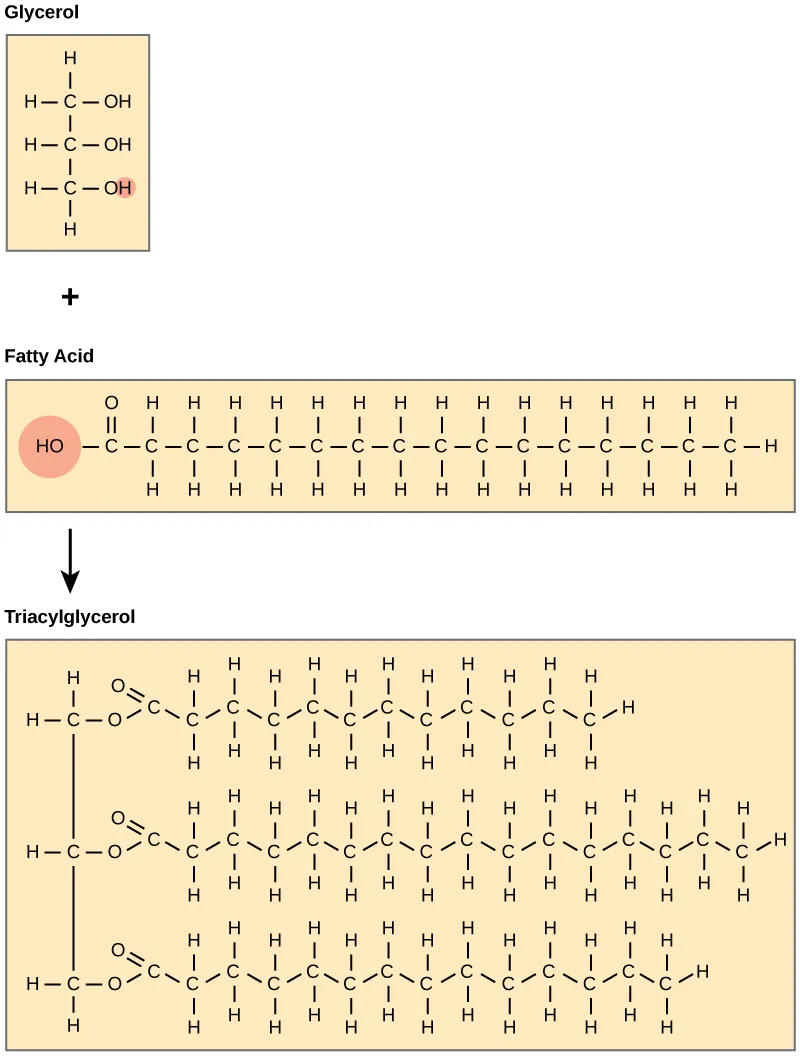
Triacylglycerols form when three fatty acids are joined to a glycerol backbone by dehydration reactions, creating three ester linkages. The figure highlights the reactants (glycerol and fatty acids) and the resulting triacylglycerol, reinforcing why the molecule is largely nonpolar and suited for long-term energy storage. Source
Triacylglycerols are well-suited to storage because their hydrocarbon chains are highly reduced (many C–H bonds) and do not interact strongly with water.
Fats as Energy Storage
Why Fats are Efficient Long-Term Storage Molecules
Organisms store fats because they maximise energy stored per unit mass and do not create major osmotic problems.
High energy density: Fatty acid chains contain many C–H bonds that release substantial energy when oxidised in cellular respiration.
Hydrophobic storage: Because triacylglycerols are nonpolar, they are stored with minimal associated water, making them compact energy reserves.
Osmotic advantage: Large fat droplets are not highly soluble, so storing fat does not raise cytosolic solute concentration the way storing many small soluble molecules would.
Where Fats are Stored and Mobilised
In animals, fats are stored mostly as droplets within specialised cells.
Adipose tissue: A connective tissue dominated by fat-storing cells (adipocytes) that stores triacylglycerols and helps regulate energy balance.
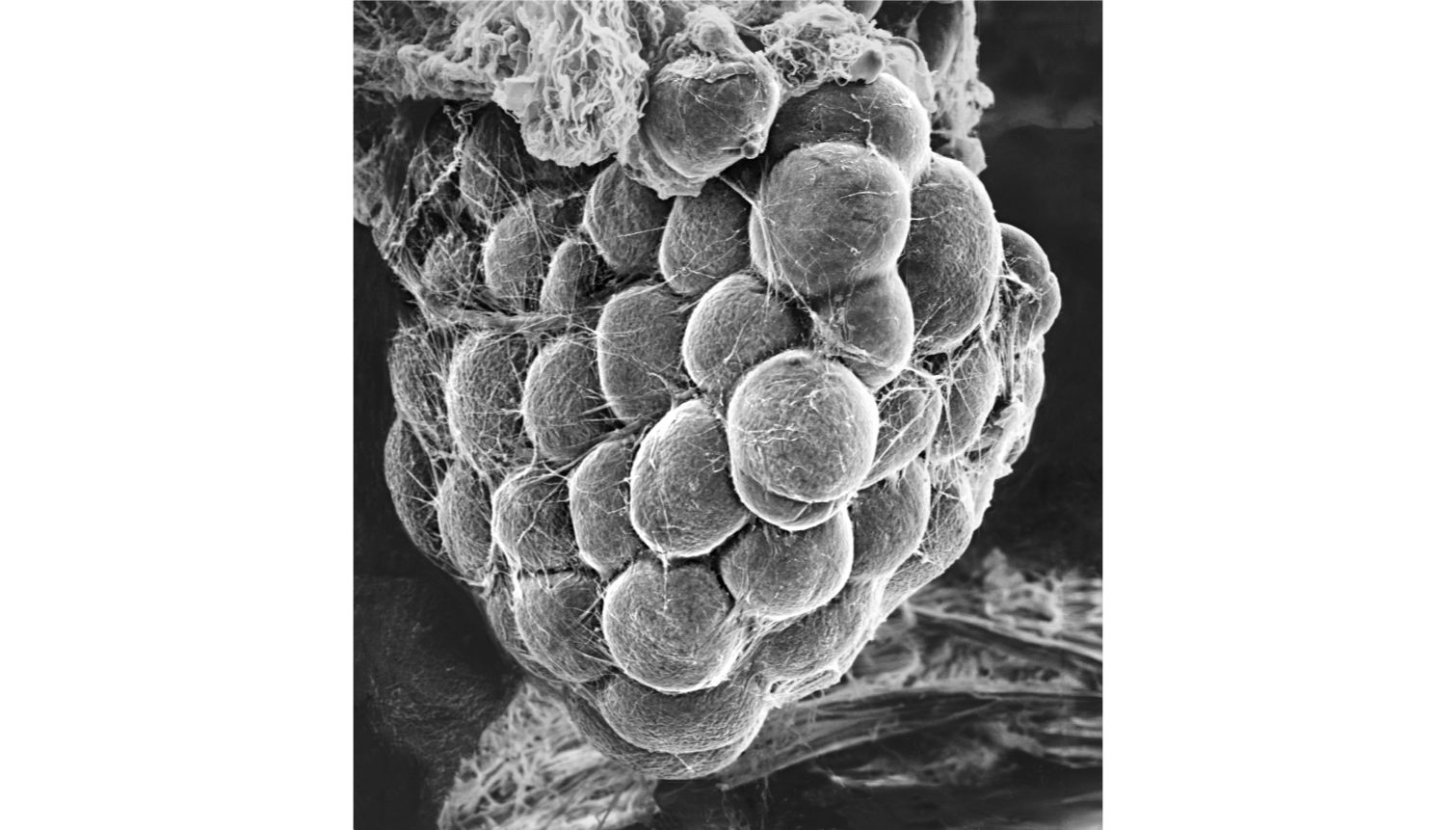
This scanning electron micrograph shows adipose tissue as a cluster of adipocytes supported by connective tissue fibers and associated vasculature/innervation. The labeled structures emphasize that adipose is a specialized tissue for lipid storage, aligning with how triacylglycerols are packaged and maintained in the body. Source
Adipose tissue supports energy needs between meals and during extended demand.
Storage state: After energy intake exceeds immediate needs, excess chemical energy can be converted into triacylglycerols and deposited in adipocytes.
Mobilisation state: When energy demand rises, triacylglycerols can be broken down to fatty acids and transported to tissues to be oxidised for ATP production.
Support of cell function: By buffering energy availability, fat stores help cells continue essential work (transport, synthesis, signalling) when external nutrient supply is low.
Fats that “Support Cell Function”
In the syllabus wording, fats support function mainly by maintaining organismal energy supply, which underpins cellular processes. Adequate fat reserves can:
Sustain metabolism during fasting or migration.
Provide energy for active transport and maintenance of ion gradients.
Preserve function of high-demand tissues (for example, skeletal muscle during endurance activity) by providing a large fuel reserve.
Fats as Insulation and Temperature Maintenance
How Fat Reduces Heat Loss
Insulation slows heat transfer from a warm body core to a cooler environment. Subcutaneous fat (fat stored beneath the skin) contributes because:
Lipids conduct heat relatively poorly compared with water-rich tissues.
A thicker fat layer increases the distance over which heat must move to escape the body.
This is especially relevant in mammals, which rely on internally generated heat to maintain a relatively constant body temperature.
Biological Contexts Where Insulation Matters
Cold environments: Mammals in cold climates often have increased subcutaneous fat, reducing the rate of heat loss to air or water.
Aquatic mammals: Water removes heat quickly; a lipid-rich layer can help conserve body heat and maintain stable internal temperatures.
Protection and cushioning: Fat deposits around organs can also provide mechanical protection, supporting normal function by reducing physical stress.
Practice Questions
State two reasons why fats are effective for long-term energy storage in animals. (2 marks)
Fats have a high energy content/energy density due to many C–H bonds/highly reduced carbon. (1)
Fats are hydrophobic/insoluble so they can be stored without associated water and with little osmotic effect/compactly. (1)
Explain how fat stores can help mammals maintain homeostasis in cold conditions and during periods of limited food availability. (5 marks)
Subcutaneous fat reduces heat loss by acting as insulation. (1)
Insulation slows heat transfer from the body to the environment, helping maintain a stable internal temperature. (1)
Fat is stored mainly as triacylglycerols in adipose tissue. (1)
During limited food availability, triacylglycerols can be broken down, releasing fatty acids for respiration/ATP production. (1)
The ATP produced supports essential cellular processes, helping maintain internal stability (homeostasis). (1)
FAQ
No. The importance depends on environment, body size, and fur density. Smaller mammals lose heat faster due to higher surface area to volume ratio, so insulation strategies (fat versus fur) vary among species.
Subcutaneous fat lies under the skin and directly reduces heat loss to the environment. Visceral fat surrounds organs and mainly provides cushioning and energy storage, contributing less to whole-body insulation.
Brown adipose tissue contains many mitochondria and can generate heat rapidly (non-shivering thermogenesis). This provides active heat production rather than passive insulation, and is important in newborns and some cold-adapted mammals.
Seasonal changes in temperature and food supply can favour increased fat deposition before winter. This improves survival by both increasing insulation and providing an energy reserve when foraging is limited.
Yes. When fats are oxidised, water is produced as a by-product (“metabolic water”). This can be biologically useful in dry habitats or during long periods without drinking, even though it is not the primary reason fats are stored.
