

AP Syllabus focus:
‘Describe how steroid hormones regulate physiological functions and how cholesterol and phospholipids stabilize and form lipid bilayers in plasma and other cell membranes.’
Membranes and hormone signalling rely on specific lipids. Phospholipids self-assemble into bilayers that define cell boundaries, cholesterol tunes bilayer stability and fluidity, and steroid hormones regulate physiology by altering cellular activity.
Phospholipids and Lipid Bilayers
Phospholipid Structure Drives Bilayer Formation
Phospholipid: An amphipathic lipid with a polar phosphate-containing head and two nonpolar fatty acid tails.
Because phospholipids contain both polar and nonpolar regions, they organize predictably in water.
The hydrophilic head interacts with water via polar/ionic interactions.
The hydrophobic tails avoid water and cluster together (hydrophobic effect).
The Bilayer as the Core Membrane Scaffold
Lipid bilayer: A double layer of phospholipids with hydrophobic tails facing inward and hydrophilic heads facing the aqueous environments inside and outside the cell.
In aqueous conditions, phospholipids spontaneously form a bilayer that becomes the fundamental fabric of the plasma membrane and many internal membranes (e.g., endomembrane system, organelle membranes).
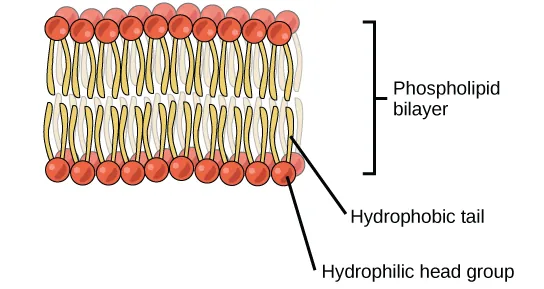
A labeled phospholipid bilayer illustrating the core amphipathic logic of membranes: polar heads face the aqueous cytosol/extracellular fluid, while nonpolar fatty-acid tails form a hydrophobic interior. This arrangement explains why membranes self-assemble and why the bilayer creates a selective barrier to many polar or charged solutes. Source
Key consequences of bilayer organisation include:
A stable boundary separating two aqueous compartments.
A hydrophobic interior that restricts many polar/charged substances from diffusing freely.
A flexible, self-sealing sheet (small tears can close as phospholipids rearrange).
Phospholipid Composition Influences Membrane Properties
Cells can modulate membrane behaviour by altering which phospholipids are present.
Head groups can vary (different charges and hydrogen-bonding capacity), affecting interactions at the membrane surface.
Tail properties affect packing:
Longer tails pack more tightly.
More saturated tails pack more tightly (fewer kinks), generally decreasing membrane fluidity.
More unsaturated tails pack less tightly, generally increasing membrane fluidity.
These compositional changes help membranes maintain appropriate structure and function under different cellular conditions.
Cholesterol in Membranes
Cholesterol as a Stabiliser and Fluidity Buffer
Cholesterol: A rigid, four-ring steroid lipid that inserts between phospholipid tails in animal cell membranes and modulates membrane packing and permeability.
Cholesterol intercalates among phospholipid tails with its small polar –OH group near the heads and its hydrophobic rings/tail among the fatty acids.
Its effects depend on temperature and tail packing:
At higher temperatures, cholesterol restricts phospholipid movement, reducing excessive fluidity and helping the membrane maintain integrity.
At lower temperatures, cholesterol disrupts tight packing of phospholipid tails, helping prevent the membrane from becoming too rigid.
This “fluidity buffering” contributes to membrane stability across changing conditions.
Cholesterol Reduces Permeability and Supports Membrane Function
By tightening and organising the hydrophobic core, cholesterol can reduce passive leakage of small polar molecules and stabilise the bilayer’s structure. This supports consistent functioning of membrane proteins and helps maintain reliable compartment boundaries in the plasma membrane and internal membranes.
Steroids and Steroid Hormones
Steroid Structure Enables Signalling Roles
Steroid: A class of lipids characterised by a carbon skeleton of four fused rings; small functional-group differences generate diverse molecules, including hormones.
Steroid hormones (e.g., sex hormones, corticosteroids) are chemically similar to cholesterol and are sufficiently nonpolar to interact strongly with membranes. Their structure underlies how they regulate physiological functions.
How Steroid Hormones Regulate Physiology
Steroid hormones coordinate long-lasting physiological responses such as development, metabolism, stress responses, and reproductive function. A central theme is that they change cellular activity by altering patterns of gene expression or protein activity.
Because they are lipid-derived and relatively hydrophobic, many steroid hormones can diffuse across the lipid bilayer more readily than polar hormones.
Inside a target cell, a steroid hormone binds a specific receptor protein; the hormone–receptor interaction changes receptor shape and activity.
Many steroid hormone receptors ultimately affect which genes are transcribed, changing the abundance of particular proteins and producing sustained physiological effects.
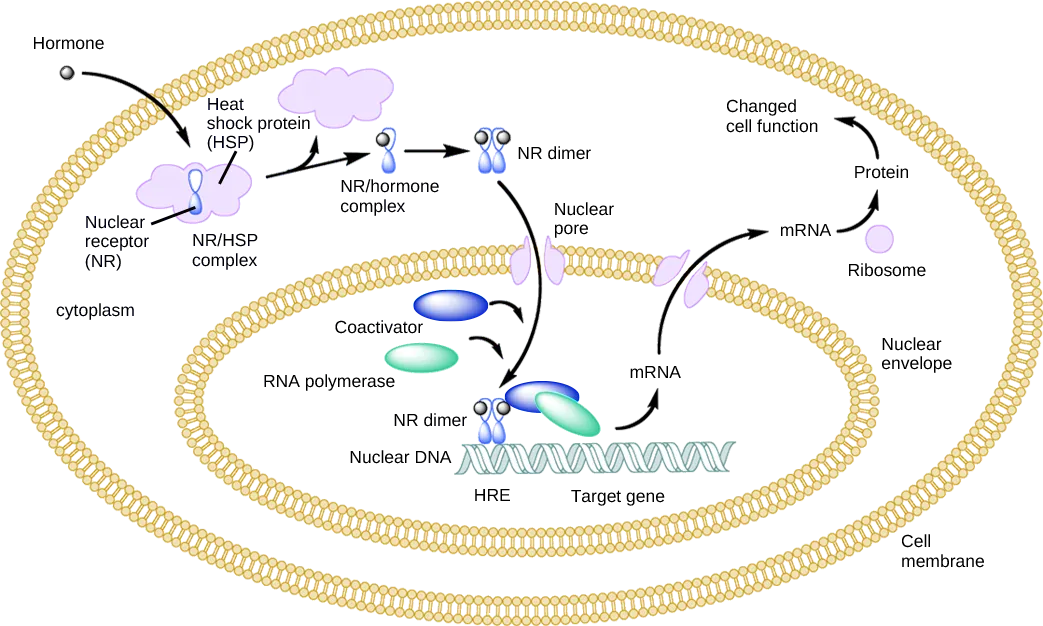
Diagram of intracellular steroid-hormone signaling: a lipid-soluble hormone crosses the plasma membrane, binds an intracellular nuclear receptor, and the hormone–receptor complex regulates transcription by binding specific DNA response elements. This provides a mechanistic link between hormone chemistry (hydrophobicity) and long-lasting physiological effects via changes in gene expression. Source
Specific outcomes depend on:
The hormone’s structure (functional groups determine receptor binding).
Receptor distribution (only cells with the appropriate receptor respond).
The set of genes and regulatory sequences available in that cell type.
Connection Between Membranes, Cholesterol, and Steroids
The shared steroid ring structure links cholesterol and steroid hormones conceptually and functionally:
Phospholipids form the bilayer framework of membranes.
Cholesterol stabilises that framework and tunes fluidity/permeability.
Steroid hormones exploit lipid-associated chemistry to deliver regulatory signals that coordinate physiology across tissues.
Together, these lipids help cells maintain stable membranes while enabling communication that integrates organismal function.
Practice Questions
Explain how phospholipids form a bilayer in water. (2 marks)
States phospholipids are amphipathic with hydrophilic heads and hydrophobic tails. (1)
Explains heads face the aqueous environments while tails face inward away from water, forming a bilayer. (1)
Describe how cholesterol and steroid hormones relate to membranes and physiological regulation. (6 marks)
Cholesterol inserts between phospholipid tails in cell membranes. (1)
Cholesterol stabilises the bilayer by affecting phospholipid packing. (1)
Explains cholesterol buffers fluidity (restricts movement at high temperature and/or prevents tight packing at low temperature). (2 max; 1 for each correct temperature-related effect)
Identifies steroid hormones as lipids with a steroid ring structure that regulate physiological functions. (1)
Describes that steroid hormones bind specific receptors and change cell activity (e.g., altered gene expression/protein production), producing longer-lasting effects. (1)
FAQ
Lipid rafts are small, dynamic membrane regions enriched in cholesterol and particular lipids/proteins.
Cholesterol’s rigid structure can promote tighter local packing, creating domains that help organise signalling proteins and trafficking pathways.
No. Cholesterol content varies by membrane and organism.
Animal plasma membranes are typically cholesterol-rich, while many internal membranes contain less. Plants and fungi often use related sterols rather than cholesterol.
They typically travel bound to carrier proteins (e.g., albumin or specific globulins).
Binding increases solubility in blood and can influence hormone half-life and delivery to target tissues.
Sensitivity depends mainly on receptor availability and receptor type.
Number of receptors expressed
Receptor localisation (cytosolic vs nuclear)
Presence of co-regulator proteins that enhance or repress receptor activity
Yes. Head groups can influence curvature, charge, and protein recruitment.
For example, negatively charged head groups can attract positively charged protein domains, helping localise enzymes or signalling complexes to specific membrane regions.
