

AP Syllabus focus:
‘Explain that DNA and RNA are nucleic acids in which biological information is encoded in specific sequences of nucleotide monomers.’
Biological systems store, copy, and use instructions for building and maintaining cells. DNA and RNA are the key molecules for these instructions because their nucleotide sequences can be read, copied, and interpreted.
DNA and RNA Store Information in Sequence
Information is Encoded Digitally in Order
Both DNA and RNA are nucleic acids whose informational content comes from the linear order of their nucleotide monomers.
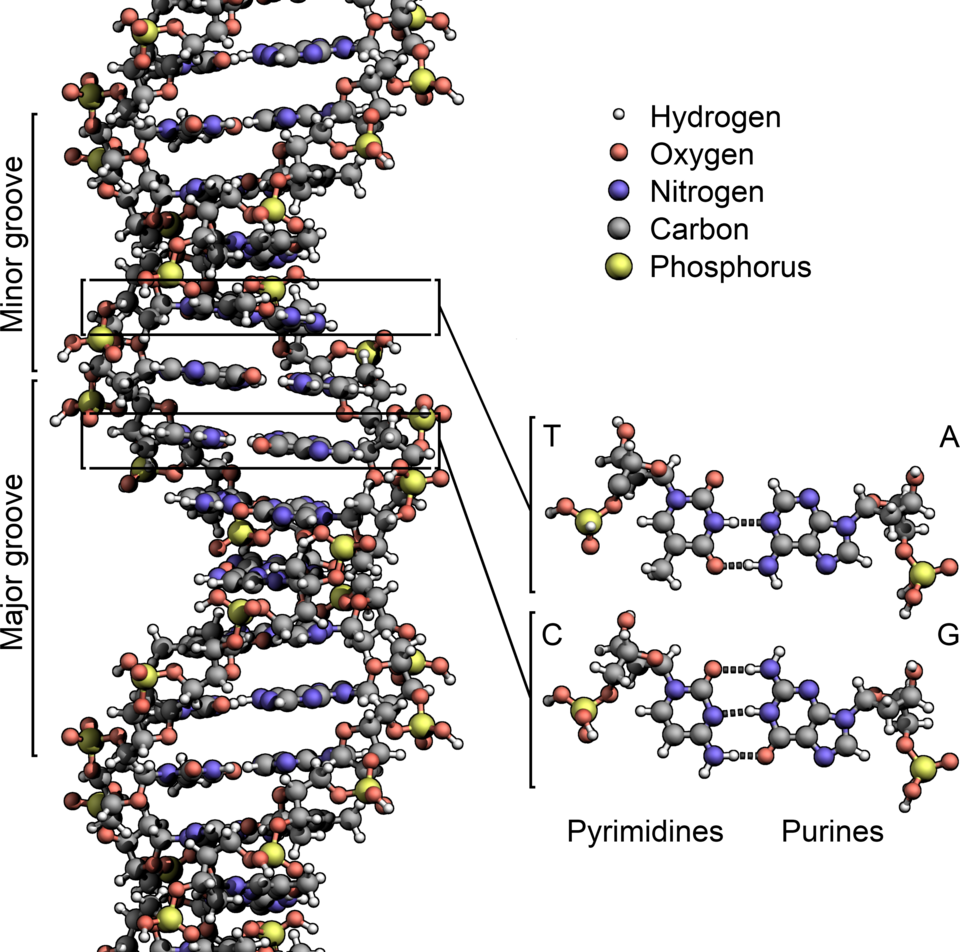
Labeled DNA double-helix structure showing the sugar–phosphate backbone, complementary base pairing, and the major/minor grooves. It visually connects nucleotide identity and pairing to the stable, readable architecture that supports sequence-based information storage in cells. Source
The sequence functions like a biological “text,” where each position contributes meaning.
The “alphabet” is made of nucleotides; information depends on sequence, not just overall composition.
A change in order can change what is produced, when it is produced, or how much is produced.
Gene: A heritable DNA sequence that contains instructions to produce a functional RNA and/or a polypeptide (often along with nearby sequences that help control when it is used).
Genes are only part of an organism’s total DNA; large stretches of DNA also help organise, regulate, and coordinate the use of sequence information.
DNA as Long-Term Information Storage
Why DNA is the Primary Archive
In most organisms, DNA is the main long-term repository of genetic information passed from cell to cell and generation to generation. Its information is stored in the specific nucleotide sequence along its length.
Different DNA sequences can specify different RNA molecules and proteins.
Regulatory DNA sequences can influence whether certain genes are used in particular cell types or conditions (even when the genes themselves are present in every cell).
The Genome as a Complete Information Set
The full set of DNA instructions must be sufficient to support growth, maintenance, and reproduction, even though only a subset is used at any moment in a given cell.
RNA as an Information Molecule
RNA Copies and Uses Genetic Instructions
RNA also encodes information in its nucleotide sequence, but it is commonly used as a working copy or as a functional product of gene expression.
Messenger RNA (mRNA) carries a transcribed sequence that can be interpreted to build a specific polypeptide.
Many RNAs function directly as RNAs, meaning the RNA sequence itself is the functional information.
RNA can be Informational Without Becoming Protein
Some RNAs act as key informational and regulatory molecules whose sequences and structures allow them to interact with other nucleic acids or proteins, shaping which genetic messages are produced and used.
From Sequence to Cellular Function
Information Flow Relies on Sequence Matching and Reading
Cells access DNA-encoded information by producing RNA molecules with sequences determined by DNA. For protein-coding genes, the RNA sequence is then used to specify an amino-acid sequence, linking nucleotide order to protein structure and function.
DNA sequence differences can lead to different RNA sequences.
Different RNA sequences can lead to different proteins or different levels/timing of production.
Changes in proteins or functional RNAs can change cellular traits.
When Information Changes
Mutation: A heritable change in the nucleotide sequence of DNA (or RNA in RNA-genome organisms) that can alter the information content.
A mutation may have no observable effect, may disrupt function, or may create new variation that can be acted on by natural selection, depending on where and how it changes the sequence.
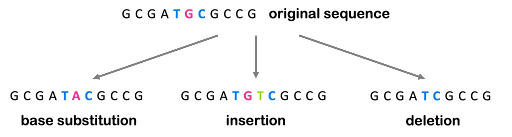
Diagram illustrating how point mutations alter nucleotide order via base substitution, insertion, or deletion. By comparing the before-and-after sequences, it highlights how even small edits to the linear sequence can change the encoded biological information. Source
Practice Questions
Explain why DNA and RNA are described as information molecules. (2 marks)
DNA and RNA are nucleic acids whose information is stored in the specific sequence/order of nucleotide monomers. (1)
That sequence can be used to specify functional products (RNA and/or polypeptides), affecting cell structure and function. (1)
Describe how a difference in DNA nucleotide sequence can lead to differences in cell function. (6 marks)
DNA contains genes with information encoded in nucleotide sequence. (1)
A gene’s sequence is used to produce an RNA molecule with a corresponding sequence (transcription). (1)
For protein-coding genes, the RNA sequence determines the amino-acid sequence of a polypeptide. (1)
Different amino-acid sequences can produce proteins with different structures and therefore different functions. (1)
Alternatively, the RNA itself may be functional, so sequence differences can alter RNA function. (1)
Resulting changes can alter cellular processes/phenotype (e.g., enzyme activity, signalling, transport). (1)
FAQ
Cells use different subsets of genes.
Differences in regulatory control and chromatin state can switch genes on/off, producing distinct RNA profiles without changing DNA sequence.
Epigenetic information involves chemical marks (e.g., DNA methylation) and chromatin changes.
It affects how sequence information is accessed, without altering the nucleotide order itself.
Some viruses use RNA genomes because RNA can store sequence information and be copied by viral enzymes.
RNA genomes can enable rapid evolution due to higher error rates during copying.
RNA stability is regulated by sequence features and RNA-binding proteins.
Cells can shorten RNA tails, remove protective caps, or use nucleases to degrade RNA when it is no longer needed.
RNA can fold into specific shapes determined by its sequence.
These structures enable binding to targets, guiding molecular interactions, and controlling gene expression through sequence-specific recognition.

