

AP Syllabus focus:
‘Explain DNA’s antiparallel double-helix structure, with two strands running opposite 5’ to 3’ orientations and complementary base pairing between A-T and C-G.’
DNA stores genetic information in a stable, copyable form. Its structure is not just “twisted ladder” imagery: the antiparallel orientation of strands and strict base-pairing rules explain both stability and accurate information matching.
Overview of the DNA Double Helix
DNA consists of two polynucleotide strands coiled around a common axis to form a double helix. The helix creates a consistent geometry that helps DNA fit in cells while protecting the information in the bases.
Key Structural Features
The sugar-phosphate backbones are on the outside of the helix.
The nitrogenous bases project inward and pair specifically across the two strands.
The strands are held together primarily by hydrogen bonds between paired bases, plus base-stacking interactions that further stabilise the helix.
Antiparallel Strand Orientation
The two DNA strands run in opposite directions relative to their carbon numbering, so one runs 5’ to 3’ while the other runs 3’ to 5’.
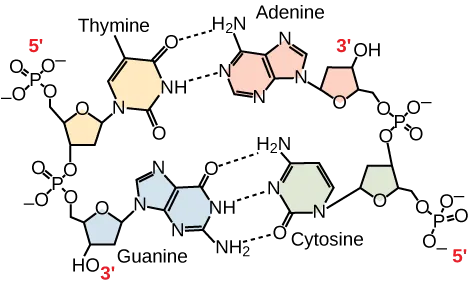
Diagram of double-stranded DNA emphasizing antiparallel directionality: one strand runs 5′→3′ while the complementary strand runs 3′→5′. It also shows the sugar-phosphate backbone on the outside and specific A–T and C–G pairing in the interior, reinforcing why strand orientation and pairing rules are linked in the helix. Source
Antiparallel: Describes two DNA strands aligned side-by-side but oriented in opposite directions, with one strand running 5’→3’ and the other 3’→5’.
This opposite alignment is essential because base pairing occurs most effectively when the bases are positioned in the proper orientation within the helix.
Why Antiparallel Matters for the Helix
It allows consistent spacing between bases along the helix, supporting a uniform diameter.
It positions hydrogen-bond donors and acceptors on each base so that correct pairs can form stable hydrogen-bond patterns.
It makes the two strands complementary, meaning each strand can specify the other’s sequence through base-pairing rules.
Complementary Base Pairing
The two strands of DNA match through complementary base pairing, where only specific base pairs form: A pairs with T, and C pairs with G. This pairing is driven by the chemical shapes and hydrogen-bonding capacities of the bases.
Complementary base pairing: Specific pairing of DNA bases where adenine (A) bonds with thymine (T) and cytosine (C) bonds with guanine (G), allowing one strand’s sequence to determine the other’s.
Complementary pairing is not arbitrary. A–T and C–G pairs fit the helix with a consistent width, while mismatched pairs would distort the structure and reduce stability.
Base Pairs and Hydrogen Bonding
A–T pairs form two hydrogen bonds.
C–G pairs form three hydrogen bonds.
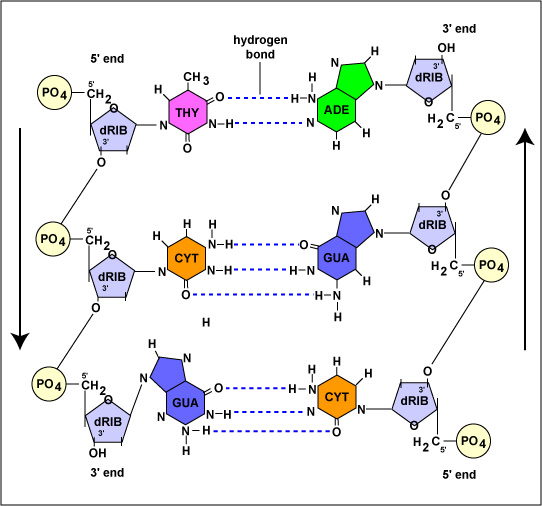
Detailed chemical schematic showing A–T and C–G base pairs with their hydrogen-bond patterns (two for A–T, three for C–G). The figure also labels 5′ and 3′ ends on opposite strands, reinforcing that correct Watson–Crick pairing requires antiparallel strand orientation. Source
More hydrogen bonds generally increase local stability, so regions with more C–G pairs tend to be harder to separate than A–T-rich regions.
How the Double Helix Supports Information Storage
The sequence of bases (A, T, C, G) carries information, while the repeating sugar-phosphate backbone provides structural support. The double helix design separates roles:
Backbone: chemical stability and structural framework
Base sequence: information content
Base pairing: faithful matching between strands
Consequences of Base Pairing for Copying Information
Because each base on one strand dictates its partner on the other strand (A↔T, C↔G), each strand can serve as a template for forming the corresponding complementary strand. Accurate matching depends on:
correct antiparallel alignment
correct complementary hydrogen-bond patterns
the physical fit of base pairs within the helix
Common Points of Confusion to avoid
Antiparallel describes directionality (5’→3’ versus 3’→5’), not whether sequences are identical.
Complementary does not mean “the same”; it means specifically matched by pairing rules (A with T, C with G).
Hydrogen bonds between bases hold strands together, but the backbone is connected by strong covalent bonds; the helix’s stability comes from both bonding and base stacking.
Practice Questions
State the complementary base pairs found in DNA. (2 marks)
A pairs with T (1)
C pairs with G (1)
Explain what is meant by DNA being an antiparallel double helix and describe how complementary base pairing occurs between the two strands. (6 marks)
DNA consists of two strands forming a double helix (1)
Strands run in opposite directions: one 5’ to 3’, the other 3’ to 5’ (2 max: mentions opposite directions and uses correct 5’/3’ orientation)
Bases face inward and pair across the strands (1)
Adenine pairs with thymine (1)
Cytosine pairs with guanine (1)
FAQ
Their shapes and hydrogen-bonding patterns align so that one purine pairs with one pyrimidine, maintaining a consistent helix diameter. Other pairings either distort spacing or fail to form stable hydrogen-bond patterns.
C–G pairs form three hydrogen bonds per pair versus two in A–T pairs. This increases the energy required to disrupt pairing across a region with many C–G pairs.
It refers to opposite strand directionality (5’→3’ vs 3’→5’). Many paired strands are reverse complements in sequence, but antiparallel describes orientation, not the specific bases present.
No. Hydrogen bonds provide pairing specificity, but base stacking (interactions between adjacent bases) significantly stabilises the helix by reducing exposure of bases to water and favouring orderly packing.
Mismatches can alter local helix geometry, weaken hydrogen bonding and stacking, and create distortions that may interfere with accurate copying and recognition by DNA-binding proteins.
