

AP Syllabus focus:
‘Describe key structural differences between DNA and RNA, including sugar type, nitrogenous bases present, and whether molecules are double or single stranded.’
Nucleic acids share a nucleotide-based backbone, but DNA and RNA differ in their chemical building blocks and overall architecture. These structural differences influence how each molecule behaves in cells and in lab conditions.
Shared Framework: What Stays the Same
Both DNA and RNA are polymers of nucleotides joined by phosphodiester bonds, forming a sugar–phosphate backbone with nitrogenous bases projecting outward. Each nucleotide includes:
A five-carbon sugar
A phosphate group
A nitrogenous base (a ring-shaped, nitrogen-containing compound)
Key Structural Differences Between DNA and RNA
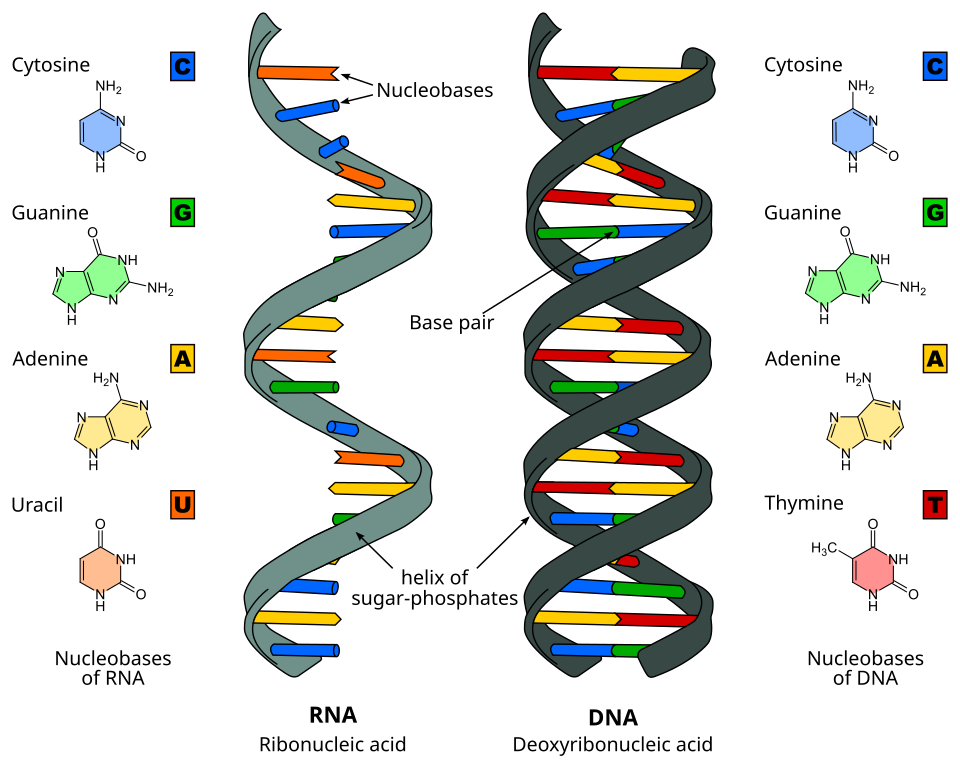
Side-by-side comparison of RNA and DNA highlighting the structural features used to distinguish them in diagrams. The graphic explicitly shows RNA as typically single-stranded with ribose (2’ –OH) and uracil, versus DNA as a double helix with deoxyribose (2’ H) and thymine. This supports quick identification based on sugar, base identity, and strandedness. Source
Sugar Type: Deoxyribose vs Ribose
DNA contains deoxyribose, while RNA contains ribose. The critical structural difference is at the 2’ carbon of the sugar:
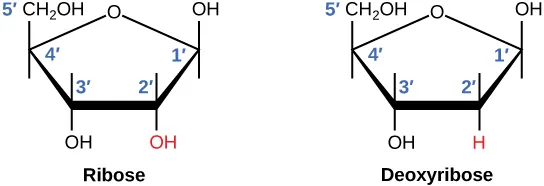
Textbook diagram comparing ribose (RNA) and deoxyribose (DNA) with the 2’ position emphasized. Ribose contains a hydroxyl group at the 2’ carbon, whereas deoxyribose has a hydrogen there, which is the defining chemical difference between the sugars. This visual makes the “2’ –OH present?” identification rule easy to apply. Source
Deoxyribose (DNA): has H at the 2’ carbon (no oxygen)
Ribose (RNA): has an –OH group at the 2’ carbon
This small chemical change affects backbone chemistry and contributes to RNA’s distinct physical properties (for example, how easily the strand can participate in certain reactions).
Deoxyribose: A five-carbon sugar in DNA that differs from ribose by lacking an oxygen at the 2’ carbon (it has H instead of –OH).
Because RNA has a 2’ –OH group, its backbone has an extra polar functional group compared with DNA.
Nitrogenous Bases Present: Thymine vs Uracil
DNA and RNA use three bases in common—adenine (A), cytosine (C), and guanine (G)—but differ in the fourth base:
DNA: uses thymine (T)
RNA: uses uracil (U)
Uracil and thymine are structurally similar pyrimidines, but thymine has an additional methyl group. For AP Biology, the key structural point is simply T in DNA versus U in RNA.
Strandedness: Double-Stranded vs Single-Stranded
A major structural distinction is whether the nucleic acid typically exists as one strand or two:
DNA: generally double-stranded, forming a stable double helix overall (two complementary strands associated together)
RNA: generally single-stranded, existing as one nucleotide chain
Although RNA is single-stranded, its flexibility allows it to bend and form a variety of shapes due to internal interactions within the same strand. In contrast, DNA’s most common cellular form is a two-stranded molecule.
Practical Cues for Identifying DNA vs RNA in Diagrams
When interpreting structures, look for:
2’ –OH present? If yes, it is RNA (ribose). If no, it is DNA (deoxyribose).
U vs T base? U indicates RNA; T indicates DNA.
One backbone or two? Single strand suggests RNA; two strands suggest DNA.
Practice Questions
State two structural differences between DNA and RNA. (2 marks)
DNA contains deoxyribose; RNA contains ribose (1)
DNA contains thymine; RNA contains uracil (1)
DNA is typically double-stranded; RNA is typically single-stranded (1) (credit any two correct differences for two marks)
A student isolates a nucleic acid and finds it contains ribose sugars and the base uracil. Explain what type of nucleic acid it is and describe two further structural features that distinguish it from DNA. (5 marks)
Identifies the molecule as RNA (1)
Uses evidence of ribose to support RNA identification (1)
Uses evidence of uracil to support RNA identification (1)
States RNA is typically single-stranded (1)
Describes the 2’ –OH group on ribose as a distinguishing structural feature (1)
FAQ
Uracil is energetically cheaper to produce than thymine. Cells can reserve thymine for DNA, where long-term information storage benefits from additional chemical marking.
The 2’ –OH increases polarity and allows extra internal interactions. It also makes the backbone more chemically reactive under certain conditions.
Yes. Some viruses have single-stranded DNA, and some viruses have double-stranded RNA. In most cells, DNA is double-stranded and RNA is single-stranded.
Many RNAs contain chemically modified bases (especially tRNA and rRNA). These modifications alter structure and stability, but the core distinction remains U (not T) in standard RNA.
Common approaches include selective enzymes: DNase breaks DNA, RNase breaks RNA. Chemical stability differences can also be exploited under alkaline conditions.

