

AP Syllabus focus:
‘Lysosomes digest materials and mediate apoptosis, while vacuoles store substances and maintain turgor pressure; chloroplasts perform photosynthesis using their double membranes and internal membranes.’
These organelles manage cellular breakdown, storage, and energy capture. Understanding their membranes, internal compartments, and core functions helps explain how eukaryotic cells maintain stability, recycle materials, and convert energy into usable chemical forms.
Lysosomes
Structure and enzymes
Lysosome: a membrane-bound vesicle containing hydrolytic enzymes that digest macromolecules and cellular debris, typically functioning best at acidic pH.
Lysosomes are prominent in many animal cells and are part of cellular “cleanup” and recycling. Their single membrane isolates digestive enzymes from the cytosol, preventing uncontrolled degradation of cellular components.
Key features and requirements:
Acidic lumen (low pH) supports maximal activity of many hydrolytic enzymes.
Hydrolytic enzymes break down proteins, nucleic acids, lipids, and polysaccharides.
Selective targeting delivers specific substrates to lysosomes rather than random cytosolic digestion.
Digestion and recycling roles
Lysosomes digest materials that come from both outside and inside the cell.
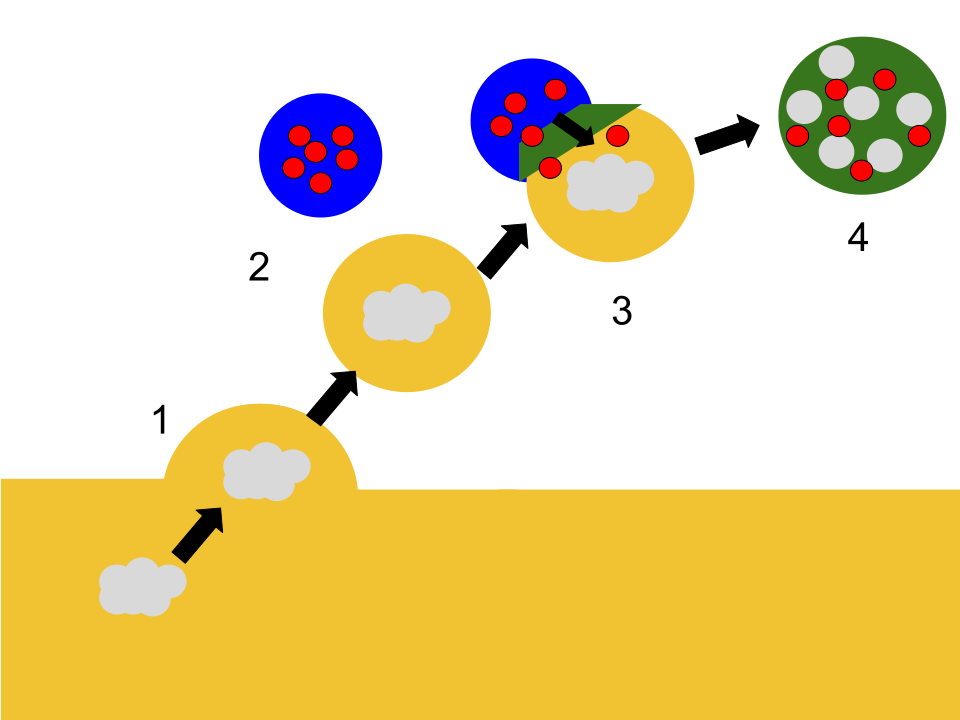
This diagram shows the sequence of lysosomal digestion, from uptake of material into a vesicle to fusion with a lysosome and enzymatic breakdown of contents. It reinforces how hydrolytic enzymes are compartmentalized within a membrane-bound organelle to prevent uncontrolled digestion of the cytosol. The final step highlights recycling, where digested products can re-enter cellular metabolism. Source
Endocytosed material: macromolecules or particles internalised into vesicles can fuse with lysosomes for breakdown.
Damaged organelles/components: worn-out cell parts can be delivered for degradation, allowing reuse of monomers (e.g., amino acids, nucleotides).
Pathogen destruction: many immune cells use lysosomal digestion to help eliminate engulfed microbes.
This recycling supports cellular efficiency by returning building blocks to biosynthetic pathways rather than relying solely on new uptake.
Lysosomes and apoptosis
Apoptosis: a regulated, energy-dependent process of programmed cell death that dismantles a cell in a controlled manner without causing widespread inflammation.
Lysosomes can contribute to apoptosis by releasing degradative enzymes that help dismantle cellular structures once death pathways are activated. This supports development, tissue maintenance, and removal of damaged cells. Controlled digestion limits harm to neighbouring cells, contrasting with uncontrolled cell rupture.
Vacuoles
General functions and diversity
Vacuole: a membrane-bound compartment used for storage, transport, and homeostatic regulation; vacuoles vary widely in size and function among cell types.
Vacuoles are especially important in plant cells, where a large central vacuole often occupies much of the cell volume. In other eukaryotes, smaller vacuoles may store nutrients or sequester substances.
Core roles emphasised in AP Biology:
Storage of water, ions, pigments, nutrients, or wastes
Regulation of internal conditions by controlling solute and water content
Structural support in plants through pressure-based mechanisms
Turgor pressure and plant support
Turgor pressure: the outward pressure of the cell contents against the cell wall, largely generated by water uptake into the central vacuole.
The central vacuole helps maintain turgor pressure by accumulating water.
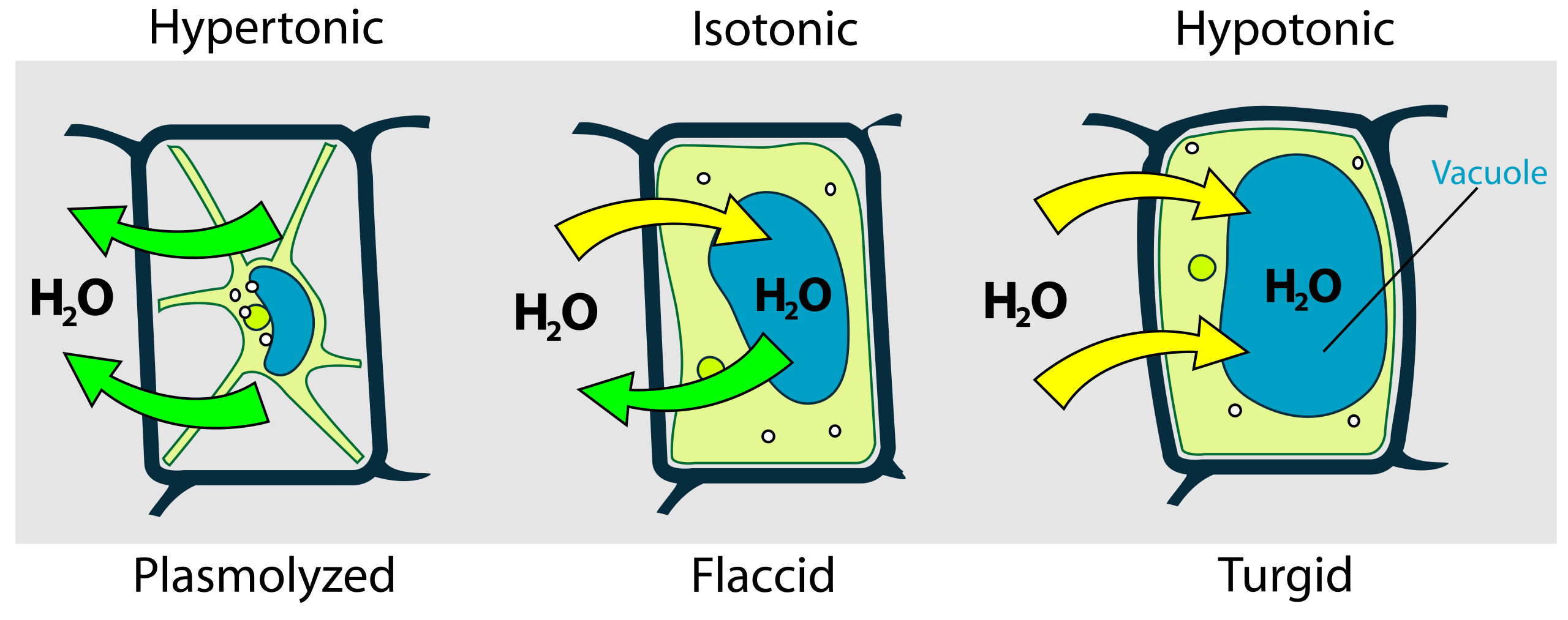
This diagram compares plant cells under different osmotic conditions to show how water entry or loss changes vacuole volume and pressure against the cell wall. It visually connects vacuolar water storage to mechanical support (turgid cells) versus wilting/flaccidity when water leaves the vacuole. The labeled arrows emphasize that turgor is an emergent property of osmosis acting on a large central vacuole. Source
When water enters the vacuole, it expands and presses the cytoplasm against the cell wall, helping the cell resist compression and maintain shape. If water is lost, turgor drops and cells become flaccid, reducing support in non-woody tissues.
Functional implications in plant cells:
Maintains upright growth in leaves and young stems
Contributes to cell expansion as vacuoles enlarge
Stores solutes that influence water movement into or out of the vacuole
Chloroplasts
Role in photosynthesis and overall organisation
Chloroplast: a photosynthetic organelle in plants and algae that converts light energy into chemical energy, using internal membranes to organise the reactions of photosynthesis.
Chloroplasts perform photosynthesis and are characterised by a complex membrane system. Their architecture creates specialised regions that support different reaction stages and efficient energy conversion.
Double membranes and internal membranes
Chloroplasts have:
An outer membrane and inner membrane (a double-membrane envelope) that separate the organelle from the cytosol and regulate exchange.
Extensive internal membranes called thylakoid membranes, which are often stacked into grana and interconnected.
These membranes create distinct compartments:
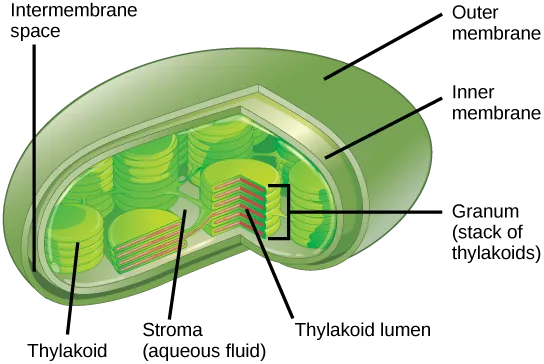
This labeled chloroplast illustration highlights the double-membrane envelope and the internal thylakoid membrane system organized into grana. It helps students map each compartment to its role in photosynthesis: the stroma as the enzyme-rich interior and the thylakoid/lumen as the membrane-bound space that supports energy conversion. The diagram reinforces how membrane organization increases surface area and separates conditions needed for photosynthetic reactions. Source
Intermembrane space: between outer and inner membranes
Stroma: fluid interior containing enzymes, DNA, and ribosomes
Thylakoid lumen: interior space enclosed by thylakoid membranes
The presence of double membranes and internal membranes increases surface area and enables separation of chemical conditions needed for photosynthetic energy conversion, including the organisation of pigment-protein complexes and electron transport components within thylakoid membranes.
Functional significance of compartmentalisation
By structuring photosynthesis across compartments, chloroplasts:
Localise light-dependent processes to thylakoid membranes
Maintain distinct chemical environments between stroma and thylakoid lumen
Improve efficiency by concentrating key molecules and membrane complexes where they are needed
This internal membrane architecture is central to chloroplast function, enabling the conversion of light energy into chemical energy stored in carbohydrates.
Practice Questions
State two functions of lysosomes and explain one way lysosomes help protect the rest of the cell from damage. (3 marks)
Any two functions, 1 mark each (max 2):
Digest endocytosed material / macromolecules
Recycle damaged organelles or cellular components
Contribute to apoptosis (mediated breakdown during programmed cell death)
Destroy pathogens after uptake by immune cells
Protection explanation, 1 mark:
Hydrolytic enzymes are contained by a membrane and/or function best at low pH, reducing risk of uncontrolled digestion in the cytosol.
Compare vacuoles and chloroplasts in plant cells by describing their key roles and explaining how their membrane structures support these roles. (6 marks)
Vacuole role, 1 mark:
Storage of water/solutes/wastes and/or maintaining turgor pressure.
Vacuole structure-function link, 1 mark:
Large central compartment stores water/solutes; water uptake helps generate turgor pressure against the cell wall.
Chloroplast role, 1 mark:
Performs photosynthesis (conversion of light energy to chemical energy).
Chloroplast double membrane, 1 mark:
Chloroplast envelope (outer + inner membrane) separates chloroplast contents from cytosol and controls exchange.
Chloroplast internal membranes, 1 mark:
Thylakoid membranes provide extensive surface area for photosynthetic machinery.
Compartmentalisation significance, 1 mark:
Different internal spaces (e.g., stroma and thylakoid lumen) allow distinct conditions that support efficient photosynthesis.
FAQ
Lysosomal membranes contain proton-pumping proteins that actively transport $H^+$ into the lysosome.
The membrane’s selective permeability helps retain the acidic environment while limiting proton leakage back into the cytosol.
They are genetic disorders where specific lysosomal enzymes (or trafficking proteins) are absent or nonfunctional.
Undigested substrates accumulate inside lysosomes, which can:
Swell organelles and disrupt trafficking
Impair normal recycling
Damage tissues with high turnover or long-lived cells (e.g., neurones)
Autophagy primarily uses lysosomes to degrade and recycle cellular components to support survival during stress.
Apoptosis is a regulated cell death programme; lysosomal enzymes may contribute to dismantling, but the cellular goal is removal rather than survival.
The vacuolar membrane isolates potentially reactive compounds from the cytosol.
Sequestration can:
Reduce interference with enzymes in the cytoplasm
Deter herbivores via stored defensive chemicals
Enable colour changes by concentrating pigments in specific tissues
Thylakoid stacking and organisation influence how light-harvesting complexes are positioned and how efficiently excitation energy is transferred.
Different arrangements can:
Optimise light capture under varying intensities
Affect distribution of electron transport components
Alter how quickly the chloroplast balances energy production with photoprotection


