

AP Syllabus focus:
‘Selective membrane permeability establishes solute concentration gradients, which drive passive and active transport processes essential for solute and water balance.’
Cells constantly exchange materials with their surroundings, but membranes restrict most movement. Understanding how membrane permeability creates and maintains concentration gradients is essential for predicting transport direction and cellular balance.
Core ideas: gradients + permeability
A concentration gradient exists whenever a solute’s concentration differs between two regions, such as the cytosol and the extracellular fluid.
Concentration gradient: A difference in the concentration of a substance across space (often across a membrane) that can drive net movement from higher to lower concentration.
Gradients are a form of potential: they represent a tendency toward mixing, but whether mixing happens depends strongly on the membrane’s properties.
Selective membrane permeability
Cell membranes are selectively permeable, meaning some substances cross easily while others cross slowly or not at all.
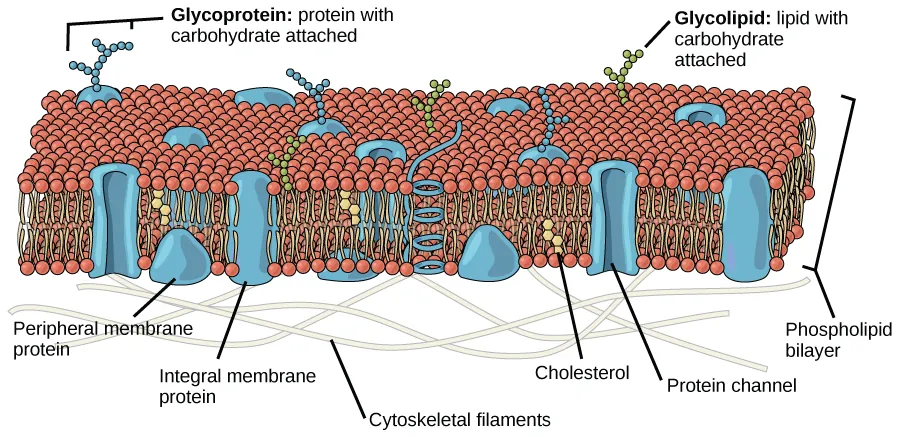
Fluid mosaic model of the plasma membrane showing the phospholipid bilayer, cholesterol, and embedded proteins (including channels) that create selective pathways for transport. The diagram visually links membrane structure (hydrophobic core vs. protein pores) to permeability differences among solutes. Source
Selective permeability is a prerequisite for gradients because:
If a solute crosses freely in both directions, differences in concentration rapidly disappear.
If crossing is restricted, cells can maintain unequal concentrations over time.
Selective permeability: The property of a membrane that allows certain substances to cross more readily than others, based on molecular features and available transport pathways.
A membrane’s permeability to a given solute depends on factors such as:
Solute characteristics (e.g., size, polarity, charge)
Presence, number, and state of transport proteins
Membrane composition that influences how easily solutes partition into or traverse the membrane
How gradients drive transport
Once selective permeability allows a gradient to exist, that gradient can drive movement in two broad ways:
Down a gradient (high → low): movement can occur without direct cellular energy input.
Against a gradient (low → high): movement requires energy input and specific mechanisms.
Gradient direction vs net movement
Molecules move randomly in both directions at all times. A gradient changes the probability of movement so that:
More particles move from the higher-concentration side to the lower-concentration side per unit time
The result is net flux down the gradient until equilibrium is reached (unless the cell maintains the gradient)
Membrane permeability controls the rate of this net movement: a steep gradient may still produce little flux if the membrane is poorly permeable to that solute.
= net movement of solute across a membrane per unit area per unit time
= permeability constant for that solute (depends on membrane and pathways)
= concentration difference across the membrane
This relationship captures the key syllabus idea: selective membrane permeability establishes solute concentration gradients, and those gradients then drive transport.
Why cells maintain gradients
Cells invest resources to maintain specific internal concentrations because gradients support essential functions, including:
Maintaining solute and water balance (preventing harmful swelling or shrinking)
Enabling uptake of needed nutrients even when external concentrations are low
Supporting export of wastes and cellular products
Gradients as stored potential for coupled processes
Maintained gradients can be used to power other movements when the membrane provides a controlled pathway.
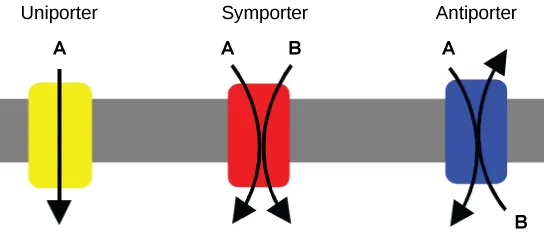
Comparison of carrier-protein transport modes: uniport (one solute), symport (two solutes same direction), and antiport (two solutes opposite directions). This schematic helps you connect how gradients plus specific transport proteins enable controlled, directional movement across membranes. Source
In general:
The “downhill” movement of one solute can be used to promote “uphill” movement of another, but only when selective permeability and transport mechanisms allow coupling.
Cells regulate permeability dynamically by changing transport protein activity or membrane trafficking, which alters how gradients affect net movement.
Interdependence of solutes and water balance
Although this subtopic focuses on solute gradients, solutes strongly influence water distribution because water moves in response to differences created by solute concentrations.
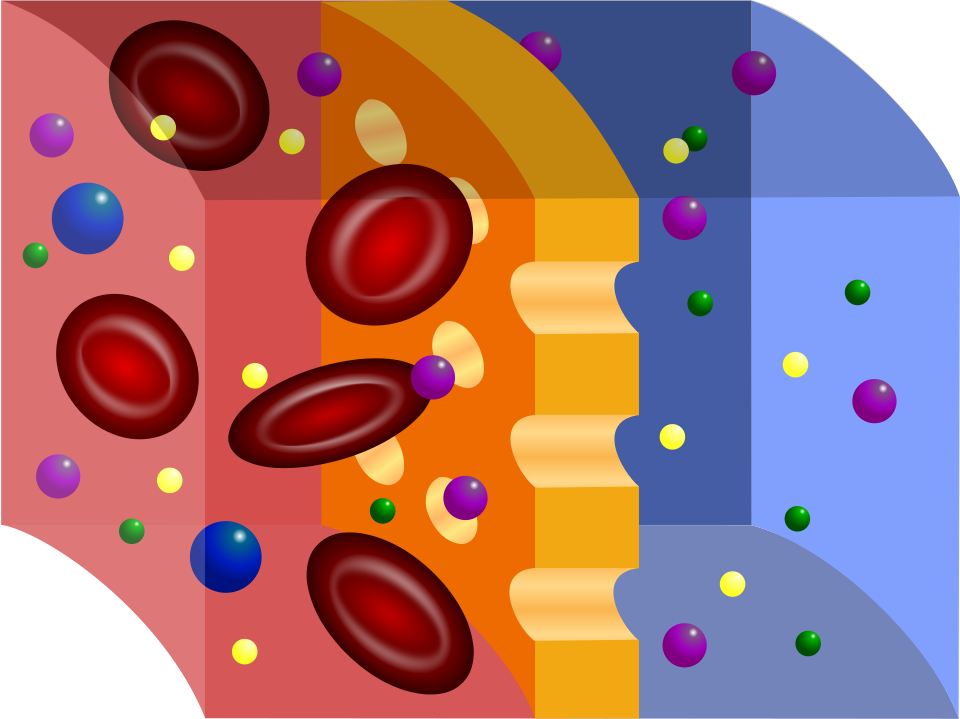
Simple osmosis diagram showing water moving across a semipermeable membrane from the side with higher water concentration (lower solute) toward the side with lower water concentration (higher solute). The figure reinforces that water balance is an indirect consequence of solute gradients when solutes cannot freely cross the membrane. Source
Therefore, controlling which solutes cross and how fast is central to keeping cellular water content stable across changing external conditions.
Practice Questions
Explain why selective membrane permeability is necessary for a cell to maintain a concentration gradient of a solute across its plasma membrane. (2 marks)
States that if a solute crosses freely, concentrations equalise and the gradient dissipates (1).
States that selective permeability restricts movement (or requires specific pathways), allowing different concentrations to be maintained (1).
A cell has a higher internal concentration of solute X than the external environment. Describe how membrane permeability and the concentration gradient together determine the net movement of X, and explain how this relates to maintaining solute and water balance. (5 marks)
Identifies the direction of the concentration gradient (inside → outside) (1).
Explains that net movement is down the gradient if a permeable pathway exists (1).
Explains that low permeability reduces net flux even with a gradient (rate depends on permeability) (1).
States that maintaining internal solute levels may require restricting permeability and/or energy-requiring mechanisms to oppose diffusion (1).
Links solute gradients to water balance (e.g., solute distribution influences water movement; controlling solute helps stabilise cell water content) (1).
FAQ
By regulating existing transport proteins. For example: gating (opening/closing), changing transporter conformation via phosphorylation, or moving proteins into/out of the membrane via vesicles.
Comparing rates of concentration change across the membrane under identical $\Delta C$, or measuring net flux $J$ to infer differences in $P$ for different solutes.
Their permeability constants differ due to size, charge, polarity, and whether specific channels/carriers exist and are active.
Continuous compensation: small passive leakage can be offset by regulated transport that restores the gradient, keeping a steady non-equilibrium state.
Random motion occurs both ways, but the gradient biases probabilities so more particles cross from high to low concentration per unit time, producing a net flux.

