

AP Syllabus focus:
‘Passive transport moves molecules down their concentration gradient without direct metabolic energy input, including simple diffusion across membranes.’
Passive transport is a foundational mechanism for moving substances in and out of cells. Understanding diffusion, concentration gradients, and membrane properties explains how cells exchange materials efficiently without spending ATP.
Core idea: passive transport
Passive transport occurs when substances move spontaneously due to existing gradients, so the cell does not directly use metabolic energy (such as ATP) to drive the movement.
Passive transport: Net movement of substances across a membrane down a gradient (concentration or electrochemical) without direct cellular energy input.
Passive transport supports steady exchange with the environment, especially for small molecules, and helps cells maintain internal conditions by allowing some materials to redistribute naturally.
What provides the “push”?
Random molecular motion: particles are always moving due to thermal energy.
Gradients: an uneven distribution creates a predictable net direction of movement.
Time: net movement continues until a stable distribution is reached.
Diffusion and concentration gradients
Diffusion is the central passive transport process emphasized here: particles spread from regions where they are more concentrated to regions where they are less concentrated because that state is statistically more likely.
Diffusion: Net movement of particles from higher concentration to lower concentration due to random motion.
Diffusion depends on a concentration gradient, which describes how concentration changes across space.
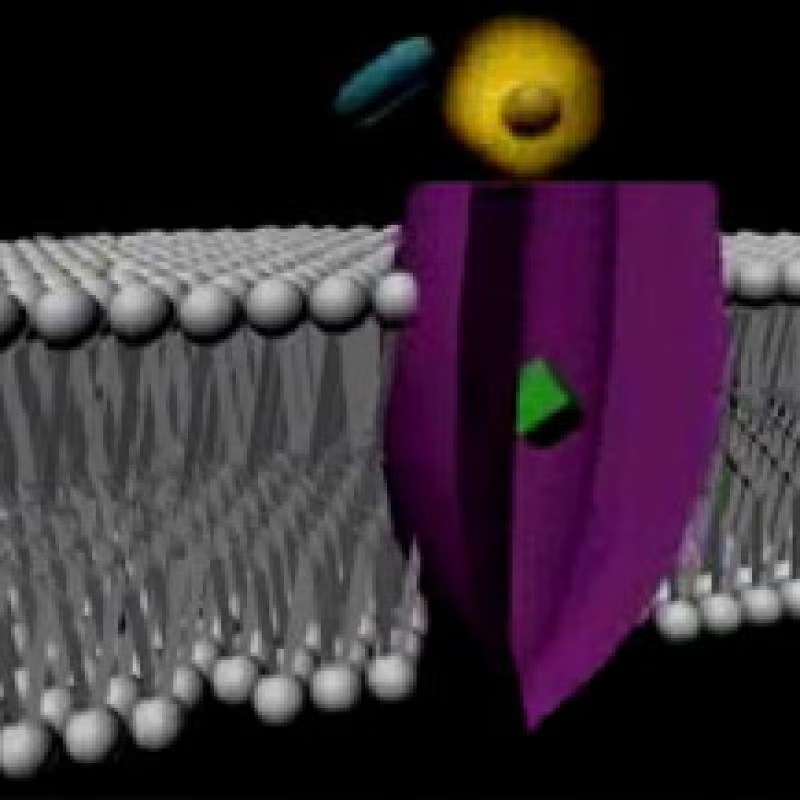
This HHMI BioInteractive resource visualizes diffusion across a lipid bilayer, emphasizing selective permeability and net movement down a concentration gradient. It helps connect the abstract idea of gradients to what is happening at the membrane scale during passive transport. Source
Concentration gradient: A difference in the concentration of a substance between two regions (often across a membrane or within a solution).
Key properties of diffusion (AP-relevant)
Net movement is down the gradient: individual particles can move either direction, but the overall (net) movement is from high to low concentration.
Dynamic equilibrium: diffusion can continue at the particle level even when there is no net change.
Dynamic equilibrium: A state in which particles continue to move randomly, but there is no net change in concentration across a region.
Simple diffusion across membranes
The specification highlights simple diffusion across membranes as a form of passive transport. In simple diffusion, the substance crosses the phospholipid bilayer without assistance from transport proteins.
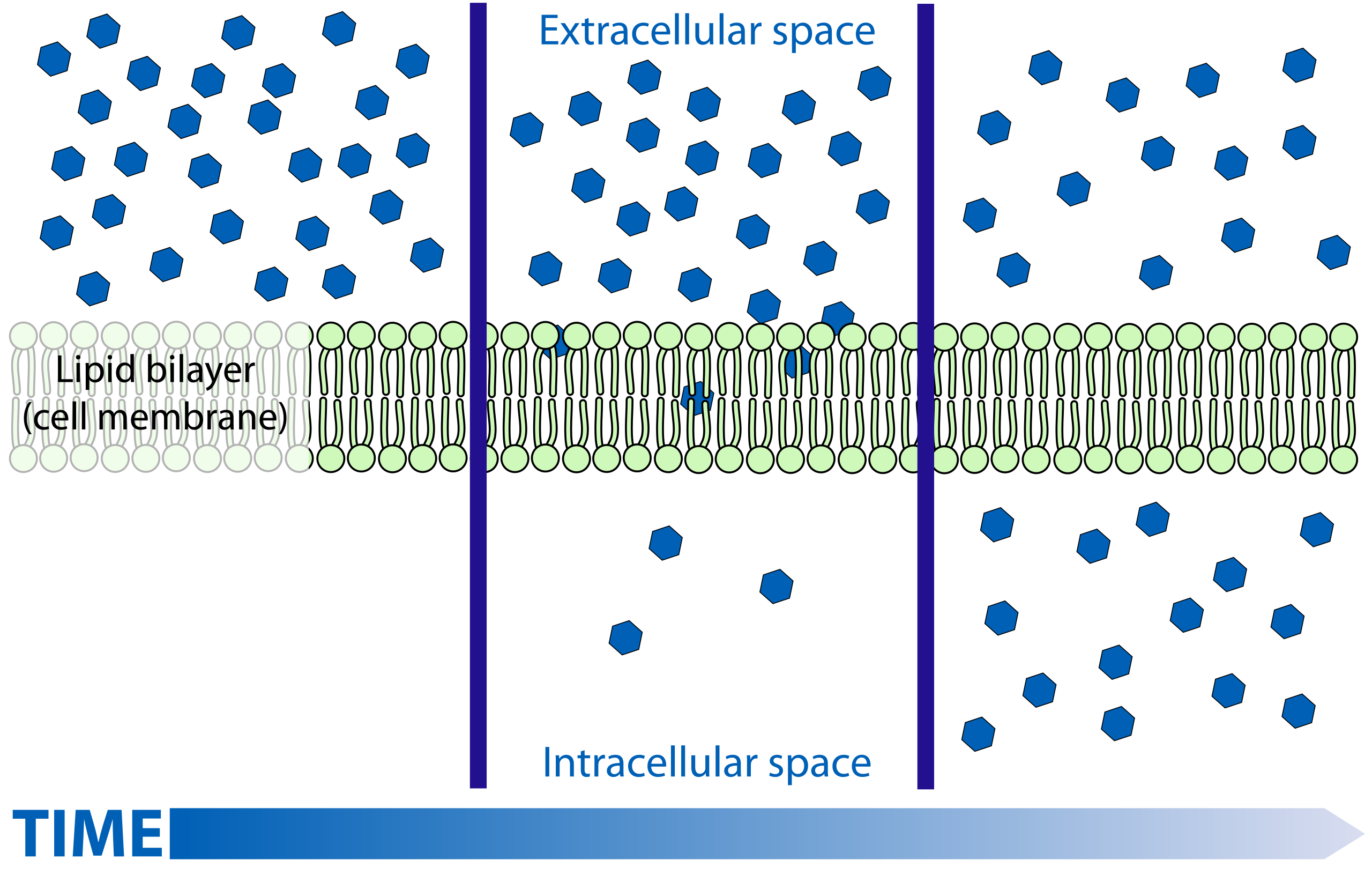
This diagram illustrates simple diffusion across a cell membrane, with particles moving from the side of higher concentration to lower concentration. It reinforces that no transport protein is required and that net movement continues until concentrations become more evenly distributed. Source
What kinds of substances diffuse simply?
In general, small, nonpolar molecules diffuse most readily through the membrane’s hydrophobic interior, while many polar or charged substances do not. The rate and extent depend on chemical properties and the membrane’s characteristics.
What controls the rate of simple diffusion?
Steepness of the concentration gradient: a larger difference produces faster net diffusion.
Membrane permeability to the solute: more permeable membranes allow faster diffusion.
Surface area available: more area allows more particles to cross per unit time.
Diffusion distance (thickness): a shorter path increases diffusion rate.
A compact way to express these relationships is captured by Fick’s law (conceptually useful for predicting how changes affect diffusion rate).
= diffusion flux (amount crossing per unit area per unit time)
= diffusion coefficient (depends on substance and medium)
= concentration difference across a distance
= diffusion distance (e.g., membrane thickness)
The negative sign indicates movement down the concentration gradient (from higher to lower concentration).
Clarifying “no direct metabolic energy input”
Passive transport does not mean “no energy is involved” in a physical sense; it means the cell is not spending ATP to make the movement happen. The energy that drives diffusion is the existing gradient plus the particles’ inherent kinetic energy.
What passive transport is not (common confusions)
Not movement against a gradient (that would require energy-coupling).
Not necessarily “fast”: diffusion can be slow over long distances.
Not a single direction for every particle: net direction is down the gradient even though individual particles move randomly.
Biological significance (within this subsubtopic)
Diffusion and other passive processes help cells exchange materials efficiently when:
the needed substance is present at higher concentration outside than inside (influx), or vice versa for waste removal (efflux)
distances are short and surface area is sufficient for the organism’s demands
rapid, continuous exchange is required without the cost of ATP for every molecule moved
Practice Questions
Define diffusion and state the direction of net movement in terms of concentration. (2 marks)
Diffusion is the net movement of particles due to random motion from a region of higher concentration to a region of lower concentration. (1)
Net movement is down the concentration gradient (high to low). (1)
Explain how simple diffusion across a plasma membrane can be affected by (i) the concentration gradient, (ii) membrane thickness, and (iii) surface area, and relate your answer to passive transport requiring no direct metabolic energy input. (5 marks)
Larger concentration gradient increases net rate of diffusion. (1)
Smaller concentration gradient decreases net rate. (1)
Greater membrane thickness (greater diffusion distance) reduces diffusion rate. (1)
Greater surface area increases diffusion rate (more crossing per unit time). (1)
Passive transport occurs down the gradient and does not require ATP input from the cell (no direct metabolic energy). (1)
FAQ
Higher temperature increases particles’ kinetic energy, increasing random motion and collision frequency.
This typically increases diffusion rate, although extreme temperatures can alter membrane structure and complicate the effect.
Diffusion time rises steeply with distance because particles take many random steps.
As distance increases, net transfer becomes too slow to meet biological demands without additional transport strategies.
Net diffusion compares movement in both directions and reports the overall result (high to low).
One-way diffusion can occur in both directions simultaneously; net diffusion is the difference between those opposing flows.
Permeability describes how readily a given solute crosses the bilayer without assistance.
It depends on solute properties (especially polarity and size) and membrane properties (such as lipid composition).
Common approaches include tracking changes in concentration over time in model membranes or using labelled molecules.
Measurements often focus on flux, rate of concentration change, or time to reach equilibrium under controlled gradients.

