

AP Syllabus focus:
‘Endocytosis uses energy to fold membrane inward, forming vesicles that bring large molecules or particles from the external environment into cells.’
Endocytosis is a core membrane-transport strategy that lets cells import material too large or too polar to cross the lipid bilayer directly. It relies on membrane bending, vesicle formation, and targeted cargo selection.
Overview of endocytosis
Endocytosis is an energy-requiring process in which the plasma membrane invaginates (folds inward) and pinches off to form an internal vesicle that carries extracellular material into the cell.
Endocytosis: An active transport process where the plasma membrane folds inward and forms a vesicle to internalise extracellular substances.
Endocytosis supports nutrient uptake, immune defence, membrane protein turnover, and regulation of signalling by controlling what enters the cell and which receptors remain at the surface.
What makes endocytosis “active”
Endocytosis requires cellular energy (often ATP indirectly) because cells must:
Deform the membrane against tension
Assemble protein coats and scaffolds
Use mechanical force for membrane scission (pinching off)
Traffic vesicles to appropriate intracellular locations
Vesicle formation: key steps and structures
Endocytosis couples cargo capture to vesicle budding. A typical sequence includes:
Recognition and clustering of cargo (sometimes via receptors)
Membrane invagination into a pit
Neck formation at the base of the pit
Scission to release a free vesicle into the cytosol
Uncoating and sorting of vesicle contents for downstream processing
Vesicle: A small, membrane-bound sac that transports or stores substances within a cell.
Vesicle formation depends on proteins that shape membranes and organise cargo. Coat proteins (commonly clathrin in many eukaryotic cells) help curve the membrane and concentrate specific molecules, while adapter proteins link cargo-bound receptors to the coat. Dynamin (a GTPase) commonly forms a collar at the vesicle neck and helps drive scission.
Role of the cytoskeleton
The cytoskeleton supports endocytosis by:
Providing force for membrane deformation (actin often contributes)
Helping move newly formed vesicles away from the plasma membrane
Directing vesicles toward sorting locations inside the cell
Major types of endocytosis (what is taken up)
Cells use multiple endocytosis modes, differing mainly in cargo size and specificity.
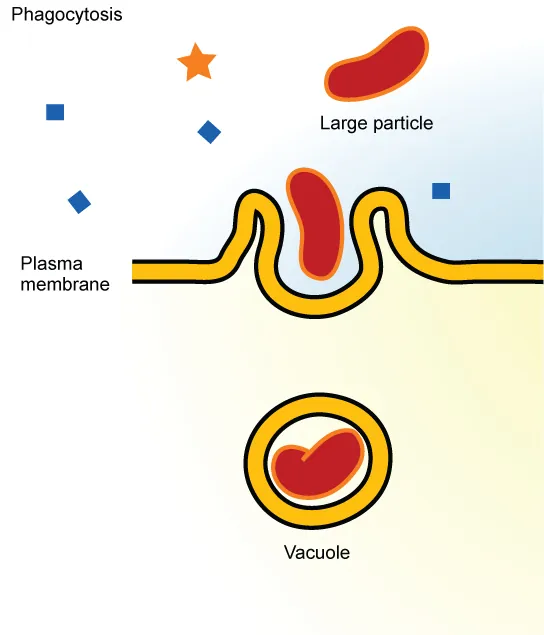
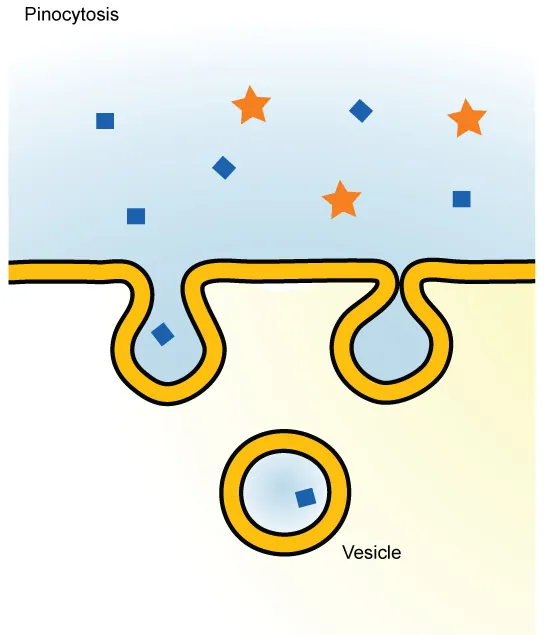
This diagram contrasts phagocytosis and pinocytosis, emphasizing the size of material taken up and the relative size of the resulting vesicles. It reinforces that both processes rely on plasma-membrane invagination and vesicle formation, but differ in cargo scale and typical biological roles. Source
Phagocytosis (“cell eating”)
Phagocytosis internalises large particles (e.g., microbes, cell debris) into large vesicles often called phagosomes.
Typically performed by specialised cells (such as immune cells)
Involves membrane extensions that surround the particle before sealing
Pinocytosis (“cell drinking”)
Pinocytosis internalises extracellular fluid and dissolved solutes in small vesicles.
Often continuous and relatively non-specific
Useful for bulk uptake when specific receptors are not required
Receptor-mediated endocytosis (high specificity)
Receptor-mediated endocytosis selectively imports specific macromolecules (ligands) that bind membrane receptors.
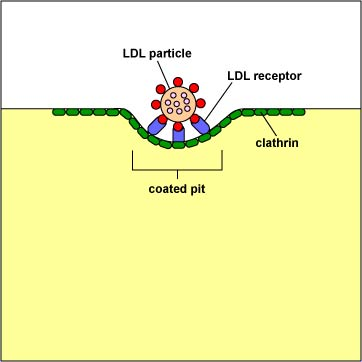
This diagram shows LDL particles binding to LDL receptors clustered in a clathrin-coated pit, illustrating how receptor-mediated endocytosis achieves high specificity. The labeled clathrin layer highlights how coat proteins help curve the membrane and concentrate selected cargo prior to vesicle budding. Source
Increases efficiency when extracellular molecules are scarce
Concentrates cargo into coated pits before vesicle formation
Helps regulate signalling by internalising receptor–ligand complexes
Selectivity, regulation, and cellular consequences
Endocytosis is tightly regulated because it changes both cell intake and membrane composition.
Selectivity: Receptors and adapters determine which ligands enter, preventing indiscriminate uptake of all extracellular solutes.
Signal control: Internalising receptors can reduce responsiveness (“desensitisation”) or, in some pathways, sustain signalling from internal compartments.
Membrane homeostasis: Removing patches of plasma membrane during endocytosis requires coordinated balancing of membrane area and lipid/protein distribution.
Sorting outcomes: Once internalised, cargo may be directed to different destinations (such as recycling back to the surface or delivery for breakdown), depending on molecular tags and the vesicle’s identity.
Because endocytosis imports large molecules or particles that cannot simply diffuse across the membrane, it is essential for cells to access complex nutrients, remove external threats, and dynamically remodel the cell surface in response to environmental conditions.
Practice Questions
Describe how endocytosis enables the uptake of large molecules into a cell. (2 marks)
States that the plasma membrane folds inward/infolds to form an invagination (1)
States that a vesicle pinches off to bring material into the cell and that energy is required (1)
Explain receptor-mediated endocytosis from ligand binding to vesicle entry into the cytosol, including how specificity is achieved. (5 marks)
Ligand binds to a specific membrane receptor (1)
Receptor–ligand complexes cluster in coated pits / via adaptor proteins (1)
Coat proteins (e.g., clathrin) help curve the membrane and form a budding vesicle (1)
Membrane scission releases a vesicle into the cytosol (may mention dynamin/GTP) (1)
Specificity explained: only cargo bound to receptors is concentrated and internalised efficiently (1)
FAQ
Cells use sorting signals on receptor cytosolic tails (short amino-acid motifs) and post-translational tags (often ubiquitin).
Sorting proteins recognise these cues and route receptors into recycling pathways or into pathways that commit them to breakdown.
Certain lipids can cluster to create membrane regions that recruit specific proteins and alter curvature.
These domains can bias where pits form and which receptors preferentially cluster, affecting uptake rates.
Macropinocytosis can rapidly internalise large volumes of extracellular fluid when nutrients are abundant.
It is often upregulated in highly metabolic or rapidly growing cells to increase bulk nutrient acquisition.
Some viruses and bacteria bind host receptors to trigger their own uptake via normal endocytic machinery.
Others mimic ligands or alter signalling to increase pit formation and internalisation efficiency.
Common approaches include tracking loss of surface receptors, uptake of fluorescently labelled ligands, or changes in membrane capacitance.
Pulse–chase designs can separate binding at the surface from internalisation over time.
