

AP Syllabus focus:
‘Active transport uses cellular energy, often ATP, to move molecules against concentration gradients from low to high concentration.’
Active transport is how cells maintain essential, non-equilibrium internal conditions. By spending energy (usually from ATP), membrane proteins pump solutes uphill, enabling nutrient uptake, ion balance, and stable intracellular chemistry.
Core idea: moving “uphill” costs energy
Concentration gradients represent differences in solute concentration across a membrane. Moving a solute from low to high concentration is energetically unfavorable and requires energy coupling.
Active transport: energy-requiring movement of substances across a membrane against their concentration gradient (low to high), typically carried out by specific membrane transport proteins.
Active transport is specific (transporters recognize particular substrates) and saturable (limited by the number and turnover rate of transport proteins).
Where the energy comes from
Cells most commonly power active transport with ATP. Transport proteins convert chemical energy into conformational changes that move solutes across the membrane.
= Adenosine triphosphate (cell’s immediate energy currency)
= Adenosine diphosphate
= Inorganic phosphate
The released energy is not “pushed into” the solute directly; it is used to change the transporter’s shape and binding properties.
Mechanisms of active transport
Primary active transport (direct ATP use)
In primary active transport, the transporter is an ATPase that uses ATP hydrolysis to move solutes uphill.
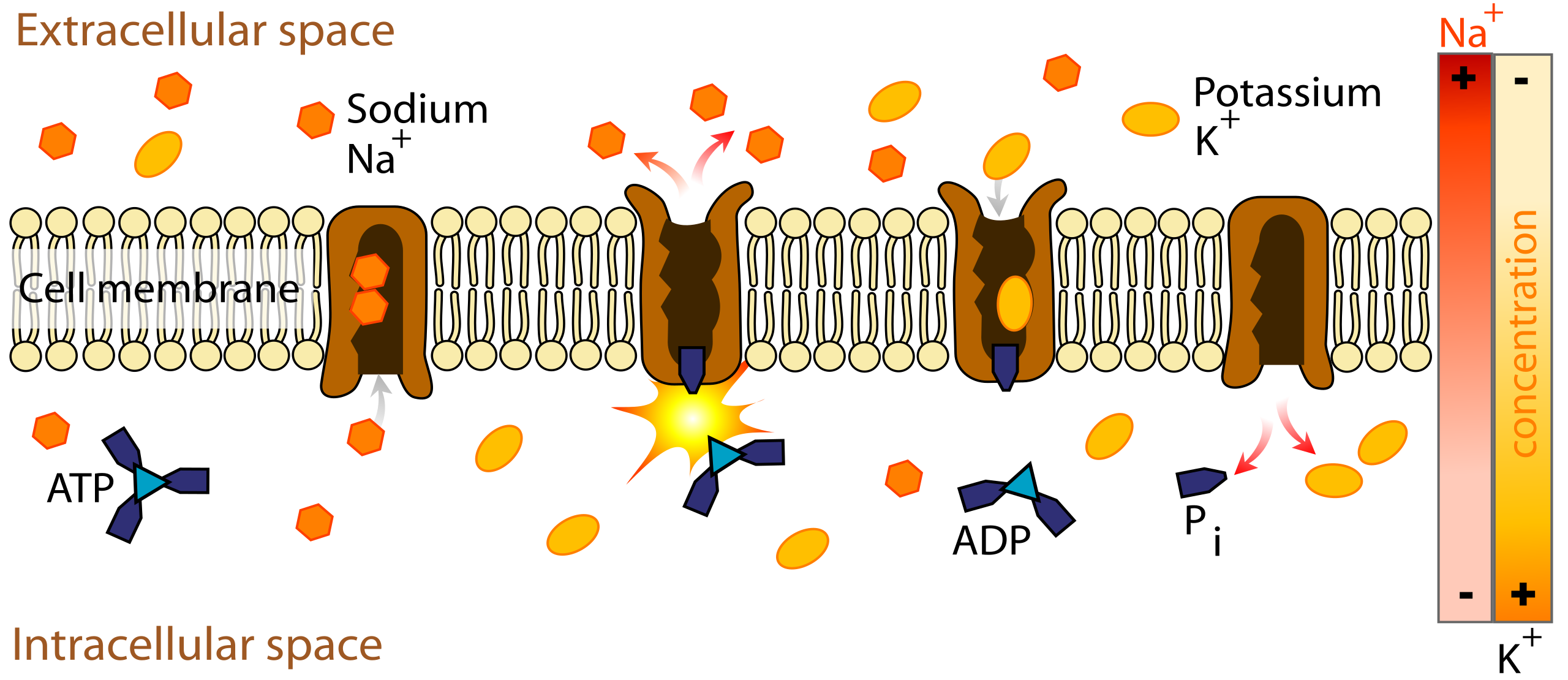
This diagram summarizes the sodium–potassium pump (a P-type ATPase) cycle, showing ATP hydrolysis driving alternating-access conformational changes. It highlights the characteristic stoichiometry—three Na exported for every two K imported—which builds electrochemical gradients. These gradients are central to maintaining membrane potential and powering many coupled transport processes. Source
Key features:
Phosphorylation-driven conformational change: ATP hydrolysis alters the protein so binding sites alternately face each side of the membrane.
Directional transport: the cycle ensures net movement from low to high concentration.
Gradient creation: primary pumps establish steep gradients that other processes can exploit.
Examples of what students should recognize:
Ion pumps that export or import specific ions to maintain appropriate intracellular concentrations (often critical for cell function and viability).
Secondary active transport (indirect ATP use via coupling)
In secondary active transport, ATP is not used by the cotransporter directly.
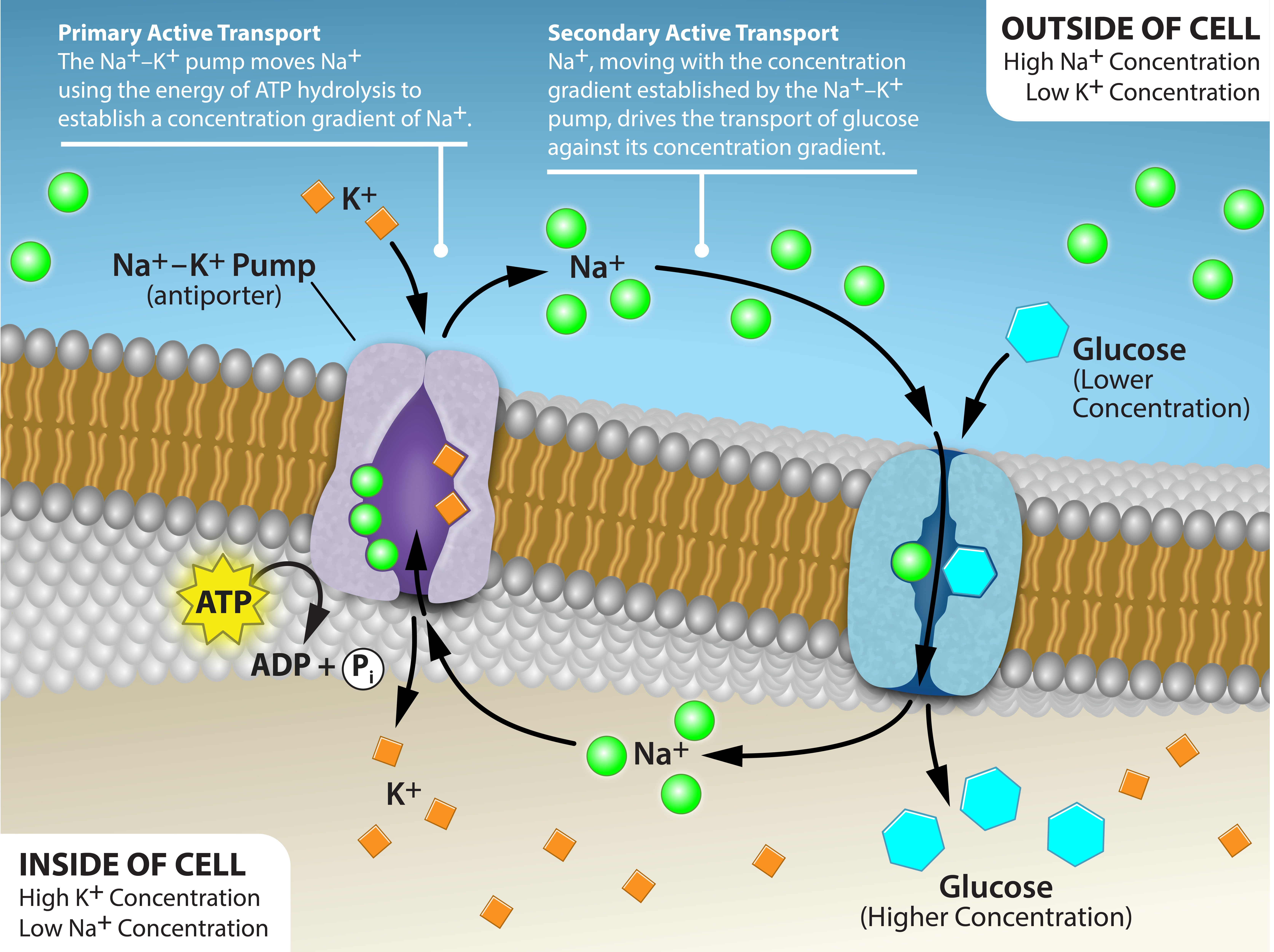
This figure illustrates secondary active transport as energy coupling: a primary ATP-driven pump first creates a steep Na gradient, and the downhill Na flow then powers uphill glucose import through a symporter. The image makes the logic of “indirect ATP use” explicit—ATP energy is stored in an electrochemical gradient and later converted into transport work. It also emphasizes why secondary transport stops when the driving gradient is lost. Source
Instead, the cell uses energy stored in an existing gradient (often created by primary active transport) to drive uphill movement of another substance.
Two common coupling patterns:
Symport (cotransport, same direction)
One solute moves down its gradient, releasing energy
A second solute is moved against its gradient in the same direction
Antiport (exchange, opposite directions)
One solute moves down its gradient
A different solute moves uphill in the opposite direction
Important constraints:
If the “driving” gradient collapses, secondary active transport stops, even if the cotransporter itself is intact.
Secondary transport still ultimately depends on cellular energy because the driving gradient typically must be regenerated by ATP-powered pumps.
Why cells invest energy in active transport
Active transport supports cellular homeostasis by maintaining conditions that passive processes would erase.
High-yield roles:
Nutrient acquisition: importing needed solutes even when external concentrations are low.
Waste and ion regulation: exporting substances that would otherwise accumulate.
Maintaining internal chemical conditions: sustaining distinct intracellular concentrations required for enzyme function and cellular processes.
Supporting larger-scale transport needs: establishing gradients that enable coupled uptake and balanced intracellular solute levels.
What affects active transport rate
Because active transport depends on proteins and energy supply, its rate changes predictably with:
ATP availability: reduced ATP limits pump cycling.
Transporter number: more pumps/carriers generally increases maximum transport rate.
Substrate concentration and affinity: affects binding and saturation.
Temperature and membrane condition: influences protein motion and conformational switching.
Inhibitors: molecules that block ATPases or prevent conformational changes reduce or stop transport.
Practice Questions
Define active transport and state the direction of movement relative to a concentration gradient. (2 marks)
Definition includes energy requirement/ATP use (1)
Movement is from low to high concentration / against the gradient (1)
Explain how ATP provides energy for active transport by membrane proteins, and distinguish primary from secondary active transport. (5 marks)
ATP hydrolysis releases energy used to change transporter conformation (1)
Conformational change moves solute against its gradient (1)
Primary active transport uses ATP directly via an ATPase pump (1)
Secondary active transport uses energy stored in another solute’s gradient (1)
That driving gradient is typically generated/maintained by ATP-powered pumps (1)
FAQ
Because each transporter has finite binding sites and a maximum cycling rate. At high substrate concentration, all sites are occupied and transport reaches a plateau.
ABC (ATP-binding cassette) transporters bind and hydrolyse ATP at cytosolic domains, driving conformational shifts that move specific substrates across membranes.
They regulate transporter activity (e.g., gating, trafficking, phosphorylation) and adjust membrane composition to reduce passive leak, lowering the ATP cost of maintaining gradients.
They reduce ATP supply, slowing or stopping ATP-dependent pumps first; secondary active transport then fails as driving gradients dissipate.
Pumping solutes alters intracellular osmolarity; water follows osmotically through the membrane, so sustained solute pumping can indirectly drive water movement.

