

AP Syllabus focus:
‘Exocytosis uses vesicles that fuse with the plasma membrane to release large molecules or large quantities of substances from cells.’
Exocytosis is a major bulk transport pathway cells use to export materials too large or too numerous for membrane transport proteins.
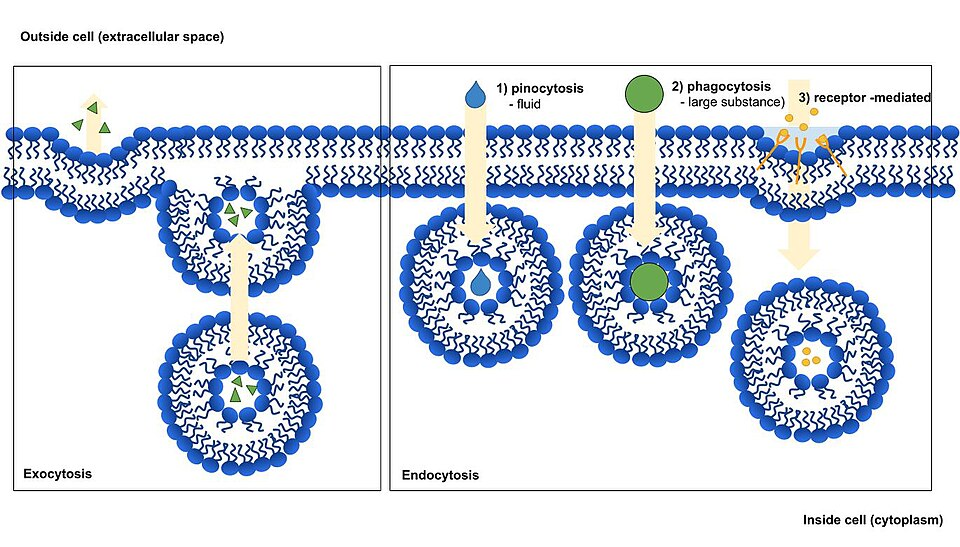
This figure contrasts exocytosis (vesicle fusion releasing material outside the cell) with several forms of endocytosis (membrane invagination bringing material into the cell). The side-by-side layout highlights the directional logic of bulk transport and makes the membrane-shape changes easy to visualize. Source
It also reshapes the plasma membrane by adding lipids and proteins during vesicle fusion.
Core idea: bulk secretion by membrane fusion
Exocytosis is a vesicle-mediated process that moves cargo from the cell interior to the extracellular space by fusion of a vesicle membrane with the plasma membrane, releasing contents outside the cell.
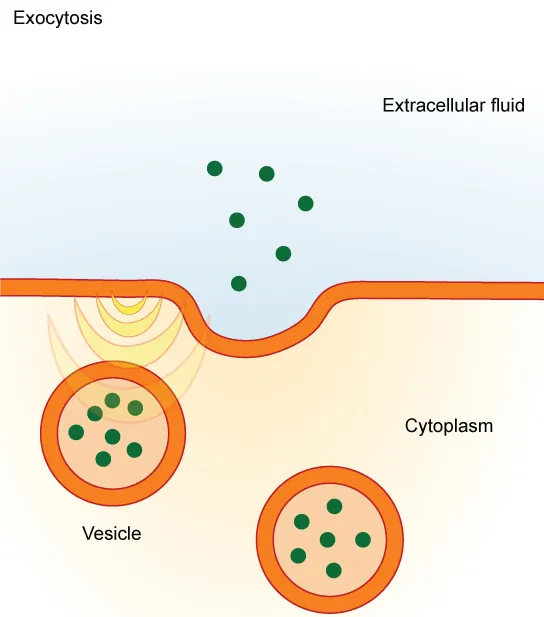
This diagram illustrates exocytosis as a membrane-fusion event: a cargo-containing vesicle docks at the plasma membrane, the bilayers merge, and soluble contents are released into the extracellular fluid. It also emphasizes that vesicle membrane becomes continuous with (and effectively adds to) the plasma membrane during fusion. Source
Exocytosis: A bulk transport process in which intracellular vesicles fuse with the plasma membrane to release large molecules or large quantities of substances to the outside of the cell.
This process is essential for exporting substances that cannot efficiently cross the hydrophobic bilayer (for example, large polar macromolecules), and for rapid, high-volume secretion when a cell must respond quickly to signals.
What gets secreted (and why it matters)
Exocytosis supports diverse cell functions by releasing large molecules and large quantities of substances, including:
Proteins such as digestive enzymes, antibodies, peptide hormones, and extracellular enzymes
Polysaccharides and glycoproteins used in extracellular matrices, mucus, and protective coatings
Cell signaling molecules released in bursts (e.g., neurotransmitters in many animal synapses)
Membrane components (lipids and membrane proteins) that expand or remodel the plasma membrane
Because the vesicle membrane becomes part of the plasma membrane, exocytosis also:
Inserts specific membrane proteins (receptors, channels) into the cell surface
Changes local membrane composition and surface area, which can affect cell interactions and responsiveness
Step-by-step mechanism of exocytosis
Exocytosis is often presented as a sequence of coordinated events. Key steps include:
Vesicle formation and cargo loading
Cargo is packaged into membrane-bound vesicles; packaging concentrates cargo for high-output secretion.
Vesicle transport
Vesicles move toward the cell surface along cytoskeletal tracks (especially microtubules and actin) using motor proteins.
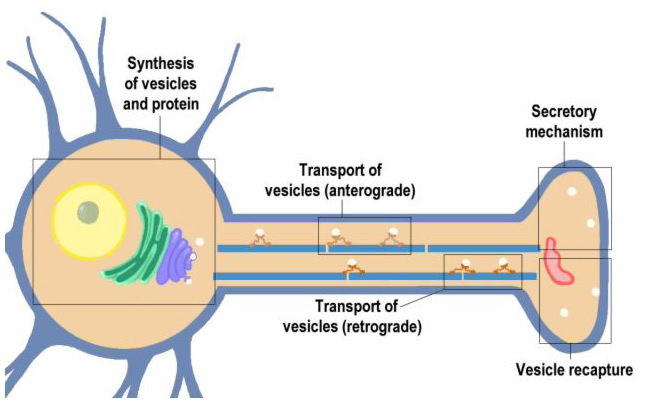
This neuron schematic summarizes vesicle trafficking at a systems level, showing vesicle synthesis in the soma, transport along the axon, and a dedicated secretory region where vesicles undergo exocytosis. It reinforces that long-range vesicle movement (typically microtubule-based) is an organized prerequisite for targeted docking and fusion at the plasma membrane. Source
Targeting and docking
Vesicles are guided to specific regions of the plasma membrane, supporting directional secretion (for example, secretion toward a gland lumen).
Membrane fusion
Fusion proteins bring the vesicle membrane and plasma membrane into close contact until they merge, forming a continuous bilayer.
Release of contents
The vesicle lumen becomes continuous with the extracellular space, allowing cargo to exit; soluble cargo disperses outside the cell.
Membrane recovery and balancing
Cells frequently regulate membrane area and composition through membrane recycling and controlled rates of secretion to maintain functional surface properties.
Constitutive vs regulated exocytosis
Cells use exocytosis in two major modes:
Constitutive exocytosis
Continuous, “default” secretion that supplies the cell surface with membrane proteins/lipids and steadily exports materials.
Common in many cell types for routine membrane maintenance and extracellular matrix secretion.
Regulated exocytosis
Cargo is stored in vesicles and released only after a specific signal triggers fusion.
Enables rapid release of large quantities on demand (for example, hormone release from endocrine cells or enzyme release from secretory cells).
Regulated exocytosis is especially important when timing and dose must be controlled, since it couples secretion to changes in intracellular signals (often ion concentration changes such as Ca²⁺).
Energy use and control
Although vesicle contents may exit passively once fusion occurs, exocytosis as a whole is energy-requiring because it depends on:
ATP for motor protein movement along cytoskeletal elements and for maintaining the cellular machinery that supports vesicle cycling
GTP-binding proteins (common in vesicle trafficking control) that help coordinate timing and targeting
Tight regulation to ensure cargo is released at the correct location, preventing inappropriate signaling or wasted secretory products
How exocytosis supports homeostasis and cell function
Exocytosis contributes to cellular and organismal function by:
Maintaining cell-to-cell communication through controlled secretion of signaling molecules
Enabling digestion and defense via secretion of enzymes and protective proteins
Building and maintaining the extracellular environment, including adhesion molecules and structural components
Adjusting the cell surface, inserting or removing surface proteins to change how the cell responds to external conditions
Because it can export both large molecules and large quantities quickly, exocytosis is a central mechanism for bulk secretion in many tissues, from glands to immune cells to neurons.
Practice Questions
State what happens to the vesicle membrane during exocytosis. (2 marks)
Vesicle fuses with the plasma membrane (1)
Vesicle membrane becomes part of the plasma membrane / adds lipids and proteins to the cell surface (1)
A secretory cell releases a large burst of protein to the extracellular space after stimulation. Explain how exocytosis enables this release and describe two features that make it suitable for bulk secretion. (5 marks)
Proteins are packaged into vesicles for transport (1)
Vesicles move to the plasma membrane and dock at specific sites (1)
Vesicle and plasma membranes fuse, creating continuity and releasing contents outside the cell (1)
Suitable feature: can export large macromolecules that cannot cross the lipid bilayer directly (1)
Suitable feature: can release large quantities rapidly in a coordinated burst (regulated secretion) (1)
FAQ
Cells use targeting labels on vesicles and recognition proteins at particular membrane domains.
Rab-type GTPases and tethering factors help match vesicles to the correct site.
Fusion proteins form specific pairs so only correctly docked vesicles fuse efficiently.
This supports polarised secretion in tissues such as epithelia.
In full fusion, the vesicle collapses into the plasma membrane and releases essentially all contents.
In kiss-and-run, a transient fusion pore opens briefly, releasing some cargo, then closes and the vesicle is retrieved.
Kiss-and-run can conserve vesicle components and allow faster repeated release.
Common approaches include:
Membrane capacitance recordings (fusion increases surface area and capacitance).
Fluorescent reporters that change signal when vesicles fuse (e.g., pH-sensitive tags).
Tracking release of labelled secreted proteins in the extracellular medium.
Each method trades off time resolution and molecular specificity.
Exocytosis can insert or remove surface proteins, including receptors and channels.
If receptor abundance at the membrane increases, sensitivity to an external ligand can rise; if receptors are internalised or not replenished, responsiveness can fall.
This membrane “remodelling” can occur on short timescales in some cells.
Depending on cell type, impairment can cause:
Reduced secretion of enzymes or hormones, disrupting tissue-level regulation
Accumulation of cargo inside the cell, stressing organelles and trafficking pathways
Abnormal cell surface composition, affecting adhesion, signalling, and membrane repair
The specific phenotype depends on which vesicle populations and fusion steps are disrupted.

.jpg)