

AP Syllabus focus:
‘Populations with higher genetic diversity are better able to respond to environmental stressors; bottlenecks can reduce genetic diversity.’
Genetic variation within a population is the raw material for natural selection. In AP Environmental Science, genetic diversity explains why some populations persist through change while others crash after disturbance or disease.
Why genetic diversity matters
Genetic diversity and environmental stressors
Genetic diversity increases the chance that at least some individuals carry traits that improve survival and reproduction when conditions shift (for example, heat waves, drought, salinity change, new predators, or pollutants). When those individuals leave more offspring, helpful alleles become more common, allowing the population to adapt rather than decline.
Genetic diversity: the variety of alleles (gene versions) and genotypes present within a population.
High genetic diversity is especially important because real ecosystems change in multiple ways at once; a population with more genetic options is less “locked in” to one narrow set of conditions.
Disease resistance and population stability
Genetic variation can reduce the risk that a single pathogen or parasite genotype devastates an entire population.
If many individuals share similar immune-related genes, a pathogen that bypasses that defence can spread rapidly.
With higher variation, some individuals are more likely to resist infection, slowing transmission and preserving reproductive adults.
Avoiding inbreeding depression
When populations become small and isolated, mating among relatives becomes more common, increasing homozygosity (two copies of the same allele). This can expose harmful recessive alleles and reduce overall fitness.
Lower survival of offspring
Reduced fertility
Poor growth or stress tolerance
These effects make populations less able to withstand additional environmental stressors, raising extinction risk.
Long-term persistence and “response capacity”
In APES terms, genetic diversity supports resilience: the ability to persist or rebound because some individuals can cope with new conditions. This is the core idea in the syllabus statement that populations with higher genetic diversity respond better to environmental stressors.
Genetic bottlenecks: what they are and what they do
Defining a bottleneck
A genetic bottleneck occurs when a population experiences a sharp reduction in size, so that the surviving individuals represent a smaller, non-random sample of the original gene pool.
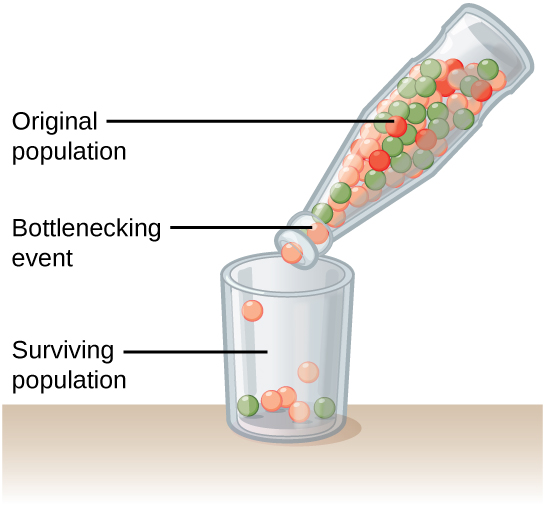
This diagram illustrates the bottleneck effect: a random, severe reduction in population size leaves only a small subset of the original gene pool. When the population later expands, it does so from those survivors, so rare alleles may be lost and allele frequencies can shift simply due to chance. The figure visually reinforces why post-recovery populations can remain genetically impoverished even if their census size rebounds. Source
Genetic bottleneck: a drastic reduction in population size that reduces genetic variation and can change allele frequencies by chance.
Because the survivors may not carry the full set of alleles that existed before, genetic diversity can remain low even if the population later grows in number.
Common causes of bottlenecks
Bottlenecks can be triggered by many stressors relevant to environmental science:
Natural events (wildfire, hurricanes, drought, volcanic activity)
Human impacts (overharvesting, habitat fragmentation, pollution spills, rapid climate shifts)
Disease outbreaks intensified by crowding or low diversity
The key APES point is not the event itself, but the genetic consequence: fewer breeding individuals means less variation to work with.
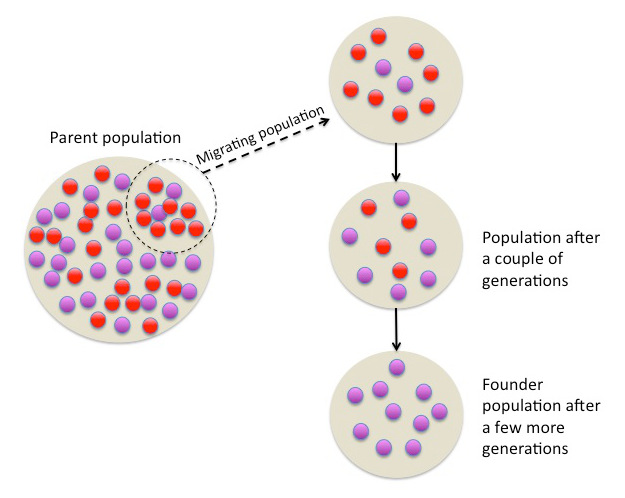
This illustration shows the founder effect: a new population started by a small number of individuals can differ genetically from the source population because the founders are an unrepresentative sample. As the new population grows, those initial allele frequencies can become “locked in,” often reducing genetic diversity relative to the original population. Conceptually, this is the same random-sampling logic that makes bottlenecks so damaging to adaptive potential. Source
Genetic consequences of bottlenecks
After a bottleneck, several linked outcomes can reduce a population’s ability to respond to environmental stressors:
Loss of rare alleles: uncommon variants are easily eliminated when only a few individuals survive.
Genetic drift increases: chance plays a larger role in which alleles become common, potentially lowering fitness.
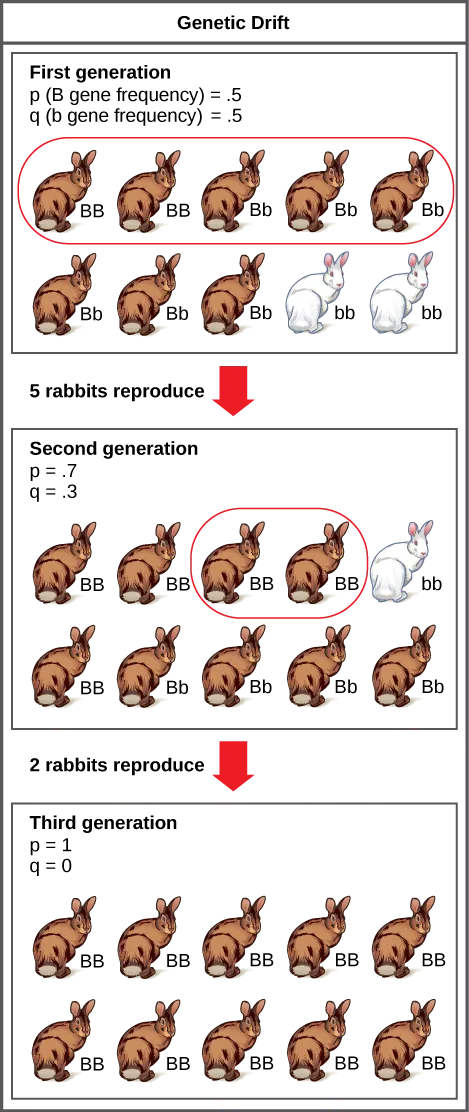
This figure walks through genetic drift across generations in a small population, showing how random sampling of which individuals reproduce can change allele frequencies without any selective advantage. In the example, one allele eventually disappears entirely, highlighting how drift can eliminate variation—especially when population size is small (as during or after a bottleneck). It directly supports the idea that reduced population size amplifies chance effects on the gene pool. Source
More inbreeding: small populations make mating among relatives more likely, increasing inbreeding depression.
Reduced adaptive potential: with fewer alleles, there may be no suitable variants for future conditions (for example, tolerance to higher temperatures or new toxins).
Lasting effects even after population recovery
A population can rebound numerically but still be genetically impoverished.
If recovery comes from a small set of founders, many lineages never return.
Low diversity can persist for many generations, especially when the population remains isolated.
For conservation and management, this explains why preventing severe declines is often more effective than attempting to rebuild populations after they crash: bottlenecks can permanently reduce genetic “options,” making future stressors more dangerous.
Practice Questions
Explain why a population with higher genetic diversity is more likely to survive a new environmental stressor. (2 marks)
States that more genetic variation increases the chance some individuals have a trait/allele that confers tolerance/resistance to the stressor. (1)
States that these individuals survive and reproduce, allowing the population to persist/adapt rather than decline. (1)
A large mammal population is reduced to a few dozen individuals after intensive hunting, then later increases to several thousand. Describe how this bottleneck could affect (i) genetic diversity and (ii) the population’s ability to respond to future environmental stressors. (6 marks)
Identifies the event as a genetic bottleneck due to a sharp reduction in population size. (1)
Explains loss of alleles/rare alleles due to the small number of survivors (reduced gene pool). (1)
Explains increased genetic drift changing allele frequencies by chance. (1)
Explains increased inbreeding/homozygosity and potential inbreeding depression. (1)
Links reduced diversity to lower adaptive potential to future stressors (e.g., disease, climate extremes, pollutants). (1)
Notes that numerical recovery does not necessarily restore lost genetic diversity. (1)
FAQ
Common approaches include DNA markers (e.g., SNPs, microsatellites) to estimate heterozygosity and allele counts.
Field sampling must avoid related individuals to prevent overestimating inbreeding.
Effective population size is the number of individuals effectively contributing genes to the next generation.
It drops when breeding is skewed (few males breed), generations overlap, or populations fluctuate strongly.
They can persist for many generations because lost alleles cannot reappear except by mutation or immigration.
Recovery is slower in long-lived species with low reproduction rates.
Genetic rescue introduces individuals from other populations to increase diversity and reduce inbreeding depression.
It is used cautiously when isolation is severe and local adaptation is unlikely to be disrupted.
Rarely, by chance it may increase the frequency of a helpful allele.
However, the overall risk is high because diversity typically declines, reducing flexibility under future stressors.


