

AP Syllabus focus:
‘Ecosystems with a larger number of species are more likely to recover after disruptions.’
Biodiversity affects how ecosystems respond to disturbance. Species diversity can buffer communities against change by spreading risk across many species and interactions, increasing the chance that key functions persist and recovery proceeds.
Core idea: species diversity improves recovery
Ecosystems with a larger number of species are more likely to recover after disruptions because more species typically means more ecological roles, more response options to stress, and more stable food webs.
Key terms for AP Environmental Science
Species diversity: The variety of species in a community, including both the number of species present and how evenly individuals are distributed among those species.
Species diversity is often linked to two related stability concepts: how much an ecosystem changes during a disturbance and how well it returns afterward.
Resistance: The ability of an ecosystem to remain relatively unchanged when disturbed.
Resistance is distinct from returning to the prior state after change.
Resilience: The ability of an ecosystem to recover after a disturbance (returning structure and function over time).
Why more species can mean faster or more reliable recovery
Functional redundancy (“backup species”)
When multiple species perform similar ecosystem functions (for example, several pollinators or several algae-grazing fish), the loss or decline of one species may not eliminate that function.
Functional redundancy: The presence of multiple species that can perform similar ecological roles, so ecosystem processes can continue if one species is reduced or lost.
More redundancy generally increases the probability that at least one species can maintain essential processes during and after disruption.
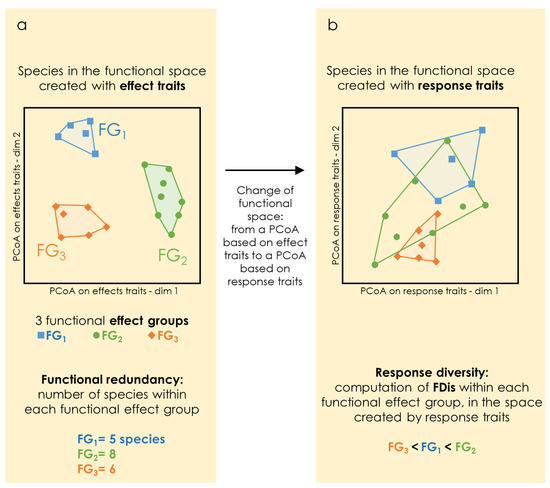
Functional redundancy is shown as multiple species clustered within the same functional effect group (several species capable of the same ecosystem role), while response diversity is shown as different spreads of traits within those groups. The figure emphasizes that communities can have similar functions represented (redundancy) yet differ in how broadly species respond to stressors (response diversity). Together, these mechanisms help explain why higher biodiversity can make ecosystem functioning more robust during and after disturbances. Source
Response diversity (different tolerances and strategies)
Even if species share a role, they may respond differently to heat, drought, disease, pollution, or habitat change. In a diverse community:
some species may decline sharply,
others may persist,
a few may increase and temporarily stabilise energy flow and nutrient cycling.
This “portfolio effect” reduces the chance that all species contributing to a key process fail at the same time.
Food-web stability and trophic support
Higher species diversity often increases the number of feeding links and alternative pathways for energy transfer.
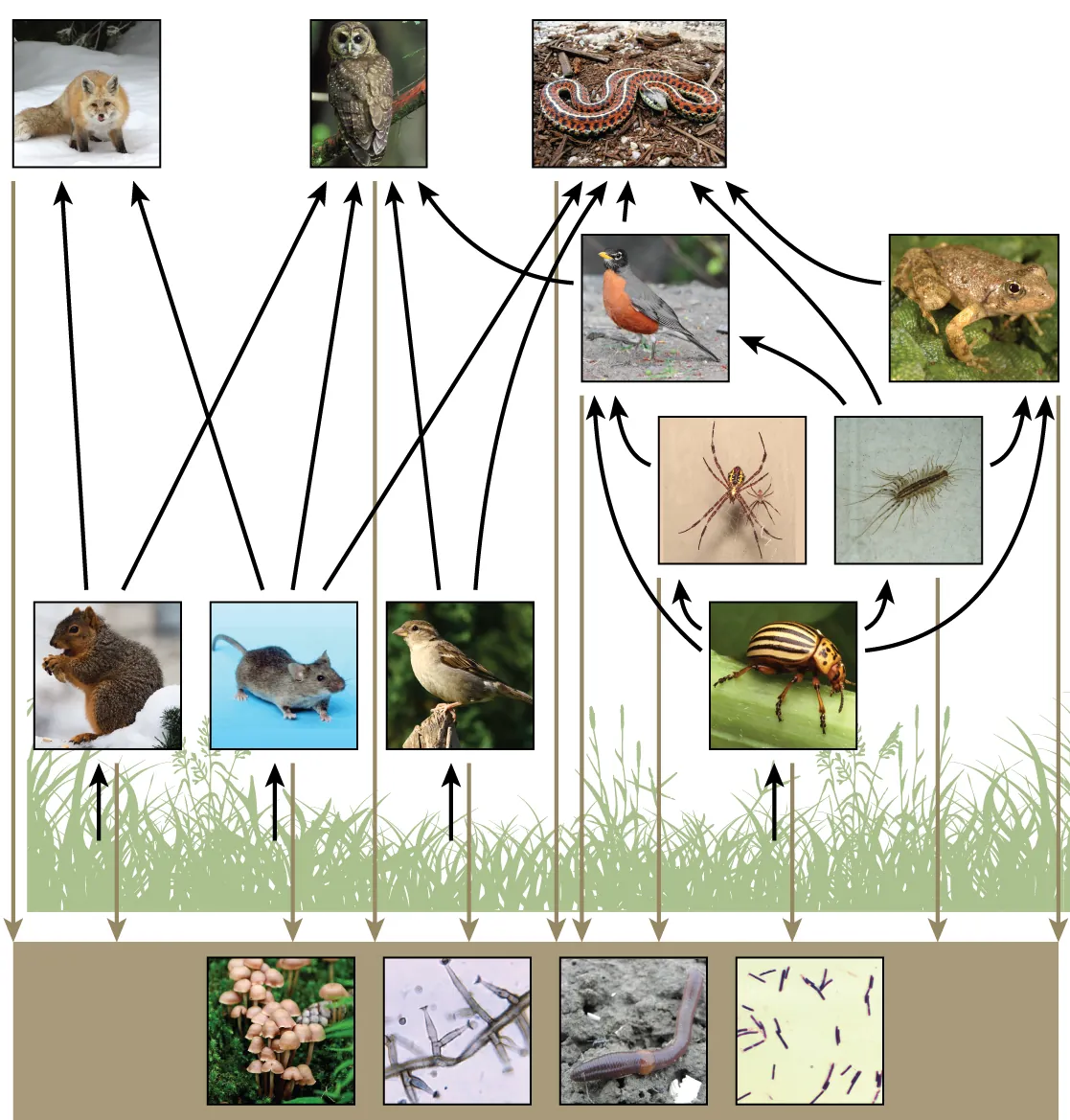
This food-web diagram shows how energy and matter move across trophic levels, with multiple consumer–resource links rather than a single linear chain. Because consumers can have alternative prey and producers can feed multiple pathways, the web structure helps explain how diverse ecosystems may maintain energy flow even when one species declines. The decomposer pathway highlights recycling of organic matter back into the system. Source
After a disruption removes or reduces one prey or producer:
consumers may switch to other available food sources,
predators may persist rather than crashing,
top-down and bottom-up controls may re-balance more quickly.
However, this benefit depends on the disruption type and whether alternative resources are actually accessible.
Productivity, nutrient cycling, and soil recovery
In plant communities, more species can increase the likelihood that some plants:
regrow quickly after damage,
tolerate altered soil moisture or salinity,
stabilize soil and reduce erosion,
maintain microbial partners that support decomposition and nutrient availability.
These processes can shorten recovery time by restoring primary productivity and rebuilding habitat structure for other organisms.
What “recovery after disruptions” can mean
Disturbance and recovery endpoints
Disturbance (disruption): A discrete event or sustained pressure that alters ecosystem structure and/or function by changing resource availability, physical conditions, or species interactions.
Recovery may be evaluated using indicators such as:
return of biomass and vegetation cover
restoration of species composition (which species are present)
re-establishment of ecosystem functions (productivity, decomposition, nutrient cycling)
stability of population dynamics (reduced boom–bust cycles)
Different metrics can give different answers; a system might regain productivity while species composition remains altered.
Limits and exceptions to the pattern
While the syllabus statement is generally supported, recovery is not guaranteed by diversity alone.

This graph illustrates the Intermediate Disturbance Hypothesis: species richness is often lowest at very low disturbance (competitive exclusion) and very high disturbance (few species tolerate frequent/intense disruption), with peak richness at intermediate disturbance. It’s a useful reminder that the diversity–stability relationship is context dependent and that disturbance regime can shape both community composition and recovery potential. Source
Factors that can weaken the diversity–recovery relationship include:
disruptions that remove habitat or abiotic conditions essential to most species
loss of a species that strongly supports many others (for example, a dominant foundation organism)
fragmentation that prevents recolonization from nearby areas
repeated disturbances occurring faster than regeneration rates
In AP terms, species diversity often increases the likelihood of recovery, but context determines outcomes.
Practice Questions
Explain why ecosystems with higher species diversity are more likely to recover after a disruption. (2 marks)
Identifies that more species increases the chance that some survive/withstand the disruption and maintain ecosystem function (1).
Explains a mechanism such as functional redundancy, alternative food-web pathways, or varied tolerances/strategies aiding recovery (1).
A storm reduces plant cover and several insect populations in two grasslands. Grassland A has high species diversity; Grassland B has low species diversity. Compare how resistance and resilience might differ between the grasslands, and justify your answer. (6 marks)
Correctly distinguishes resistance from resilience (1).
Predicts Grassland A may show higher resistance and/or higher resilience than Grassland B (1).
Justifies with functional redundancy/back-up species maintaining processes (1).
Justifies with response diversity/varied tolerances increasing survival and regrowth (1).
Justifies with more complex food webs/alternative feeding links supporting population recovery (1).
Notes a valid limitation (e.g., if the storm alters abiotic conditions broadly, diversity may not prevent major change) (1).
FAQ
Yes. If one species dominates, losing it can cause a large functional drop even when many rare species exist.
Higher evenness can spread functional contribution across more species, improving reliability after disturbance.
They choose endpoints such as biomass, species composition, or functional rates (productivity, decomposition).
Because endpoints differ, recovery can be partial: function may return before the original community returns.
It can, if strong competition limits rapid colonisers, or if recovery depends on a small set of fast-growing species that are suppressed.
This is more likely when resources are scarce immediately after disturbance.
Functional redundancy: multiple species perform similar roles.
Response diversity: those role-sharing species differ in tolerance and response to stress, so at least some continue functioning under new conditions.
Greater diversity can reduce the probability of crossing a tipping point by maintaining key processes (e.g., ground cover reducing erosion).
But if a disturbance pushes conditions beyond the tolerance of most species, a regime shift can still occur regardless of diversity.

