

AP Syllabus focus:
‘Habitat loss reduces biodiversity by removing specialist species first, then generalists, and lowering numbers of species needing large territories.’
Habitat loss changes which species can live in an area and how they interact. As space and resources shrink, communities reorganise predictably, often losing sensitive species first and becoming simpler, more generalist-dominated systems.
What habitat loss does to a community
Core idea: shrinking and simplifying habitat
Habitat loss: The reduction in the amount or quality of suitable living space available for a species, often from land-use change (e.g., agriculture, urbanisation), logging, or infrastructure.
Habitat loss affects communities by:
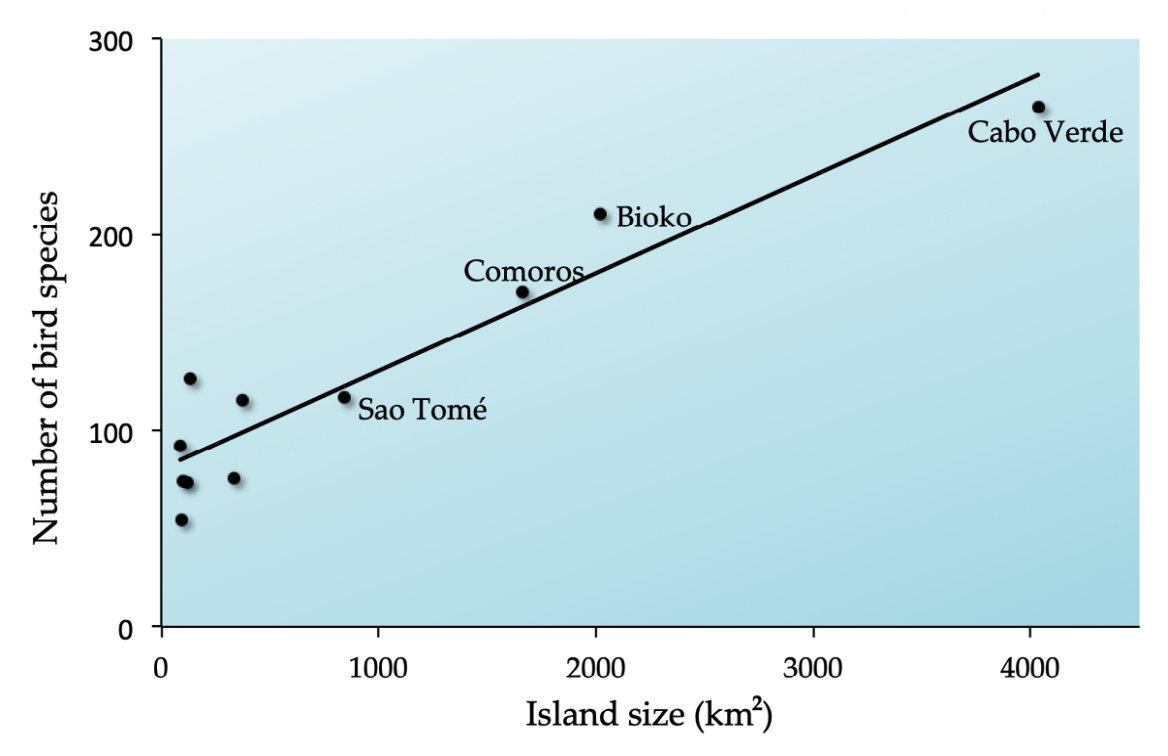
This figure shows a classic species–area relationship: as island area increases, the number of bird species increases. It visually reinforces why reducing habitat area typically lowers species richness and raises extinction risk, because smaller areas support smaller, more fragile populations. Source
Reducing total food, shelter, and nesting/breeding sites
Breaking continuous habitat into smaller pieces, increasing isolation
Altering abiotic conditions (light, temperature, wind, moisture) near boundaries
Increasing exposure to disturbance and human contact
Specialists are removed first
Specialist species: A species with a narrow niche, relying on specific habitat conditions or limited food sources.
As habitat quality declines, specialists tend to disappear first because:
They often require a particular microhabitat (e.g., specific soil moisture, canopy cover, host plant)
They are less able to switch food sources or nesting sites
They may have lower dispersal ability, so they cannot easily relocate
Typical early losses include species dependent on:
Old-growth structure (large hollow trees, multilayer canopy)
Specific mutualisms (host plants, pollinators)
Stable conditions (cool, moist interior forest)
Generalists persist longer, then decline
Generalist species: A species with a broad niche that can use a wide range of resources and habitats.
Generalists often remain after specialists are gone because they can:
Use varied foods and tolerate a wider range of conditions
Exploit human-modified environments (edges, fields, suburbs)
However, as habitat loss becomes severe, generalists also decline due to:
Insufficient total resources to support viable populations
Reduced breeding success and increased competition in the remaining patches
Why large-territory species drop out
Some species need large home ranges to find food, mates, or den sites (common in top predators and wide-ranging herbivores). Habitat loss reduces these species because:
Smaller habitat fragments cannot supply enough energy or prey
Individuals face higher mortality crossing roads or open areas
Populations become too small to remain stable, increasing local extinction risk
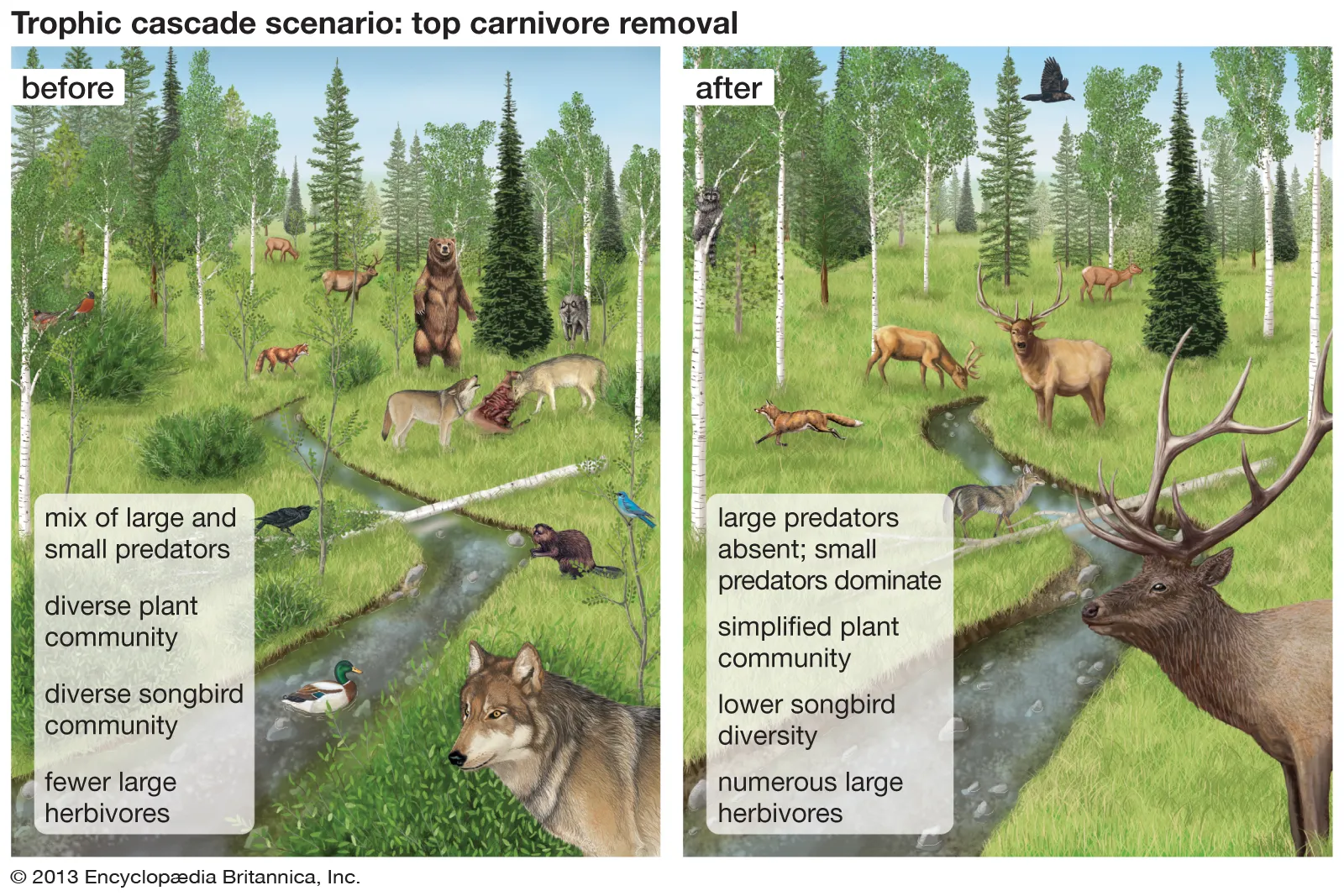
This schematic illustrates a trophic cascade initiated by removing top carnivores, showing how changes at the top of a food chain propagate downward through consumers to producers. It matches the ‘top predator loss → release effect → altered predation pressure’ pattern described for habitat loss and community reshaping. Source
Loss of top predators first
Increases in mid-level consumers (a “release” effect), altering predation pressure on smaller species
Simplified food webs with fewer trophic levels
Mechanisms that drive the pattern
Fragmentation, isolation, and edge conditions
Even if some habitat remains, it may be broken into patches.
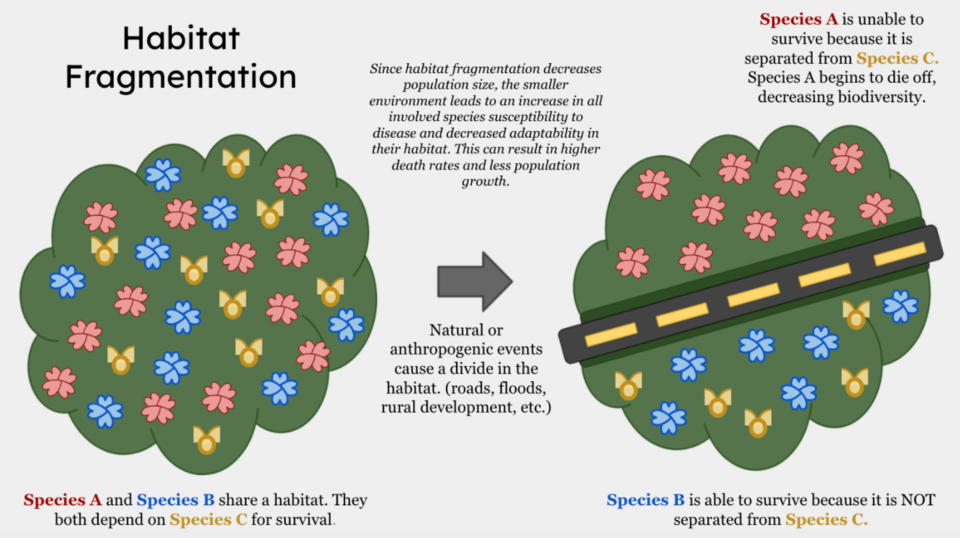
This diagram depicts habitat fragmentation as a transition from continuous habitat to separated patches within a human-modified matrix. It helps connect fragmentation to isolation, reduced movement between patches, and higher local extinction risk in smaller subpopulations. Source
Habitat fragmentation: The division of a continuous habitat into smaller, separated patches, often increasing isolation and boundary (“edge”) area.
Key community impacts include:
Smaller patches support fewer individuals, raising chance events and local extinctions
Isolation reduces recolonisation after local loss
More “edge” changes conditions (warmer, drier, windier), favouring disturbance-tolerant species
Changes in interactions
As composition shifts from specialists to generalists, interactions change:
Reduced pollination or seed dispersal if specialist partners vanish
Increased competition for general resources in crowded remnants
Greater vulnerability to opportunistic species (including human-associated species) that thrive in disturbed habitats
What “reshaped” communities look like
Common outcomes of habitat loss include:
Lower overall biodiversity as specialists disappear, then generalists
Communities dominated by a few adaptable species
Fewer large-territory species and fewer top predators
Altered species interactions, often reducing community stability and resilience within the remaining habitat
Practice Questions
Explain why specialist species are typically lost from an ecosystem before generalist species when habitat is reduced. (2 marks)
Specialists have narrow habitat/resource requirements, so reduced habitat quality/availability affects them first. (1)
Generalists can use a wider range of resources/conditions, so they persist longer. (1)
A forest is cleared into several small, isolated patches. Describe how this habitat loss can reshape the animal community, referring to (i) specialists, (ii) generalists, and (iii) species requiring large territories. (6 marks)
Specialists decline first due to reliance on specific microhabitats/foods/breeding sites. (1)
Loss of specialists reduces overall biodiversity and simplifies the community. (1)
Generalists initially persist by using varied resources and tolerating disturbed conditions. (1)
With continued loss, generalists also decline as total resources and space become insufficient. (1)
Large-territory species decline because patches cannot support required home ranges/food supply. (1)
Loss of large-territory species (often predators) alters community structure via changed predation/food-web simplification. (1)
FAQ
Specialists often start with smaller, more localised populations. When habitat shrinks, they can fall below a minimum viable population more quickly due to low breeding success and higher chance events.
Generalists that tolerate disturbance may concentrate near people. This can increase encounters (crop raiding, predation on pets/livestock) even while specialist wildlife disappears.
Connectivity depends on the “matrix” between patches. Features that help movement include hedgerows, riparian strips, and low-traffic crossings; barriers include wide roads, intensive monoculture, and fencing.
Long, thin patches have proportionally more edge and less interior habitat. Edge-tolerant generalists may do better, while interior-dependent specialists are more likely to be excluded.
Look for rising dominance by a few adaptable species, declining occupancy of niche-dependent taxa, and increasing observations near edges, roads, and disturbed areas compared with habitat interiors.

