

AP Syllabus focus:
‘Indicator species are organisms whose presence, abundance, scarcity, or chemistry reveals distinctive aspects of ecosystem quality.’
Indicator species provide an efficient way to infer ecosystem condition without measuring every variable directly. They are widely used in field surveys and long-term monitoring to detect change, diagnose stressors, and guide management actions.
What indicator species are (and what they indicate)
Indicator species: An organism whose presence, abundance, scarcity, or chemistry provides information about ecosystem quality and specific environmental conditions.
Indicator species act as biological “signals” because their survival and performance are tightly linked to particular habitat features (for example, dissolved oxygen, pH, temperature, or contaminant levels). In AP Environmental Science terms, they help translate complex ecological conditions into observable biological patterns.
The four “signals” you can measure
Presence: found only when suitable conditions exist (e.g., taxa that require cold, well-oxygenated water).
Abundance: population size changes along a stress gradient (more individuals where conditions are better).
Scarcity/absence: missing where they used to be, suggesting degraded habitat or new stressors.
Chemistry: pollutants or nutrients measured in tissues reflect environmental exposure over time.
Why indicator species are useful in environmental assessment
Practical advantages
Cost-effective: fewer lab tests may be needed if biota reliably track conditions.
Time-integrating: organisms reflect exposure over days to years, not just “snapshot” water or air readings.
Ecologically relevant: responses connect directly to living communities (growth, survival, reproduction).
Common monitoring uses
Detecting pollution (nutrients, heavy metals, pesticides)
Tracking habitat quality (sedimentation, canopy cover, stream flow changes)
Evaluating restoration success (return of sensitive taxa over time)
Identifying environmental stress before obvious ecosystem collapse occurs
Interpreting indicator species data correctly
Linking signals to environmental conditions
To use an indicator species well, you must justify the ecological link between the organism and the condition being inferred:
If a species is sensitive to low dissolved oxygen, declining abundance can imply increased organic pollution or stagnation.
If tissue chemistry shows elevated mercury, it suggests contamination and potential food-web risks.
Bioindicator: An organism used to assess environmental conditions by measuring its occurrence, condition, or chemical composition.
Bioindicators often overlap with indicator species, but the key AP emphasis is the specific signals: presence, abundance, scarcity, or chemistry revealing ecosystem quality.
Criteria for a strong indicator species
Known tolerance range to a stressor (sensitive or predictably tolerant)
Limited mobility (reflects local conditions rather than distant habitats)
Sufficiently common to sample reliably
Consistent response across seasons and sites (or responses that can be standardised)
Feasible sampling with minimal harm and clear identification
Examples of indicator species signals (conceptual)
Water quality
Many aquatic macroinvertebrates differ in tolerance to pollution and low oxygen.
Shifts from sensitive groups toward tolerant groups can indicate declining water quality.
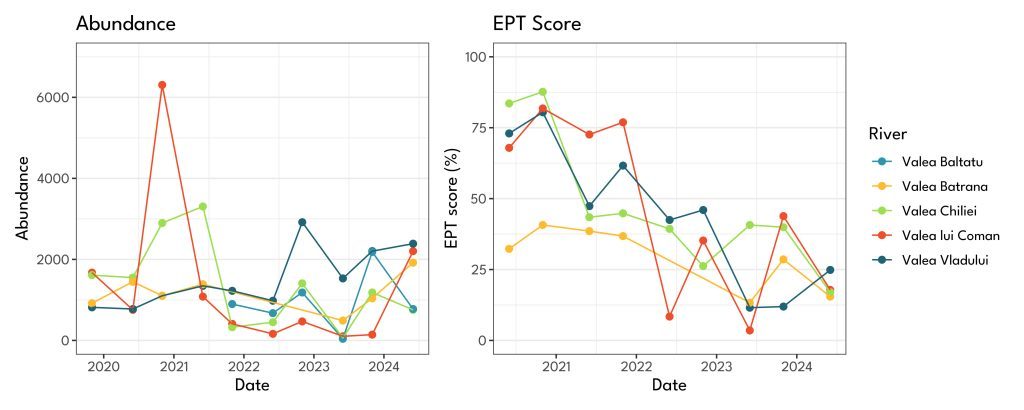
Line plots show how total macroinvertebrate abundance and the EPT score (percent of the community made up of pollution-sensitive mayflies, stoneflies, and caddisflies) change over time across multiple river sites. Because EPT taxa tend to decline under pollution or habitat degradation, a falling EPT score is a biological signal consistent with worsening water quality. This is a concrete example of using community composition as an indicator rather than measuring every abiotic variable directly. Source
Air quality
Some organisms respond strongly to airborne pollutants; changes in their presence or condition can signal chronic exposure.

The image shows epiphytic lichens growing on tree bark—organisms that obtain water and nutrients largely from the atmosphere rather than from soil. Because lichens can be sensitive to air pollutants (including nitrogen- and sulfur-containing compounds), changes in lichen presence and community condition are commonly used to infer air-quality trends. This illustrates how a biological response can serve as an indicator of chronic atmospheric exposure. Source
Contaminant exposure (chemistry)
Measuring contaminant concentrations in tissues can reveal bioavailable pollution, sometimes even when water concentrations are low or variable.
Limitations and sources of error
Indicator species do not provide perfect diagnoses. Sound interpretation requires controlling for confounding factors and using multiple lines of evidence.
Key limitations
Non-specificity: one change (e.g., decline) may have multiple causes (temperature shift, disease, habitat fragmentation).
Natural variability: seasonal cycles and weather can alter abundance without long-term degradation.
Scale mismatch: a highly mobile species may reflect regional conditions, not the sampled site.
Threshold effects: populations may appear stable until a tipping point is reached.
Best practices to reduce misinterpretation
Use reference sites (least-impacted comparisons).
Repeat sampling over time (trend detection).
Pair biological data with targeted abiotic measurements (to support causal claims).
Consider using indicator suites (multiple taxa) to strengthen inference.
Practice Questions
Define an indicator species and state one type of information it can reveal about ecosystem quality. (2 marks)
Defines indicator species as an organism whose presence/abundance/scarcity/chemistry reveals ecosystem quality (1)
States one appropriate type of information revealed (e.g., pollution level, oxygen conditions, habitat quality, contaminant exposure) (1)
A stream survey finds fewer pollution-sensitive macroinvertebrates than in previous years, while tolerant taxa have increased. Explain what this suggests about ecosystem quality and outline two reasons why the conclusion might be uncertain. (6 marks)
Interprets pattern as likely decline in water quality / increased stress consistent with pollution or lower dissolved oxygen (1)
Links decline of sensitive taxa to reduced suitability of conditions (1)
Links increase of tolerant taxa to advantage under degraded conditions (1)
Uncertainty reason 1 explained (e.g., seasonal variation, recent flood/drought, temperature differences, sampling effort/identification error) (1)
Uncertainty reason 2 explained (as above, different from reason 1) (1)
States a way to strengthen inference (e.g., repeat sampling, compare with reference site, measure DO/nutrients/temperature) (1)
FAQ
Sentinel species are chosen for early warning of hazards to humans or ecosystems, often near pollution sources. Indicator species are broader: they signal ecosystem quality via presence, abundance, scarcity, or chemistry.
Yes. eDNA can detect presence/absence of indicator taxa from water/soil samples. Interpretation still requires understanding detection limits and how DNA persistence varies with temperature and flow.
An IBI combines multiple biological metrics (often including indicator taxa) into a single score of ecosystem condition. It reduces reliance on one species by integrating community-level signals.
Choice depends on the pollutant and biology. For example: fat stores for persistent organic pollutants, muscle for some metals, or leaves/needles for airborne deposition—balancing detectability and ethics.
Local extinction can follow habitat alteration, altered flow regimes, invasive predators, disease, or loss of breeding sites. These can change presence/abundance without a direct change in measured pollutant levels.
