

AP Syllabus focus:
'The recovery of Greek and Roman texts shifted education away from theology toward classical learning and new methods of scientific inquiry.'
During the Italian Renaissance, recovered classical writings reshaped what educated Europeans read, how they studied, and what kinds of questions they considered worth asking about language, nature, and human life.
Recovery of Greek and Roman Texts
Renaissance scholars believed that many of the most valuable guides to language, ethics, politics, and nature were found in the writings of ancient Greece and Rome. Manuscripts that had been neglected, copied imperfectly, or kept in limited circulation were sought out in monastic libraries, urban collections, and courts.

Digitized Greek manuscript pages (Duke University Libraries) illustrate the kind of hand-copied codices Renaissance scholars hunted down in monastic and private collections. The visible script, layout, and material features underscore why copying errors and variant readings were common, motivating careful comparison and correction. Source
The recovery of Greek works mattered especially because many western Europeans had long relied more heavily on Latin materials than on Greek originals. When scholars gained better access to authors such as Plato, Homer, Euclid, Galen, and Ptolemy, the range of learning available to educated Europeans widened.
This recovery did not simply add new books to old shelves.
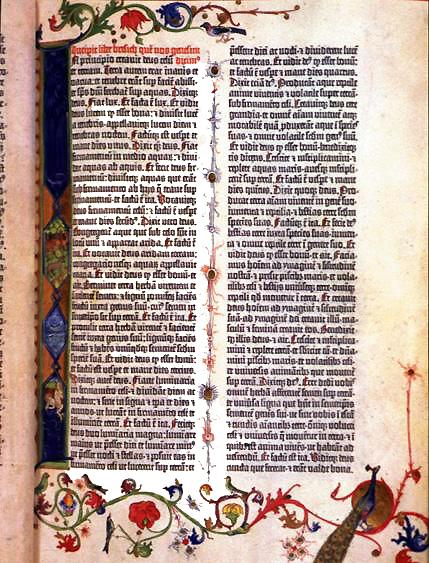
A page from the Gutenberg Bible (mid-15th century) shows early movable-type printing, whose uniform letterforms contrast with the variability of hand-copied manuscripts. In practice, printing helped multiply access to authoritative texts and supported wider educational reforms by making books more available and more consistent across copies. Source
It encouraged the belief that older sources should be read directly, carefully, and in their original languages whenever possible. That impulse helped reshape both schooling and scholarship.
Education and the Humanist Curriculum
The new educational ideal was often organized around the studia humanitatis.
Studia humanitatis: A course of study centered on grammar, rhetoric, poetry, history, and moral philosophy, based on classical texts.
This curriculum differed from an older emphasis on training students mainly for theological debate. Humanist teachers valued eloquence, moral reflection, and historical understanding. They wanted students to read classical authors as models of style and guides to public life, not just as authorities to quote.
Medieval universities had long been shaped by scholasticism.
Scholasticism: A method of learning that emphasized logic, disputation, and the reconciliation of Christian theology with authoritative texts.
Humanists did not abolish theology, and universities did not suddenly stop teaching it. However, classical learning gained prestige in schools, courts, and urban academies. Education increasingly aimed to form well-rounded, persuasive, and morally serious individuals. Grammar and rhetoric were crucial because mastery of language was seen as the basis of sound judgment and effective action.
From Theology to Classical Learning
The shift away from theology did not mean religion disappeared from education. Rather, theology no longer stood alone as the dominant model for intellectual life. Students were encouraged to study history, poetry, moral philosophy, and language as valuable in themselves. Classical texts seemed to teach civic responsibility, ethical conduct, and disciplined thought. In this sense, education became more secular, meaning more concerned with human affairs in this world rather than only salvation and doctrine.
Humanist educators also placed great importance on imitation. Students copied the prose styles of classical authors, memorized speeches, and learned to argue persuasively. Such training served practical purposes: it prepared officials, diplomats, secretaries, and civic leaders for public roles. Education therefore became more closely tied to social and political usefulness.
Methods of Reading and Critical Inquiry
The recovery of classical texts changed not only what students read but also how they read. Renaissance scholars compared different manuscript versions, studied grammar closely, and looked for errors made by copyists. They paid attention to historical context and authorship. This critical approach weakened blind dependence on later commentators and encouraged confidence in the scholar's own judgment.
One important result was the growth of philology, the close study of language in order to establish accurate texts and meanings. When scholars asked whether a text was authentic, whether a word had been mistranslated, or whether a passage fit its historical setting, they were practicing a more exact method of inquiry. In that sense, the recovery of classical literature promoted habits of evidence, precision, and skepticism toward inherited authority.
Toward New Scientific Inquiry
Classical recovery also mattered for the study of nature. Greek and Roman works in mathematics, medicine, astronomy, and natural philosophy gave scholars a broader intellectual foundation. Texts by Euclid, Galen, and Ptolemy provided models of systematic reasoning and organized bodies of knowledge. Yet their influence was not simply conservative. Once scholars had access to these works, they could compare ancient claims with direct observation.
This was a crucial change. Learning about nature no longer depended only on repeating accepted opinions. Scholars increasingly combined respect for ancient authorities with the examination of the natural world. Careful description, measurement, and comparison became more important. The classical past therefore helped inspire new methods of inquiry, even when later thinkers revised or rejected ancient conclusions.
Continuity and Limits
The educational transformation of the Renaissance was significant but gradual. Theology remained central in many universities, and access to classical education was still largely limited to male elites. Much of Europe changed slowly, and older medieval forms of learning persisted alongside humanist innovations.
Even so, the recovery of Greek and Roman texts altered the balance of European intellectual life. Education placed greater value on classical languages, historical understanding, persuasive writing, and disciplined reading. At the same time, the habit of returning to original sources encouraged scholars to question received interpretations and to investigate the world with new seriousness.
Practice Questions
Identify one way the recovery of classical texts changed education in Renaissance Italy, and explain how it differed from earlier theological study. (2 marks)
1 mark for identifying a change such as increased emphasis on grammar, rhetoric, history, poetry, moral philosophy, or direct study of Greek and Roman authors.
1 mark for explaining that this differed from earlier education centered mainly on theology or scholastic disputation.
Evaluate the extent to which the recovery of Greek and Roman texts changed methods of inquiry during the Renaissance. (5 marks)
1 mark for a clear argument that the recovery of classical texts significantly changed inquiry, while acknowledging limits or continuity.
1 mark for explaining that scholars increasingly read original texts rather than relying only on later authorities.
1 mark for explaining how philological methods, such as comparing manuscripts or studying language closely, encouraged critical reading.
1 mark for explaining that classical works in mathematics, medicine, astronomy, or natural philosophy supported more systematic investigation of nature.
1 mark for noting a limitation or continuity, such as the continued importance of theology, universities, or older medieval methods.
FAQ
Many educated western Europeans could read Latin but not Greek. That meant they often knew ancient thought through translations, summaries, or commentaries rather than through the original wording.
Once scholars learnt Greek, they could study authors such as Plato more accurately. This improved precision, exposed translation errors, and gave humanists a stronger sense that language itself mattered to meaning.
The Ottoman capture of Constantinople in 1453 encouraged some Greek-speaking scholars to move westward, especially into Italian cities. They brought manuscripts, linguistic knowledge, and teaching skills with them.
This did not begin Renaissance learning by itself, but it did strengthen it. Their presence made Greek study easier and helped expand access to texts that had been rarer in western Europe.
Cicero offered more than political ideas. For humanist teachers, he represented elegant Latin style, persuasive speech, and a model of educated public life.
Because of that, pupils often copied Ciceronian prose, memorised passages, and used his works to improve composition. His popularity shows that Renaissance education valued expression and civic usefulness as well as knowledge.
A small number of elite women did receive humanist instruction, especially in courtly or highly educated families. They might study Latin, literature, and moral philosophy.
However, access remained limited. Most schools and universities were designed for men, so female participation depended heavily on family wealth, private tutors, and unusual local opportunities.
Yes. Reverence for writers such as Galen or Ptolemy could make scholars reluctant to challenge inherited ideas, even when observations suggested problems.
At the same time, serious engagement with those texts trained scholars to argue carefully and systematically. Ancient authority could therefore be both a barrier and a stepping stone to later scientific developments.

.JPG)