AP Syllabus focus:
'Admiration for classical political institutions encouraged civic humanism and secular models of individual and political behavior.'
In the Italian Renaissance, admiration for ancient republics reshaped ideas about citizenship, virtue, and political action, especially in city-states where educated elites linked learning to public service.
Political Setting of the Italian City-States
Italian city-states such as Florence and Venice had political systems that made public life unusually important.
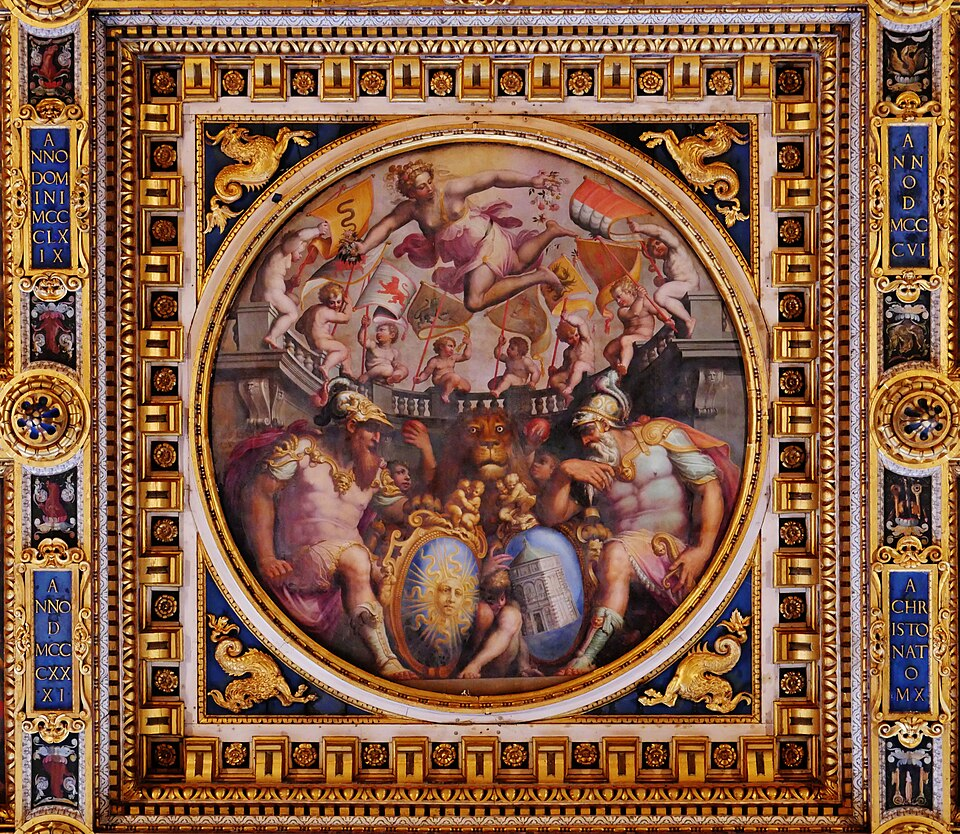
Ceiling view of the Salone dei Cinquecento (Hall of the Five Hundred) in Florence’s Palazzo Vecchio, the monumental council chamber built for large-scale civic assemblies. The lavish decoration and sheer size underscore how political deliberation in a republic could be staged as a public, honor-laden activity—an environment well suited to civic humanist ideals of educated service to the state. Source
In these urban republics, leading citizens debated laws, taxes, diplomacy, and war.
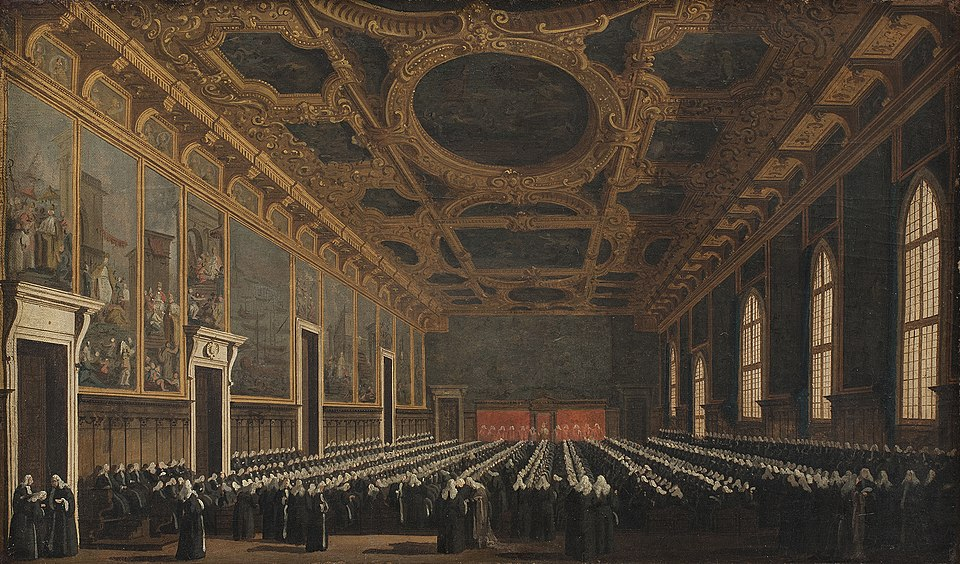
Canaletto’s interior scene depicts the Doge and the Great Council meeting in the Sala del Maggior Consiglio (Doge’s Palace), visualizing Venice’s aristocratic republican governance. The ordered seating and ceremonial focal point of the Doge highlight how political authority was exercised through councils, ritual, and collective deliberation rather than a single hereditary monarch. Source
Because government depended on active participation by officeholders and councils, humanists increasingly connected learning to service in the state.
Civic humanism emerged most clearly in this environment, where political involvement was seen as honorable rather than distracting from moral life.
Civic humanism: A Renaissance political outlook that joined classical learning to active public service, arguing that educated citizens should participate in government and defend the common good.
Unlike older ideals that often valued withdrawal from worldly affairs, civic humanism praised engagement in civic affairs. It taught that the best citizens should use historical knowledge, moral judgment, and eloquence to strengthen their city. Florentine chancellors such as Coluccio Salutati and Leonardo Bruni helped express this idea by linking humanist learning with republican government.
Why classical models mattered
Humanists did not admire antiquity only for its literature. They also admired the political institutions of the Roman Republic, which seemed to offer lessons about liberty, citizenship, and public duty. Ancient Rome appeared to show how free citizens could govern themselves, resist tyranny, and place the welfare of the community above private ambition.
Classical authors gave civic humanists practical political examples:
Cicero provided the model of the educated statesman-orator
Livy offered historical lessons about republican courage and patriotism
Roman councils, magistracies, and public debate became examples of organized civic life
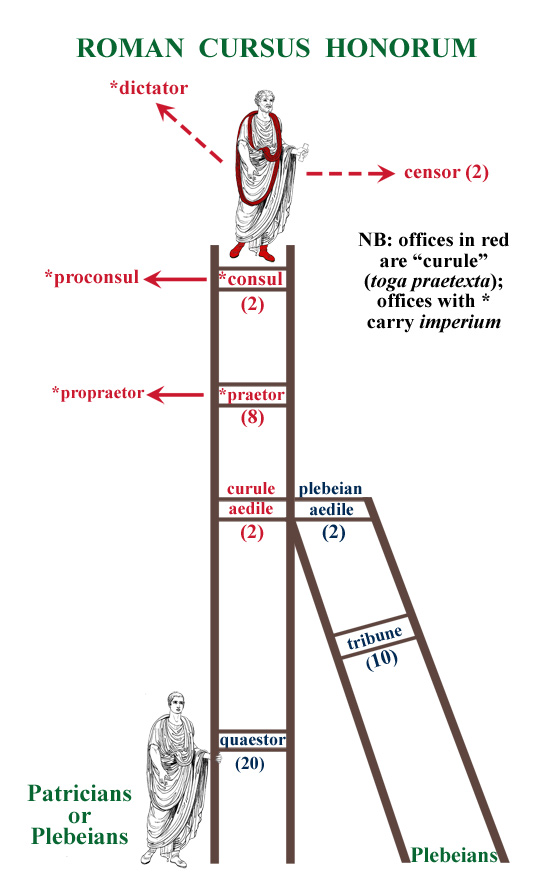
Diagram of the Roman Republic’s cursus honorum (“course of offices”), a stepwise sequence of magistracies that structured elite political participation. Civic humanists treated arrangements like this as practical evidence that liberty and public duty could be sustained through offices, term limits, and regularized civic advancement. Source
Classical Models of Citizenship
For civic humanists, ancient political institutions were valuable because they provided standards for present-day behavior. A well-governed city required citizens who were willing to hold office, deliberate in councils, and defend the republic when necessary. Public life became a measure of character.
This admiration strengthened the ideal of the active life over the contemplative life. A worthy individual was not simply pious or learned in a private sense. He was expected to contribute to the city through service, leadership, and responsible action. Humanists therefore tied personal excellence to civic virtue, meaning discipline, public responsibility, and commitment to the community’s freedom.
Leonardo Bruni famously praised Florence as a republic whose liberty resembled that of ancient Rome. In this kind of argument, liberty survived only when citizens participated in politics instead of surrendering power to princes or tyrants. Civic humanism thus helped justify republican forms of government and encouraged elites to see political participation as a moral duty.
Several values stood at the center of this outlook:
educated citizenship
devotion to the common good
defense of liberty
willingness to serve the republic
suspicion of corruption and tyranny
Secular Models of Individual and Political Behavior
The syllabus also emphasizes that civic humanism encouraged secular models of behavior. In this context, secular did not mean hostility to Christianity. Instead, it meant that human conduct in politics could be judged by worldly standards such as prudence, effectiveness, honor, and service to the state.
This was a major shift. Medieval political thought often tied public authority closely to religious ideals. Civic humanists, by contrast, gave greater importance to human choice and to the practical demands of governing. Citizens and rulers could be evaluated through history, ethics, and political experience, not only through theology.
The citizen in public life
A civic humanist ideal citizen was expected to display:
prudence in decision-making
eloquence in persuasion and debate
discipline in public service
glory earned through useful action
honor attached to defending the republic
These values created a more worldly model of behavior. Political leadership was measured by success in preserving the city, maintaining order, and protecting liberty. Reputation came from visible achievement in civic life rather than from withdrawal from it.
This way of thinking encouraged a more realistic understanding of politics. Public affairs involved conflict, ambition, and changing circumstances, so leaders had to act with judgment and flexibility. Civic humanism therefore helped legitimize political behavior based on practical outcomes and civic necessity.
Tensions and Limits in Practice
Although civic humanism celebrated participation, it did not create broad democracy. In most Italian city-states, real political power remained concentrated in the hands of male elites. Merchants, professionals, and patrician families often claimed to represent the whole community, even though women, laborers, and the poor usually had little direct political influence.
Still, the language of civic humanism mattered deeply. It gave urban elites a vocabulary of liberty, patriotism, and public duty. It also challenged political models based only on hereditary privilege or feudal obligation. By placing classical citizenship at the center of public life, civic humanism reshaped expectations of how an individual should behave within the state.
Competition among Italian republics sharpened these ideas further. Humanist speeches and histories presented republics as communities of active citizens and portrayed political success as the result of civic unity, moral discipline, and effective leadership. In this way, admiration for classical political institutions directly influenced both political ideals and everyday assumptions about honorable public behavior.
Practice Questions
Briefly explain two ways admiration for classical political institutions influenced civic humanism in the Italian city-states. (2 marks)
1 mark for explaining that classical Rome inspired ideals of active citizenship and public service.
1 mark for explaining that classical models promoted republican liberty, civic virtue, anti-tyranny ideas, or the educated statesman-orator.
Award full marks for any two distinct, historically accurate points.
Answer all parts.
a) Identify one classical writer or political model admired by civic humanists in the Italian city-states. (2 marks)
b) Explain one way civic humanism encouraged a secular model of individual behavior. (2 marks)
c) Explain one limitation of civic humanism in practice within the Italian city-states. (2 marks)
(6 marks)
Part a:
1 mark for correctly identifying a valid example such as Cicero, Livy, or the Roman Republic.
1 mark for linking that example to civic humanist ideals such as citizenship, rhetoric, liberty, or public duty.
Part b:
1 mark for stating that civic humanism judged individuals by worldly standards such as prudence, service, honor, or effectiveness in politics.
1 mark for explaining how this shifted attention away from purely religious models of behavior.
Part c:
1 mark for identifying a valid limitation such as elite male dominance or the exclusion of women and lower social groups.
1 mark for explaining how political participation remained restricted despite civic humanist language about the common good.
FAQ
Florence had a strong republican tradition and intense political competition among elite families, guild interests, and officeholders. That setting made arguments about citizenship, liberty, and public service especially useful.
Florentine writers could present their city as a living heir to ancient republican Rome. Because political participation mattered so much in Florence, humanist learning was more easily turned into a civic and political programme.
The chancery was the office that produced official letters, speeches, and diplomatic correspondence. In republics like Florence, chancellors were often highly educated humanists.
This mattered because civic humanist ideas were not confined to private scholarship. They entered government language directly through:
state letters
public orations
historical writing used to defend republican identity
Women were largely excluded from formal political participation, so they did not occupy the central role imagined by civic humanist writers. The ideal citizen was usually assumed to be male.
However, some elite women engaged with humanist culture through reading, patronage, family networks, and letter writing. Their influence was indirect rather than institutional, which shows the gap between civic humanist ideals and actual political inclusion.
Civic humanists often wrote history to teach political lessons. Historical works were meant to show how virtues such as courage, discipline, and loyalty could strengthen a republic.
This made history a practical subject. Instead of simply recording events, writers used the past to:
praise liberty
condemn corruption
warn against tyranny
shape the political values of educated readers
Not entirely. Both admired classical models and valued service to the state, but they operated within different political cultures.
Florentine civic humanism often stressed active debate and republican liberty in a more openly competitive setting. Venetian political thought tended to emphasise stability, order, and the harmony of a mixed constitution. So the same classical language could support somewhat different civic ideals.