AP Syllabus focus:
'European states sought direct access to gold, spices, and luxury goods to increase wealth and strengthen state power.'
In the fifteenth and sixteenth centuries, European rulers and merchants pursued oceanic routes to bypass intermediaries, secure valuable commodities, and turn overseas trade into greater wealth, influence, and political strength.
Why Direct Access Mattered
The Problem of Intermediaries
By the late fifteenth century, European demand for eastern goods was already strong, but most of that trade moved through long and expensive commercial chains.
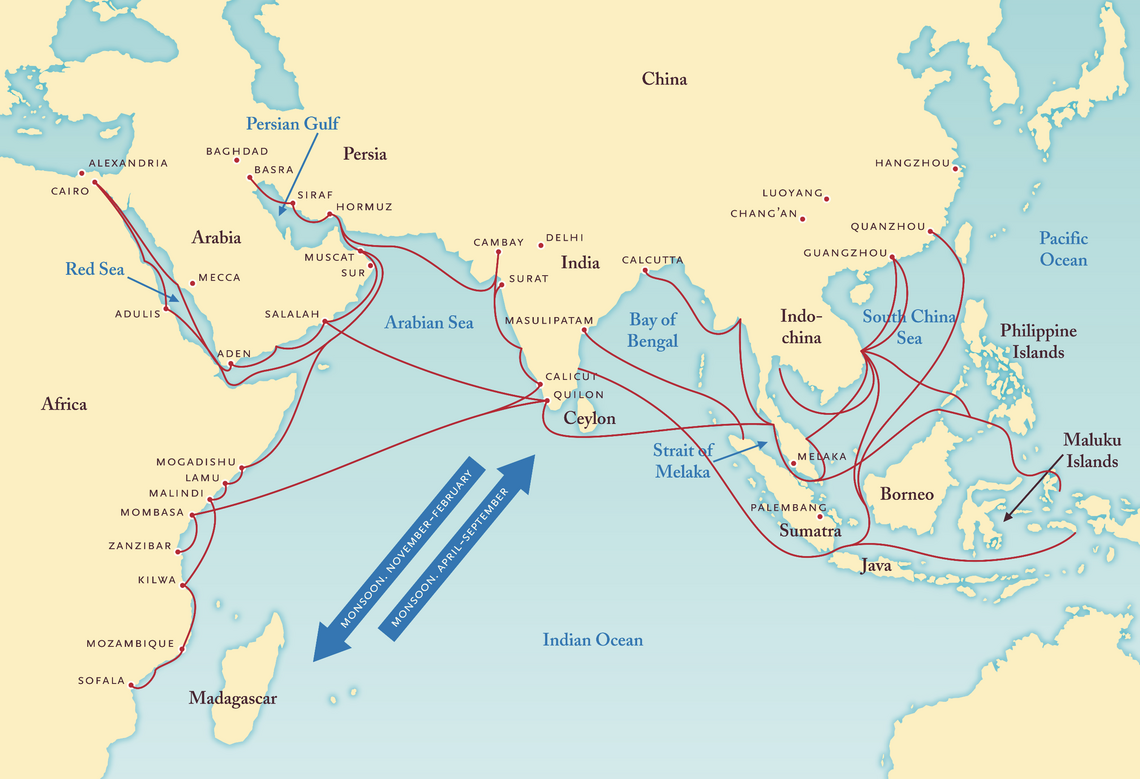
This map depicts major Indian Ocean trade routes linking East Africa, the Red Sea/Persian Gulf, India, and Southeast Asia. It highlights the port-to-port network that moved high-value goods (including spices and textiles) through multiple commercial hubs—exactly the intermediary system Atlantic monarchies hoped to bypass. The monsoon-wind arrows underscore how seasonal winds structured shipping schedules and shaped the profitability of maritime trade. Source
Asian producers, Muslim merchants, and Mediterranean middlemen all took profits before goods reached western Europe. As a result, pepper, cinnamon, silk, and other prized imports became very costly.
European states therefore wanted direct access to the sources of wealth rather than dependence on existing routes. If rulers could reach Africa and Asia by sea, they could buy goods more cheaply, sell them at higher prices in Europe, and keep more of the profits within their own kingdoms. This was not simply curiosity about the wider world. It was a deliberate effort to shift the balance of wealth away from established commercial powers and toward rising Atlantic monarchies.
Direct access also had a strategic meaning. A state that controlled the route to valuable goods could weaken rivals, enrich its ports, and increase the authority of the crown.
Gold and Monetary Power
Bullion, Coinage, and Purchasing Power
For early modern governments, gold mattered because political power depended heavily on ready cash. Rulers needed precious metals to mint coins, pay soldiers, reward officials, support diplomacy, and sustain court life. A monarchy with better access to gold had a stronger financial base than one that lacked it.
Bullion: Gold or silver in bulk form, valued as a source of monetary wealth.
The search for bullion helped drive Europeans toward Africa, where they hoped to gain access to existing gold networks without relying on trans-Saharan trade. Portuguese activity along the West African coast was shaped in part by this aim. Gold was also useful because it could be exchanged for Asian goods. Europeans often lacked products that merchants in Asia wanted in large quantities, so bullion became a crucial medium for long-distance trade.
The desire for gold reflected a wider political assumption: wealth strengthened sovereignty. More bullion gave rulers greater fiscal flexibility, improved credit, and increased their ability to wage war or defend their territories.
Spices and High-Value Commerce
Why Spices Were So Profitable
Spices were among the most attractive goods in world trade because they were scarce in Europe, widely desired, and extremely valuable relative to their weight. Pepper, cloves, nutmeg, and cinnamon could yield large profits after transport to European markets.
Spices were sought for several uses:
seasoning food and drink
making medicines and perfumes
supporting religious and household practices
displaying refined taste and elite status
Because spices combined high demand with high resale value, European states saw them as an economic prize. A direct sea route to Asian markets promised to reduce reliance on older eastern Mediterranean channels and allow monarchies to redirect commercial wealth into their own ports and treasuries. Portuguese voyages around Africa were strongly shaped by the hope of entering the Indian Ocean spice trade directly.
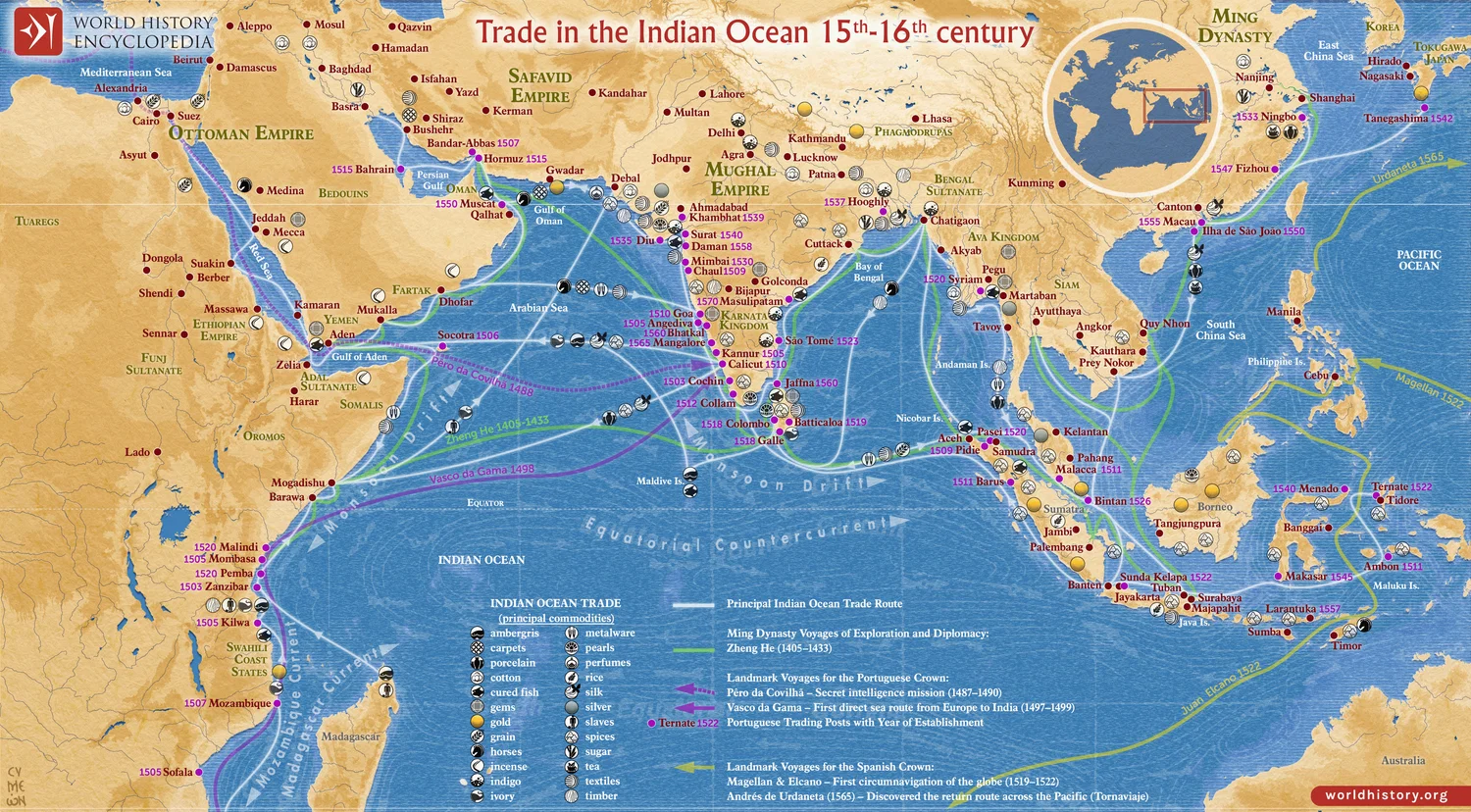
This map presents the Indian Ocean trading system in the fifteenth and sixteenth centuries and overlays European (especially Portuguese) voyages onto older Afro-Eurasian maritime routes. By showing where ships sailed, where goods concentrated (ports and choke points), and how routes connected across regions, it clarifies why controlling sea lanes could translate into customs revenue, monopolies, and geopolitical leverage. The result is a concrete geographic picture of how “direct access” was pursued as a tool of state power rather than mere exploration. Source
Control over spice imports could also improve a state's standing in Europe. A monarchy that dominated profitable trade routes gained customs revenue, attracted merchants, and increased its leverage over competitors.
Luxury Goods and Elite Demand
Consumption, Status, and Political Culture
The search for overseas wealth extended beyond spices. Europeans also wanted luxury goods such as fine textiles, gems, dyes, and other rare commodities associated with wealth and refinement.
Luxury goods: Expensive, nonessential products valued for rarity, quality, and social prestige.
Demand for such goods was closely tied to courts, nobles, and wealthy urban consumers. Imported objects helped rulers display magnificence, while merchants and aristocrats used them to imitate princely lifestyles. This meant that overseas trade had political as well as commercial value. Successful access to luxury goods could enhance royal prestige and increase state income through duties and regulated trade.
Luxury consumption was therefore not trivial. In a competitive political culture, visible access to rare commodities could reinforce hierarchy, advertise power, and demonstrate a ruler's connection to global commerce.
From Commercial Ambition to State Power
Trade as a Tool of Monarchy
The pursuit of gold, spices, and luxury goods encouraged rulers to support costly and risky expeditions because the potential rewards were immense. Monarchs were interested not only in private profit, but also in the ways trade could serve the state.
European state power could be strengthened through:
customs duties on imported goods
greater access to bullion for coinage and military spending
profitable monopolies and trading privileges
stronger ports and maritime connections
the weakening of rival commercial powers
Portugal offers a clear example. Its crown sponsored exploration not merely to discover new lands, but to enter African and Asian trade on more favorable terms. Spain’s support for Columbus likewise reflected the hope of reaching the riches of Asia by a western route. In both cases, exploration was shaped by the expectation that commercial success would translate into revenue, military capacity, prestige, and geopolitical influence.
Practice Questions
Identify one reason European states wanted direct access to spices in the fifteenth century, and explain how that reason could strengthen a state. (2 marks)
1 mark for identifying a valid reason, such as bypassing intermediaries, lowering purchase costs, increasing profit, or gaining control of supply.
1 mark for explaining how this could strengthen a state, such as by increasing customs revenue, enriching the treasury, or giving rulers more resources for war and government.
Explain how the search for gold, spices, and luxury goods contributed to the growth of European state power in the fifteenth and sixteenth centuries. (6 marks)
1 mark for a clear thesis that links valuable overseas goods to stronger state power.
1 mark for explaining the context of expensive existing trade networks and the desire to bypass middlemen.
1 mark for specific evidence about gold, such as bullion for coinage, paying armies, or access to African gold.
1 mark for specific evidence about spices or luxury goods, such as their high value, customs duties, or prestige.
1 mark for explaining how economic gains translated into political or military strength.
1 mark for a more developed explanation, such as showing that rulers sought not only profit but also an advantage over rival states.
FAQ
Not chiefly. That older explanation is now treated with caution by historians.
Spices were more often valued for flavour, medicine, perfume, and social display. Because they were expensive, using them could signal status as much as practical need.
Value depended on rarity, distance, and how tightly supply was controlled.
Cloves and nutmeg, for example, came from very limited production zones, which made them easier to monopolise and more profitable than common bulk goods. Their high value relative to weight also made them ideal for long voyages.
African gold was useful in its own right, but it also helped Europeans buy goods in Asian markets.
Many Asian merchants had limited interest in European products. Gold therefore acted as a widely accepted medium of exchange, linking African commerce directly to the search for eastern spices and luxury goods.
They were central to appearance, rank, and ceremony.
Rich fabrics and costly colours could communicate status immediately. In courts and elite households, imported silks or expensive dyes were not simply decorative; they helped express authority, wealth, and refinement in a highly visual political culture.
Not necessarily. Lower purchasing costs did not always mean lower selling prices.
Rulers and merchants often preferred to keep prices high through duties, controlled supply, or monopoly privileges. Direct access could increase profit margins even if ordinary consumers saw little benefit.