

AP Syllabus focus:
'Mercantilism gave states a larger role in promoting trade, economic development, and overseas colonies.'
In the early modern period, governments increasingly treated economic life as a matter of state power. Mercantilism tied commerce, manufacturing, and colonial growth to the strength of rulers and their states.
What Mercantilism Meant
Mercantilism treated the economy as something to be directed for political advantage. Instead of leaving trade entirely to private merchants, rulers tried to shape commerce so that the state would gain wealth, strategic resources, and greater independence from rivals.
Mercantilism: An economic system in which governments actively regulated trade, encouraged exports, restricted imports, and used colonies to strengthen state wealth and power.
Mercantilist thinking assumed that international economic competition was intense and that states had to secure resources before their rivals did. Wealth was commonly associated with bullion, especially gold and silver, but mercantilism was broader than simply collecting precious metals. It also emphasized building manufacturing, protecting domestic industries, and controlling trade routes.
This idea gave rulers a clear justification for greater intervention. Economic policy became closely linked to diplomacy, war, taxation, and imperial administration. In this system, a strong state did not simply defend territory; it also directed economic activity to increase national power.
Why States Embraced Mercantilism
Trade as a source of power
Mercantilist rulers believed that a favorable balance of trade would enrich the state. If a country exported more than it imported, money and resources would flow inward rather than outward. For that reason, governments often encouraged finished goods exports while limiting imported manufactured products that might weaken local producers.
States pursued mercantilist goals because trade could support:
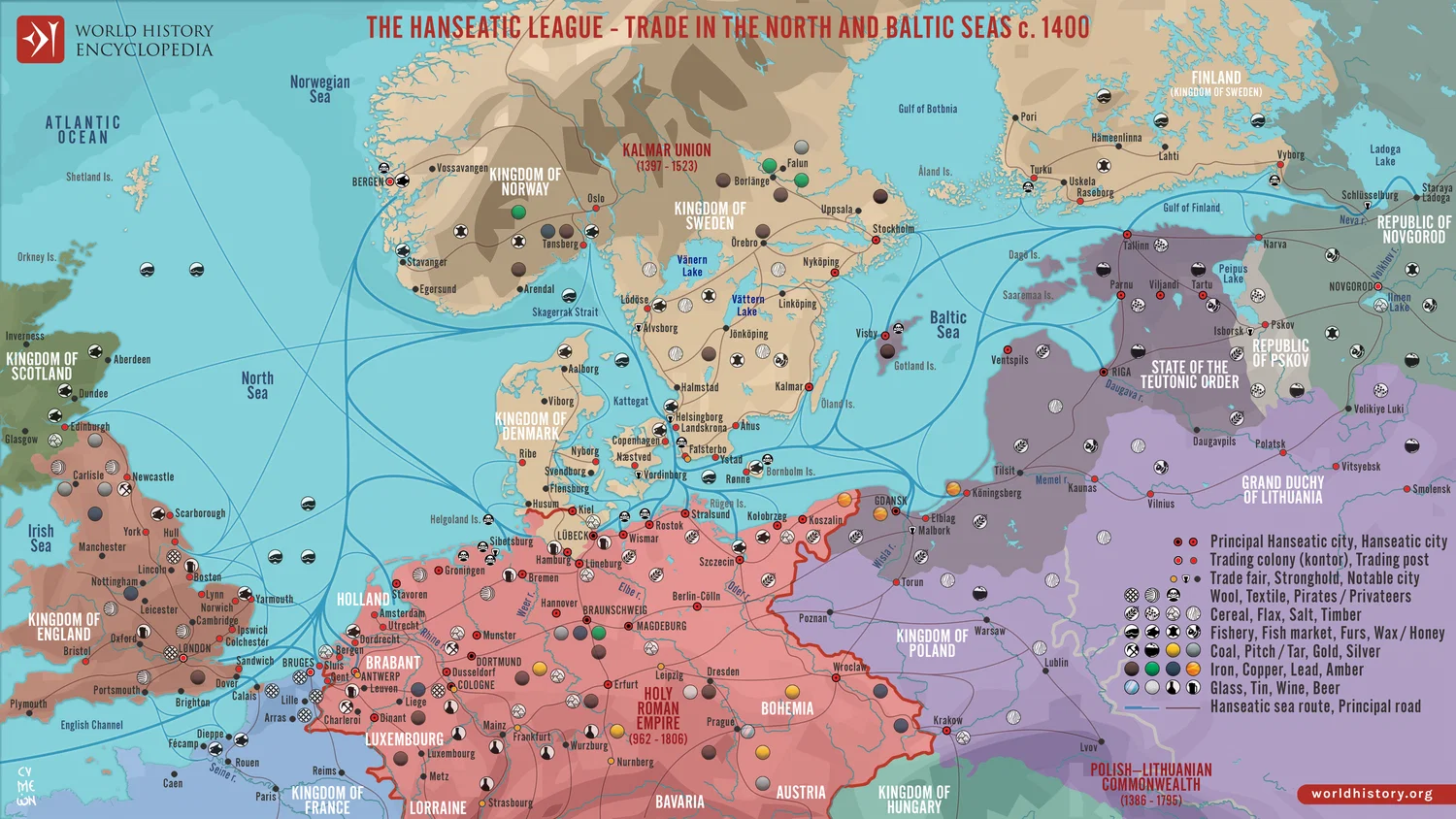
Map of the Hanseatic League’s trade network (c. 1400), highlighting key commercial cities, sea routes, and staple commodities. It provides a concrete geographic model of how European wealth and power could be built through organized long-distance trade and control of key ports. Source
Tax revenue for monarchies and governments
Military strength, especially navies
Urban growth in ports and commercial centers
Employment in shipping and manufacturing
Political independence from foreign suppliers
Economic development was therefore not seen as separate from politics. A larger merchant fleet, a stronger textile industry, or a better-supplied navy all contributed to the wider authority of the state.
Government intervention in the economy
Mercantilism increased the direct role of government through a wide range of policies. States might impose tariffs on imports, grant monopolies, regulate colonial trade, subsidize industries, or support shipbuilding. These were not random measures; they were part of a larger effort to make commerce serve national interests.
Common mercantilist policies included:
High duties on foreign goods
State support for strategic industries
Rules favoring national ships and merchants
Exclusive colonial trading systems
Regulation of imports and exports
Such policies reflected the idea that private profit should align with state goals. Merchants could become wealthy, but their activity was expected to strengthen the kingdom, republic, or empire.
State-Sponsored Expansion Overseas
Mercantilism strongly encouraged state-sponsored expansion. Overseas colonies were valuable because they could supply raw materials, purchase European manufactured goods, and serve as protected markets within an imperial system. Colonies were not simply settlements; under mercantilist logic, they were economic assets tied to the strength of the state.
Governments often relied on partnerships with merchants to carry out expansion.
Chartered company: A private trading company granted special privileges by the state, often including monopoly rights, commercial protection, or authority in overseas territories.
These companies allowed governments to expand overseas without paying all costs directly. By granting monopolies or legal privileges, states encouraged merchants to invest in risky long-distance ventures while still keeping expansion tied to national interests. Private capital and public authority therefore worked together.
Main features of state-sponsored expansion
Mercantilist overseas expansion usually involved several connected features:
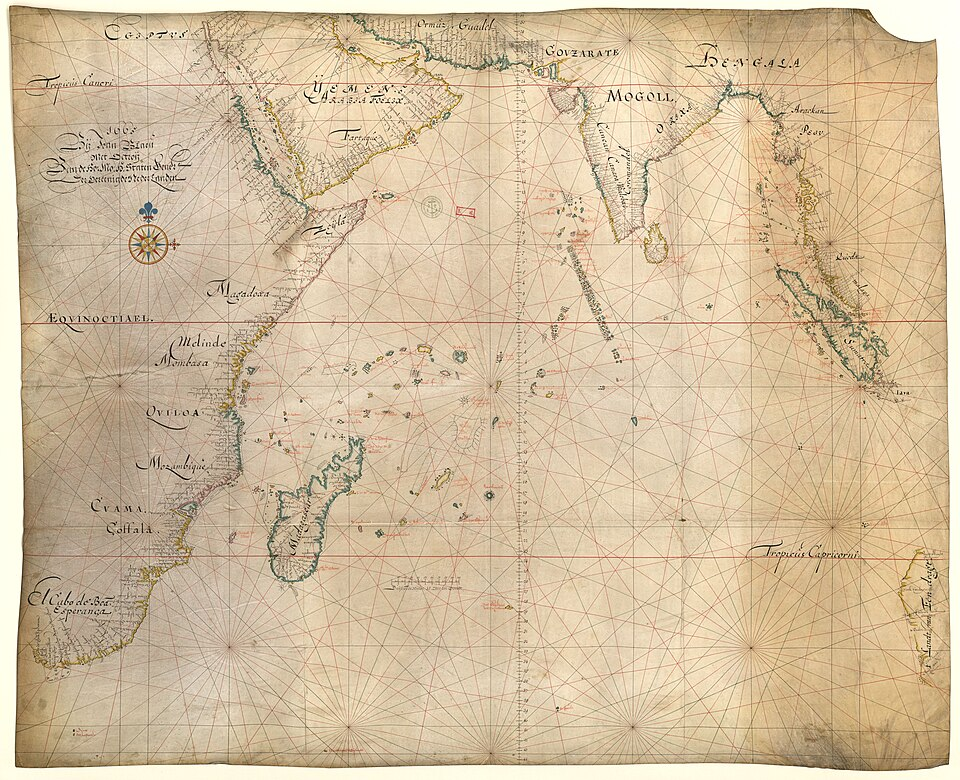
A 1665 Indian Ocean chart by Joan Blaeu showing the maritime geography European powers navigated to connect ports, secure sea lanes, and project force overseas. As a navigational-style map, it reinforces why mercantilist empires treated oceanic routes as strategic infrastructure—protected by navies and regulated through imperial administration. Source
Monopoly trading rights for approved merchants or companies
Naval protection for commercial routes
Colonial regulation to keep trade within the empire
Administrative oversight through royal or state officials
Military backing when commercial interests needed defense
This system enlarged state power in practical ways. Governments supervised customs collection, determined which goods could move where, and tried to ensure that colonies benefited the mother country rather than foreign competitors. Overseas trade became a matter of public policy, not merely private exchange.
Economic Development Under Mercantilism
Mercantilism was not only about overseas trade. It also promoted domestic economic development. Rulers wanted stronger industries at home so they would rely less on imports and gain more from exports. Governments therefore supported workshops, manufactures, and infrastructure connected to trade.
Industries considered especially important included:
Textiles
Shipbuilding
Metallurgy
Weapons production
Colonial processing trades
Ports, arsenals, and dockyards often expanded under these policies. In this sense, mercantilism linked internal development and imperial growth. Colonies provided raw materials, European producers turned those materials into goods, and protected trade networks carried profits through state-regulated channels.
Tensions and Limits
Mercantilism expanded government power, but it was difficult to enforce perfectly. Merchants often tried to evade restrictions, and smuggling became common when regulations limited profitable trade. Colonists might also resist policies that favored the mother country over local interests.
Mercantilist systems could strengthen states, but they also created tensions:
They encouraged rivalry with other powers
They required expensive enforcement
They often benefited some groups more than others
They could provoke resistance inside colonies and trading communities
Even with these limits, mercantilism marked an important shift in European history. States increasingly claimed the right to manage trade, direct economic growth, and organize overseas expansion as essential parts of political power.
Practice Questions
Identify two ways mercantilist governments increased state control over trade. (2 marks)
1 mark for identifying one valid method, such as tariffs, monopoly grants, colonial trade regulation, naval protection, or customs enforcement.
1 mark for identifying a second valid method.
Explain how mercantilism linked economic development in Europe to overseas expansion in the early modern period. (5 marks)
1 mark for a clear claim that mercantilism connected state power to both domestic growth and colonial expansion.
1 mark for explaining that governments promoted domestic industries or manufacturing.
1 mark for explaining that colonies supplied raw materials or served as protected markets.
1 mark for explaining that states used policies such as monopolies, tariffs, or chartered companies to control this system.
1 mark for showing how these policies aimed to increase wealth, revenue, or political power for the state.
FAQ
Customs officials turned mercantilist policy into daily practice. They inspected cargoes, collected duties, checked licences, and tried to stop illegal trade.
Without them, tariffs and monopoly rules would have existed mostly on paper. Their work also gave governments better information about trade flows, which helped rulers decide where to tighten regulation or offer support.
Shipbuilding had both economic and strategic value.
It employed labour in ports and dockyards.
It supported timber, rope, sailcloth, and iron industries.
It strengthened the merchant marine.
It provided vessels and skills that could support naval warfare.
A larger shipping sector meant a state could carry more of its own trade rather than paying foreign carriers.
Yes. Mercantilist policy was not limited to acquiring bullion directly.
A state could still pursue mercantilist goals by:
increasing exports,
encouraging manufacturing,
taxing trade,
building a commercial fleet,
and controlling colonial markets.
In practice, many governments treated productive industry and regulated commerce as just as important as precious metals.
Mercantilist rules often made legal trade slower, narrower, or more expensive than merchants wanted. If colonial producers could get better prices from foreign buyers, illegal trade became attractive.
Smuggling also flourished because coastlines were long, enforcement was costly, and local officials were not always reliable. In some regions, informal trade networks were so established that they became part of everyday economic life.
Chartered companies were private bodies, but they often exercised powers that looked governmental. Depending on their charter, they might negotiate, fortify settlements, administer justice, or maintain armed forces.
This blurred line mattered because it allowed states to project power cheaply. Instead of ruling every overseas possession directly, governments could delegate authority while still expecting commercial and political loyalty.

.jpg)