AP Syllabus focus:
'Christianity motivated exploration as rulers and religious authorities aimed to spread the faith and justify conquest.'
Religion gave early European exploration a powerful language of purpose. Christian rulers, sailors, and churchmen often described overseas expansion as a mission to convert peoples, defend Christendom, and legitimize domination.
Christianity as a Motive for Exploration
In the fifteenth and sixteenth centuries, many Europeans understood the world through a deeply Christian framework. Political authority and religious duty were closely linked, so expansion could be presented as both a royal project and a sacred obligation. Exploration was not seen simply as travel; it could be described as the extension of a Christian order into lands ruled by non-Christians.
Christendom and sacred mission
European rulers inherited the idea of Christendom, a community of Christian peoples whose rulers were expected to defend and enlarge the faith. This outlook encouraged the belief that contact with non-Christian societies created a responsibility to preach Christianity and bring new populations under Christian rule.
Evangelization: The effort to spread Christianity by preaching, conversion, religious instruction, and the establishment of churches or missions.
Because of this mindset, voyages could be framed as spiritually meaningful enterprises. Royal support for exploration often drew strength from the belief that expanding political influence and spreading the gospel were compatible goals.
Influence of crusading traditions
Religious motives were also shaped by older traditions of conflict with non-Christians. Iberian kingdoms in particular carried memories of the Reconquista, which reinforced the idea that Christian rulers had a duty to fight unbelief and advance the faith. Overseas expansion therefore borrowed the language of crusade, even when the setting was now the Atlantic or Indian Ocean rather than the Mediterranean.
Rulers and Religious Authorities
Royal sponsorship and Christian legitimacy
Monarchs used Christianity to present exploration as righteous governance. A ruler who sponsored voyages could claim to be serving God by supporting missionaries, establishing churches, and bringing non-Christians into the Christian faith. This made expansion easier to defend at home, because conquest could be portrayed as more than ambition or violence; it could be cast as moral duty.
In Catholic Europe, religious unity also strengthened monarchy. If a king or queen could extend both political rule and Christian worship overseas, that success enhanced the ruler's prestige as a defender of the faith. Exploration therefore helped connect dynastic ambition to religious purpose.
The role of church authorities
Religious authorities helped validate these claims.
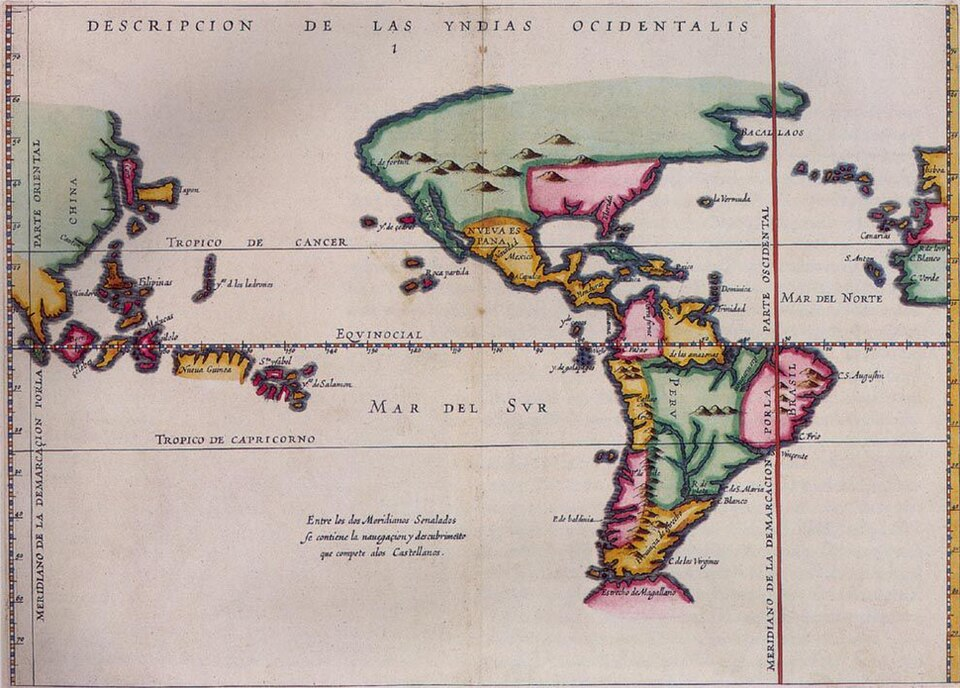
This historical map depicts the meridian (line of demarcation) associated with the Treaty of Tordesillas, which divided newly claimed overseas territories between Spain and Portugal. It visually reinforces how European expansion was framed as legally and spiritually legitimate through alignment with Christian authority and papal endorsement. Source
Church leaders could bless expansion, recognize Christian claims in newly encountered regions, and encourage missionary work. This approval mattered because it gave conquest a language of legitimacy. When rulers said they were bringing baptism, teaching, and churches to foreign peoples, they presented domination as a form of spiritual improvement rather than mere seizure.
Clergy also traveled with explorers and settlers. Priests, friars, and other missionaries were expected to teach Christian doctrine, administer sacraments, and reorganize daily life around Christian worship. Their presence showed that exploration was tied not only to trade or empire but also to active religious transformation.
Conversion and Encounters Overseas
Converting indigenous peoples
A major Christian goal of exploration was the conversion of peoples encountered overseas. Europeans frequently assumed that Christianity possessed universal truth and that rulers had the right, even the duty, to spread it. Conversion was therefore central to how expansion was explained and defended.
This did not mean that Europeans always understood the beliefs or social structures of the people they encountered. Instead, they often judged unfamiliar religions by Christian standards and treated difference as proof of spiritual error. That attitude encouraged paternalism: non-Christians were often portrayed as people needing guidance, discipline, and instruction.
Missions, churches, and cultural change
Religious expansion involved more than formal baptism. Missionaries aimed to reshape marriage practices, moral rules, education, and patterns of worship.
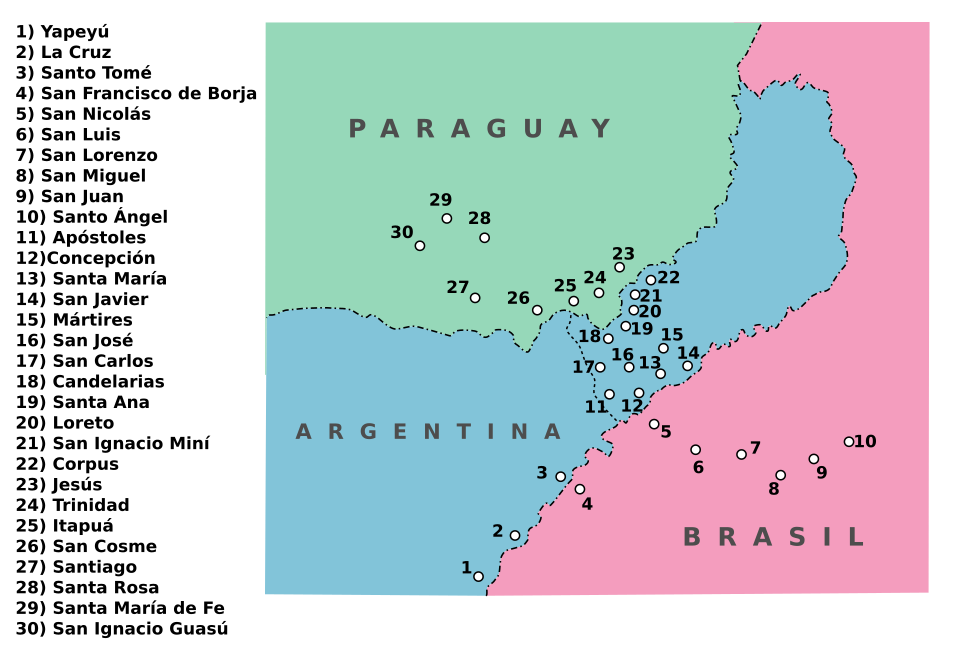
This map locates the Jesuit reducciones (mission settlements) associated with Guaraní communities, shown against modern national borders in southern South America. It helps illustrate that evangelization was not only preaching but also the construction of new, church-centered communities that reshaped daily life and social organization. Source
Establishing Christianity often meant trying to transform entire communities. In practice, this could produce pressure to abandon existing beliefs and social customs.
Because of this broader goal, Christianity became closely linked to imperial authority. A converted population was often expected to accept new institutions, new leaders, and new forms of obedience. Spiritual conversion and political control could therefore reinforce one another.
Christianity as a Justification for Conquest
Moral language and imperial power
Christianity did not only inspire exploration; it also helped justify conquest after contact had been made.
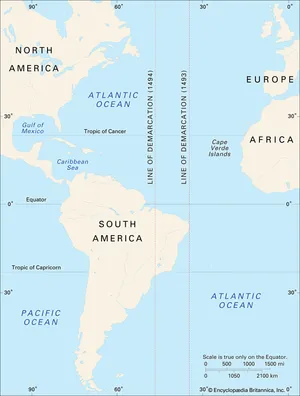
This map summarizes the Treaty of Tordesillas’ dividing line and the resulting Spanish and Portuguese spheres of influence in the Atlantic world. It provides a quick visual link between religiously framed legitimacy (papal involvement) and the practical geopolitical division that underpinned later conquest and colonial rule. Source
European rulers and religious supporters could argue that taking control of territory was acceptable if it opened the way for conversion, ended idolatry, or placed lands under Christian government. Religious language gave conquest a moral cover.
This was especially important when violence occurred. If conquest could be described as serving a higher spiritual purpose, it appeared less like aggression in European eyes. The claim of spreading the faith could transform domination into a supposedly benevolent act.
Contradictions and tensions
Some church figures criticized abuses and insisted that conversion should be sincere rather than forced. Yet rulers continued to use Christian language to defend empire, and missionaries often worked within expanding structures of overseas rule. Faith functioned as a public argument for domination over non-Christian peoples.
Practice Questions
Answer all parts briefly.
a) Identify one reason Christianity encouraged European exploration in the fifteenth or sixteenth century.
b) Identify one role played by religious authorities in overseas expansion.
c) Explain one way Christianity could be used to justify conquest.
(3 marks)
1 mark for identifying a Christian motive such as conversion, evangelization, or spreading the faith.
1 mark for identifying a role of religious authorities such as blessing expansion, supporting missions, or legitimizing rulers’ claims.
1 mark for explaining that conquest could be defended as morally acceptable because it was said to bring Christianity, suppress non-Christian worship, or place peoples under Christian rule.
Evaluate how far Christianity shaped both the goals and the justification of European exploration in the fifteenth and sixteenth centuries. (6 marks)
1 mark for a defensible thesis that Christianity significantly shaped exploration by promoting conversion and legitimizing overseas rule.
1 mark for explaining Christianity as a goal of expansion, such as converting non-Christians or extending Christendom.
1 mark for explaining how rulers presented exploration as a sacred duty or as evidence of godly kingship.
1 mark for explaining how religious authorities supported or legitimized overseas claims.
1 mark for explaining how Christianity justified conquest by portraying domination as spiritually beneficial or morally necessary.
1 mark for showing nuance or complexity, such as the tension between sincere conversion and coercion, or the coexistence of religious ideals and imperial violence.
FAQ
The Requerimiento was a statement used by Spanish officials in the early sixteenth century. It announced the authority of the Spanish Crown and the Christian faith, then demanded submission from Indigenous peoples.
It was controversial because it was often read in Spanish or Latin to people who could not understand it. In practice, it turned refusal into a supposed legal excuse for war, enslavement, or seizure of land. Many critics saw it as a deeply flawed Christian justification for conquest.
Prester John was a legendary Christian ruler whom many Europeans believed lived somewhere in Africa or Asia. The story mattered because Europeans hoped to find a powerful Christian ally beyond the Islamic world.
This hope blended religion and exploration. If such a ruler existed, he might help defend Christianity, support missionary work, or strengthen Christian power abroad. Even though Prester John was mythical, belief in him shows how strongly religious imagination shaped exploratory goals.
Different Catholic orders approached mission work in different ways.
Franciscans often emphasised poverty, preaching, and mass conversion.
Dominicans were more likely to stress teaching and the defence of Indigenous rights in moral debates.
Jesuits later became known for disciplined education, language study, and attempts to adapt Christianity to local cultures.
These differences affected how conversion was carried out, how Indigenous beliefs were judged, and how closely missionaries worked with colonial authorities.
These were arrangements that gave the Spanish and Portuguese crowns major influence over church affairs in overseas territories. In return for funding churches and missions, monarchs gained the right to nominate clergy and organise religious institutions.
This mattered because it tied Christian expansion directly to royal power. Conversion was not simply a church matter; it became part of imperial administration. The systems made it easier for Iberian rulers to claim that empire-building and Christianisation were part of the same duty.
The Valladolid debate of 1550–1551 asked whether Spain’s treatment of Indigenous peoples could be justified under Christian principles. Bartolomé de las Casas argued that Indigenous peoples were fully human and should be converted peacefully, while Juan Ginés de Sepúlveda defended conquest under certain conditions.
The debate mattered because it showed that Christianity did not produce one single view of empire. Some Christians used the faith to defend domination, while others used the same faith to condemn coercion and violence.