AP Syllabus focus:
'Spanish colonies in the Americas, Caribbean, and Pacific made Spain a dominant European power in the sixteenth century.'
In the sixteenth century, Spain built a vast overseas empire whose territories, labor systems, and mineral wealth gave the monarchy exceptional military, political, and global influence.
Building Spanish Overseas Power
Caribbean bases and early expansion
Spain’s overseas dominance began with its establishment of colonies in the Caribbean after Columbus’s voyages. Islands such as Hispaniola and Cuba became bases for settlement, administration, and further expeditions. These early colonies gave Spain a permanent presence across the Atlantic and helped the crown turn exploration into empire.
From the Caribbean, Spanish forces moved onto the American mainland. The conquest of the Aztec Empire by Hernán Cortés in the 1520s and the conquest of the Inca Empire by Francisco Pizarro in the 1530s brought Spain control over densely populated and wealthy regions. These victories were not simply the result of superior weapons. Spanish conquerors also benefited from:
alliances with indigenous groups hostile to Aztec or Inca rule
the shock effect of horses, steel weapons, and firearms
the spread of epidemic disease, which weakened native societies
The result was a rapid expansion of Spanish authority across large parts of the Americas, far beyond the original Caribbean footholds.
A monarchy with global reach
Spanish control did not stop in the Atlantic world. By the later sixteenth century, Spain also established a presence in the Pacific, most notably through the Philippines. This made Spain more than an Atlantic empire; it became a monarchy with a truly global reach. The empire stretched from Europe to the Caribbean, through the American mainland, and across the Pacific Ocean.
Governing the Empire
Royal authority and colonial administration
The Spanish crown tried to make overseas expansion serve royal power, not just private adventurers. It therefore created institutions to govern conquered lands, collect revenue, and limit local independence. Spain’s empire was not only large; it was also increasingly organized.
The crown divided its major American possessions into viceroyalties.
Viceroyalty: A large colonial territory ruled by a viceroy who governed in the monarch’s name.
The two most important sixteenth-century viceroyalties were New Spain and Peru. Through viceroys, judges, governors, and church officials, the monarchy attempted to extend its authority across great distances. This administrative structure helped Spain hold together a vast empire and convert conquest into durable political control.
Extraction of labor and tribute
Spanish rule depended heavily on the extraction of tribute, labor, and resources from indigenous populations. Colonial authorities and settlers imposed systems that required native communities to provide work and payments. This strengthened Spanish control and made the colonies economically valuable to the crown.
Spanish dominance therefore rested not only on conquest, but also on the ability to reorganize colonial societies around imperial needs. The colonies became sources of manpower, agricultural goods, and especially mineral wealth.
Wealth and the Basis of Spanish Dominance
Silver and imperial strength
The greatest source of Spanish overseas power was silver. Mines such as Potosí in the Andes and Zacatecas in New Spain produced immense quantities of bullion. This wealth transformed Spain’s position in Europe.
American silver helped the Spanish monarchy:
finance armies and military campaigns
support royal government and administration
pay for diplomacy and defense
project power under rulers such as Charles V and Philip II
Because of this colonial wealth, Spain became the leading European power for much of the sixteenth century. Its empire supplied resources on a scale unmatched by other states. Colonial possessions in the Americas were therefore central to Spain’s military and political dominance.
Trade and imperial connections
Spain also benefited from imperial trade networks linking the Caribbean, the American mainland, and the Pacific. Colonial ports connected treasure fleets to European markets, while Pacific routes linked Spanish America to Asia.
This widened Spain’s influence beyond Europe and made its empire part of an emerging global economy.
The Pacific dimension mattered because it connected Spanish America to Asian commerce.
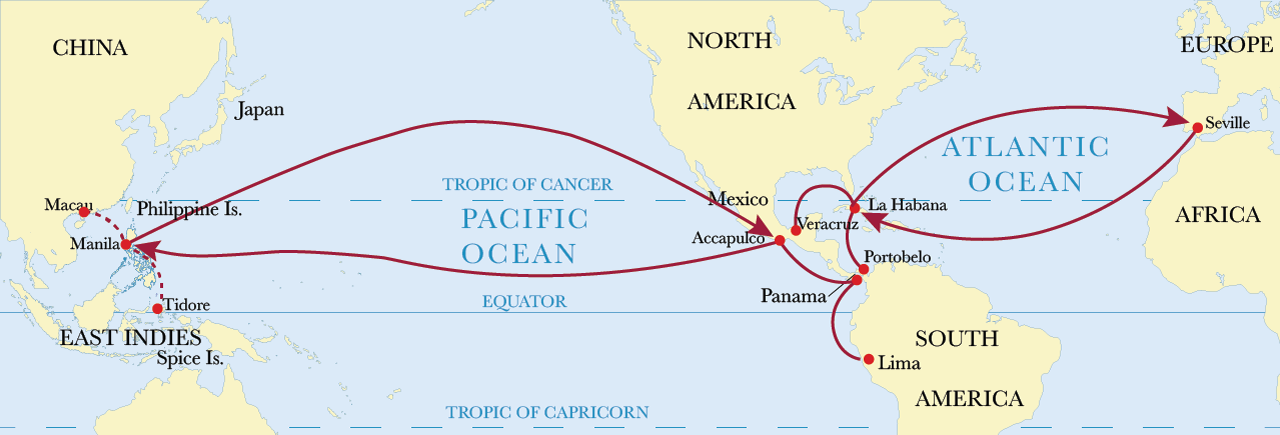
This route map shows the Manila galleon system linking the Philippines to New Spain across the Pacific and then connecting onward to Spain via Atlantic routes. It illustrates how American silver and Asian luxury goods moved through an integrated imperial network, helping explain why Spain’s empire functioned as a genuinely global system. Source
The Philippines served as a strategic outpost that extended Spain’s prestige and commercial possibilities. Spain’s power was therefore based not only on territorial possession, but on control of major oceanic routes.
Why Spain Was Dominant in the Sixteenth Century
Political and military importance
Spain’s overseas empire gave it advantages that no other European monarchy possessed on the same scale during the sixteenth century. The combination of:
extensive colonies
access to precious metals
strong royal administration
Atlantic and Pacific connections
made Spain the most formidable European state of the period. Colonial wealth increased the prestige of the monarchy and supported wider Spanish ambitions in Europe.
This dominance was especially significant because overseas empire and European power reinforced one another. Victories and resources abroad strengthened Spain at home, while royal authority in Europe helped sustain imperial expansion overseas.
Limits within success
Spanish dominance was powerful, but it also had weaknesses. Governing far-flung colonies was difficult, and dependence on American silver created financial distortions and heavy expectations. Even so, in the sixteenth century the sheer scale of Spain’s colonies in the Americas, Caribbean, and Pacific made it the dominant European power and gave the Spanish monarchy a uniquely global position.
Practice Questions
Identify one way Spanish colonies increased Spain’s power in Europe during the sixteenth century. (2 marks)
1 mark for identifying a valid way, such as access to silver, colonial trade, territorial expansion, or strategic oceanic bases.
1 mark for explaining how that factor strengthened Spain, such as financing armies, increasing royal prestige, or expanding Spanish influence.
Explain how Spain’s colonies in the Americas, Caribbean, and Pacific made Spain the dominant European power in the sixteenth century. (6 marks)
1–2 marks for explaining the importance of conquest and territorial control in the Caribbean and mainland Americas.
1–2 marks for explaining the role of silver or other colonial resources in strengthening the Spanish monarchy.
1–2 marks for explaining how colonial administration, trade routes, or Pacific possessions expanded Spain’s political and global power.
To reach the top marks, the response must clearly connect colonial expansion to Spain’s dominance in Europe during the sixteenth century.
FAQ
Seville became the main legal gateway for trade with Spain’s American colonies.
It housed the Casa de Contratación, which supervised shipping, licensing, navigation, and colonial commerce. This helped the crown monitor wealth flowing from the empire and tighten royal control over overseas activity.
Its position also made it a centre for merchants, officials, mapmakers, and financiers involved in imperial business.
The Casa de Contratación was a royal institution established to regulate Spain’s overseas trade and navigation.
Its functions included:
registering ships and cargoes
licensing emigrants and merchants
collecting information from voyages
training pilots and supervising maps
It was important because it turned empire into something the crown could administer, rather than leaving overseas activity entirely in private hands.
The Philippines mattered because they gave Spain a foothold in the Pacific and access to Asian trade.
Through Manila, Spanish America could exchange silver for high-value Asian goods such as silk and porcelain. This linked American mining wealth to wider commercial networks.
The islands also had strategic and religious value, since they extended Spanish influence and offered a base for missionary activity in Asia.
The crown feared that successful conquerors might become too powerful in the colonies.
To reduce that risk, it:
appointed viceroys and royal judges
expanded bureaucracy
sent royal officials to collect revenue
asserted direct monarchical authority over land and officeholding
This helped transform loosely controlled conquests into a more centralised imperial system.
The Valladolid debate of 1550–1551 concerned whether Spain’s treatment of Indigenous peoples was morally and legally justified.
Bartolomé de las Casas argued that native peoples had rights and should not be brutalised, while Juan Ginés de Sepúlveda defended conquest on different grounds.
The debate did not end imperial rule, but it showed that Spanish expansion raised serious questions about justice, conversion, and the legitimacy of domination.