AP Syllabus focus:
'Competition for trade intensified rivalries and contributed to conflicts among European powers in the seventeenth and eighteenth centuries.'
Trade became a major source of power in early modern Europe. As overseas commerce expanded, states fought not only for land and dynastic advantage, but also for markets, shipping routes, colonial wealth, and commercial dominance.
Why Trade Competition Became So Important
In the seventeenth and eighteenth centuries, European rulers increasingly viewed commerce as a foundation of military and political strength. Overseas trade brought customs revenue, access to valuable goods, and opportunities to expand national influence. Because wealth and power were closely linked, competition over trade often became competition over the future balance of power in Europe itself.
This rivalry was especially intense among the leading maritime states, including the Dutch Republic, England/Britain, and France.
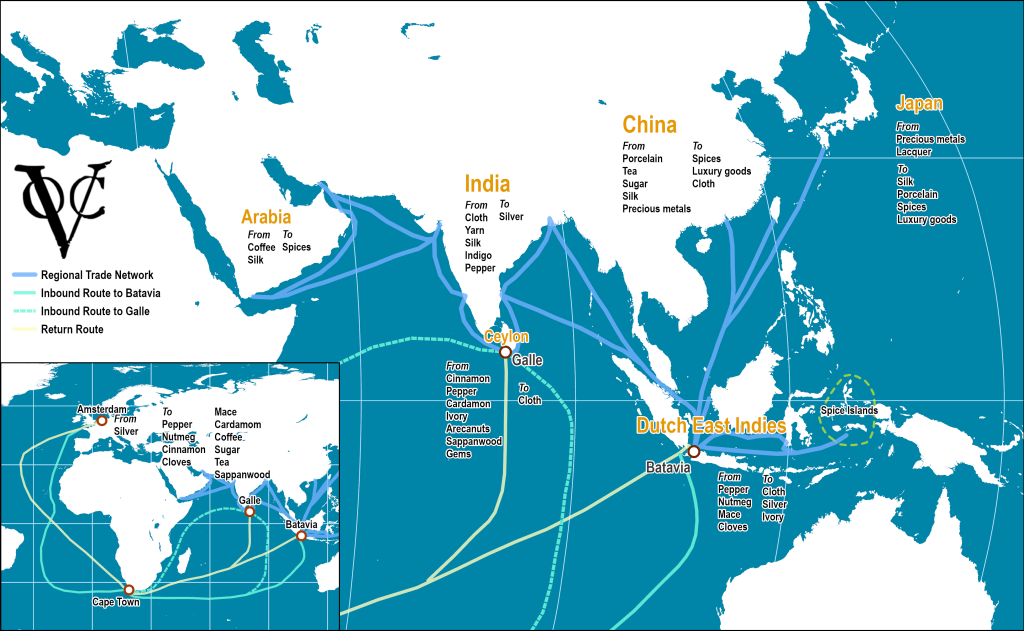
This map visualizes the Dutch East India Company (VOC) trading network, highlighting how European commercial power depended on a system of fortified hubs, regional feeder routes, and long-distance ocean passages. By labeling major ports (e.g., Batavia, Galle, Cape Town) and commodity exchanges, it illustrates how control of routes and chokepoints translated into economic leverage and geopolitical influence. Source
These states sought to control:
profitable shipping routes
access to colonial markets
re-export trade within Europe
strategic ports and naval bases
monopolies over valuable goods
Trade mattered because it helped states pay for fleets, armies, and administration. As a result, economic rivalry was rarely separate from politics. Commercial success strengthened governments, while commercial weakness could make a state more vulnerable in war.
Mercantilism: An economic theory and practice in which governments sought to increase national wealth and power by regulating trade, encouraging exports, limiting imports, and controlling colonial commerce.
Under mercantilist ideas, trade was often treated as a limited resource. If one state gained access to a market or shipping lane, another might lose out. This encouraged a zero-sum view of international competition and made compromise more difficult.
Trade and the Interests of the State
Governments did not leave overseas trade entirely to private merchants. Instead, states intervened heavily through:
tariffs
navigation laws
monopolies
chartered companies
naval protection
This close connection between trade and government policy meant that commercial disputes could quickly become diplomatic or military crises. A challenge to a nation’s merchants could be interpreted as a challenge to the nation itself.
Commercial rivalry also encouraged the growth of the fiscal-military state, a state that developed stronger systems of taxation, borrowing, and naval administration in order to support warfare. In this way, trade competition not only caused conflict but also changed how European states organized power.
Why Trade Rivalry Led to Conflict
Trade rivalry contributed to conflict because European governments aimed to exclude rivals from profitable commerce. States tried to reserve colonial markets for themselves, restrict foreign shipping, and break competitors’ monopolies. These efforts often produced retaliation.
One major source of tension was control of the seas. Merchant shipping depended on naval protection, and naval strength depended on revenue from trade. This created a cycle in which trade financed war, and war was used to protect or enlarge trade.
Commercial rivalry also overlapped with political alliances and dynastic struggles. Trade competition did not cause every war by itself, but it intensified existing rivalries and raised the stakes of conflict. Wars that may have begun over succession or territorial issues often expanded because states hoped to gain commercial advantages from victory.
Major Patterns of Conflict
The Anglo-Dutch Wars of the seventeenth century provide a clear example of trade competition turning into military conflict. England and the Dutch Republic were both major commercial powers. Their rivalry over shipping, colonial trade, and maritime supremacy led to repeated naval wars.
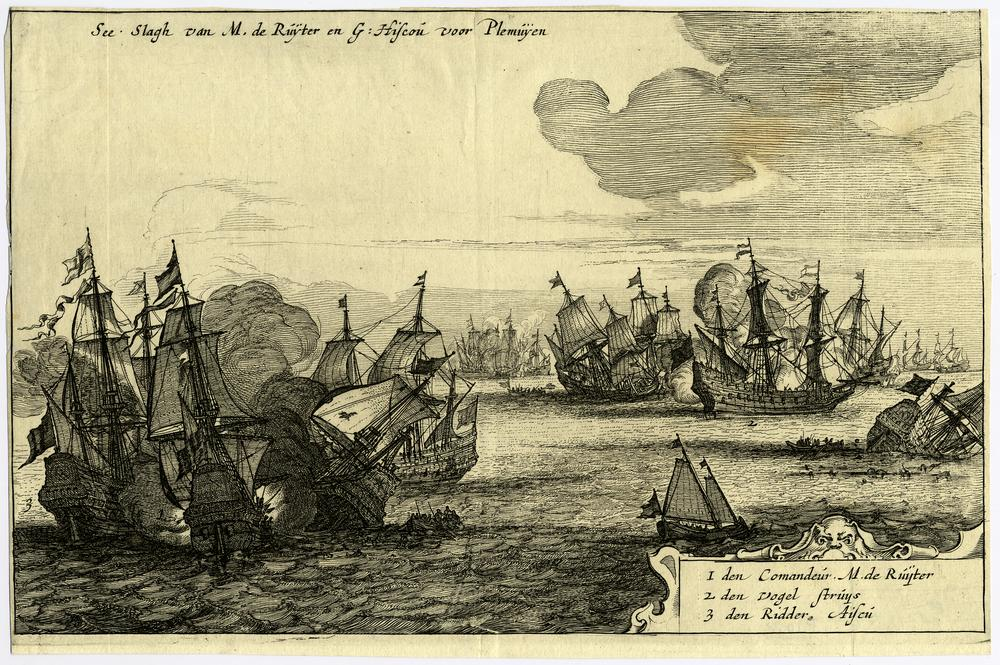
This etching depicts a naval engagement associated with the First Anglo-Dutch War, emphasizing how rival commercial powers fought for control of sea lanes and merchant protection. As a contemporary-style visual source, it reinforces the connection between maritime trade competition and the growth of large, state-supported fleets. Source
Later, Britain and France became the principal commercial and imperial rivals of the eighteenth century. Their conflicts were not only European wars; they were also struggles over overseas markets, naval access, and colonial wealth. Commercial competition helped make these confrontations broader and more intense.
The War of the Spanish Succession and especially the Seven Years’ War show how trade issues could become part of large-scale international conflict.
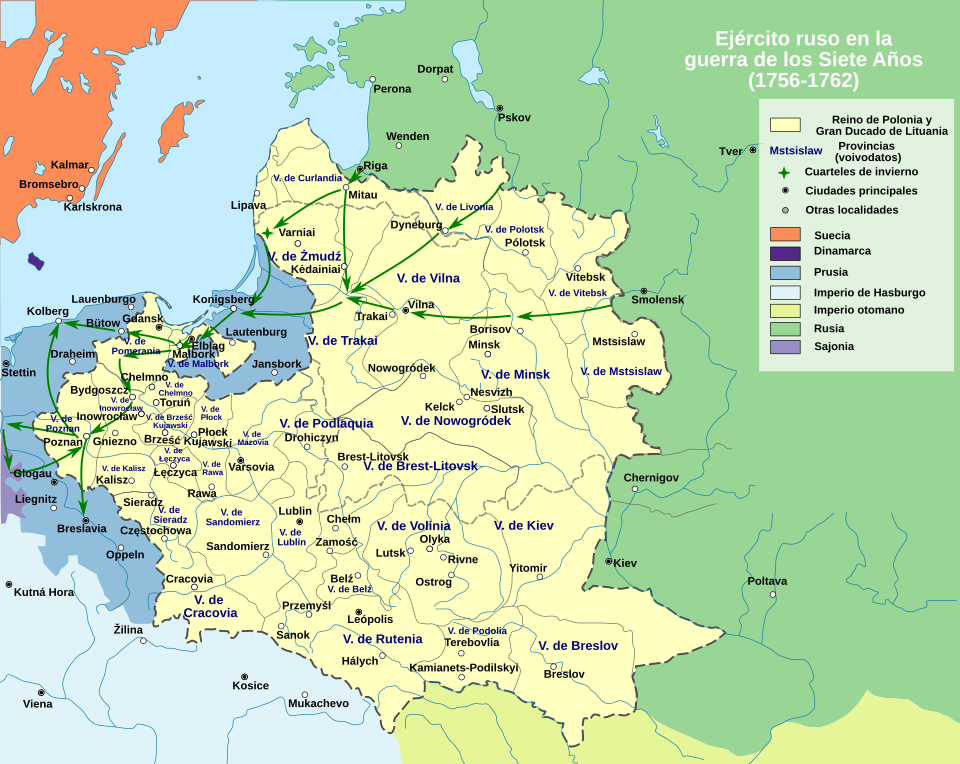
This legend-based campaign map shows military operations during the Seven Years’ War, making visible how eighteenth-century wars unfolded across wide regions rather than in a single localized theater. Used alongside the text, it helps students connect trade-and-empire rivalry to the logistical reality of sustained, multi-front warfare. Source
These wars involved dynastic and strategic questions, but trade was deeply important because victory could reshape access to ports, colonies, and profitable exchange networks.
European rivalry was therefore increasingly global in its effects. Conflicts between European states were no longer limited to the continent. Commercial competition helped turn war into a struggle fought across oceans as well as on land.
Consequences of Trade Competition for Europe
Trade-driven rivalry had several important consequences. First, it increased the importance of naval power. A strong navy was essential not only for defense but also for protecting merchants, blockading enemies, and capturing trade routes.
Second, it contributed to the growth of state centralization. Governments needed better taxation, more effective administration, and stronger credit systems to sustain long wars tied to commercial interests.
Third, it made diplomacy more complicated. Peace settlements increasingly considered not just borders but also commercial rights, colonial possessions, and maritime access. Economic terms became part of international politics.
Finally, trade competition sharpened long-term hostility among major powers. Commercial rivalry created persistent distrust, especially when one state appeared to threaten another’s access to wealth and influence. By the eighteenth century, European conflict was shaped not only by princes and territory, but also by merchants, navies, and the struggle for global trade.
Practice Questions
Identify and explain one reason why trade competition contributed to conflict among European powers in the seventeenth and eighteenth centuries. (2 marks)
1 mark for identifying a valid reason, such as rivalry over shipping routes, colonial markets, naval supremacy, or mercantilist restrictions.
1 mark for explaining how that reason increased tensions or led to war between states.
Evaluate the extent to which commercial rivalry was a major cause of conflict among European powers in the seventeenth and eighteenth centuries. (5 marks)
1 mark for presenting a clear argument that commercial rivalry was significant, limited, or significant in combination with other causes.
1 mark for using one specific piece of relevant evidence, such as the Anglo-Dutch Wars.
1 mark for using a second specific piece of relevant evidence, such as British-French rivalry or the Seven Years’ War.
1 mark for explaining how trade competition intensified conflict through mercantilism, colonial markets, shipping, or naval policy.
1 mark for demonstrating complexity by noting that dynastic, territorial, or balance-of-power concerns also shaped these wars.
FAQ
Maritime states had direct access to oceanic commerce, which made shipping and naval power central to their prosperity.
Because of this, states such as Britain and the Dutch Republic depended heavily on:
merchant fleets
port activity
naval protection
overseas commercial networks
Their economies and security were therefore closely connected, making commercial disputes more likely to become military ones.
Privateering allowed governments to use privately owned ships to attack enemy commerce during wartime.
This mattered because it blurred the line between state warfare and commercial competition. Privateers could damage an enemy’s trade without requiring the full cost of a permanent naval campaign.
It also encouraged merchants to think of war as an opportunity for profit, not just as a disruption.
Although war could interrupt trade, some merchants expected to benefit if their own state defeated competitors.
They might gain:
access to closed markets
reduced foreign competition
government contracts
prize money from captured ships
In that sense, certain merchant groups saw war as a means to secure long-term commercial advantage.
No. It could also lead to tariffs, embargoes, treaty disputes, and diplomatic pressure.
States often tried to weaken rivals economically before turning to war. Commercial treaties, port restrictions, and retaliatory regulations were common tools.
Open warfare usually came when economic rivalry merged with strategic or political tensions.
Its effects reached beyond rulers and merchants. War linked to trade could raise taxes, increase naval recruitment, and disrupt supplies.
In port cities, conflict could bring unemployment if shipping declined. In other cases, wartime demand could stimulate shipbuilding or related trades.
So, although trade rivalry was directed by states, its consequences were felt widely across society.