AP Syllabus focus:
'Some Protestants, including Calvinists and Anabaptists, rejected the idea that the church should be subordinate to the secular state.'
In the sixteenth century, debates over reform were also debates over power. Calvinists and Anabaptists both challenged state control of religion, but they imagined very different relationships between church and government.
Why Church-State Relations Became a Major Issue
The Reformation raised a basic question: who should control religious life? In many European states, rulers and magistrates supervised churches, appointed clergy, or enforced religious conformity. For many reformers, this seemed practical. For others, it threatened the spiritual independence of the church.
Calvinists and Anabaptists both objected to the idea that the church should simply obey the secular government in religious matters. However, they did not agree on what should replace that system.
Their disagreements centered on several issues:
who had authority over doctrine
who enforced moral discipline
who belonged to the church
whether the state should support, supervise, or stay apart from the church
Calvinists: A Church with Independent Spiritual Authority
Calvin’s View of Church and Government
John Calvin believed that both church and civil government were established by God, but they had different functions.
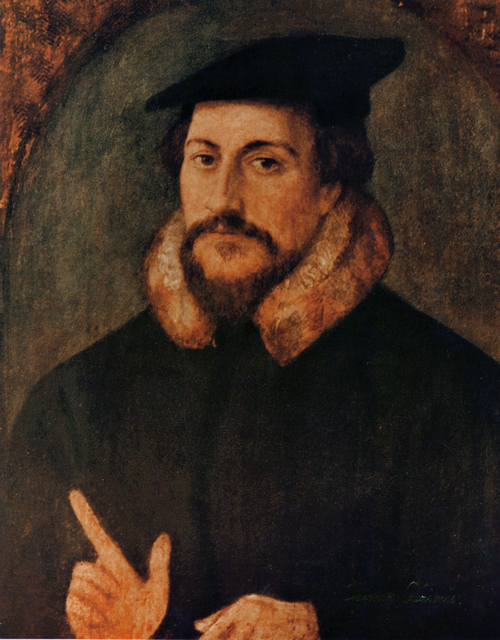
Portrait traditionally identified with John Calvin (mid-16th century). Using a recognizable image of Calvin reinforces that “Calvinism” was shaped by real institutional leadership, not just abstract theology, and it helps students connect his political theology to the Reformation-era struggle over jurisdiction and discipline. Source
Civil rulers were responsible for public order and protection. The church was responsible for preaching, sacraments, and spiritual discipline. This meant that the church should not be reduced to a department of the state.
Calvin did not advocate complete separation between religion and politics in the modern sense. Instead, he imagined a godly society in which church and state cooperated, while the church retained authority in spiritual matters.
One of the most important areas of conflict was discipline. Calvin believed the church needed the power to correct immoral behavior and, if necessary, exclude members from communion.
Consistory: A church court in Calvinist communities, usually made up of pastors and lay elders, that supervised moral discipline and helped assert ecclesiastical authority separate from civil magistrates.
In Geneva, the consistory became a central institution. It investigated drunkenness, sexual misconduct, blasphemy, and other offenses. This was important because it showed that the church claimed the right to govern the moral and spiritual life of believers without being fully controlled by city officials.
Why Calvinism Challenged the State
Calvinism challenged secular authority in a specific way:
it insisted that magistrates could not define doctrine
it argued that church leaders had authority over excommunication and discipline
it treated the church as an institution with its own God-given jurisdiction
This position could create tension with rulers who wanted full control over religion in their territories. A prince or city council might support reform, but Calvinists did not believe that support gave the state unlimited control over the church.
Anabaptists: The Church as a Voluntary Community
Core View of the Church
The Anabaptists went further than Calvinists in rejecting established church structures tied to government.
Anabaptists: Radical Protestant groups that argued only conscious adult believers should be baptized and that the true church should be a voluntary community, not a body controlled by the state.
For Anabaptists, the church was not the whole population of a territory. It was a gathered community of committed believers. This directly challenged the common European assumption that political society and religious membership should overlap.
Because of this belief, Anabaptists rejected infant baptism.

Jan Luyken’s design drawing for “Philip baptizes the Eunuch” (1710–1712), from the Rijksmuseum’s collection. The image provides a concrete visual for baptism as a rite of entry into the Christian community—exactly the practice Anabaptists reinterpreted by insisting that only conscious adult believers should receive it. Source
In much of Europe, infant baptism linked people to both church and community from birth. Rejecting it meant rejecting the idea that citizenship and church membership were automatically joined.
Why Anabaptists Rejected State Control
Many Anabaptists believed that the state relied on coercion, while true Christianity required voluntary faith. As a result, many refused practices that tied the believer too closely to political authority, such as:
taking oaths
serving in the military
holding government office
participating in an official state church
Unlike Calvinists, Anabaptists often did not seek to reshape the whole political community into a godly commonwealth. Instead, many aimed to form separate, disciplined congregations distinct from the surrounding world.
This made Anabaptism especially threatening to rulers. If religion was supposed to unify society, a group that rejected the official church and separated itself from civic religion seemed politically dangerous as well as religiously deviant.
Calvinists and Anabaptists Compared
Although both groups rejected the church’s subordination to secular rulers, their alternatives were very different.
Similarities
Both denied that civil government should have total control over the church.
Both believed the church had a higher spiritual purpose than the state.
Both challenged the idea of a single, state-supervised religious structure.
Differences
Calvinists wanted an organized reformed church that worked with government but kept its own spiritual authority.
Anabaptists often wanted a believers’ church separated from coercive political structures.
Calvinists accepted an important role for magistrates in defending order and religion; many Anabaptists were much more distrustful of state power itself.
Political and Social Consequences
These views mattered because they undermined the assumption that rulers could simply command religious life. Calvinist communities pressed for church institutions that could resist state domination in matters of doctrine and discipline. Anabaptist groups questioned whether a true Christian church could exist at all when tied to state power.
As a result, church-state relations became one of the central political issues of the Reformation era. The conflict was no longer just about theology. It was also about jurisdiction, obedience, and whether spiritual authority belonged to rulers, clergy, or gathered communities of believers.
Practice Questions
Identify TWO ways in which Calvinists challenged the idea that the church should be subordinate to the secular state. (2 marks)
1 mark for explaining that Calvinists believed the church had independent authority in spiritual matters such as doctrine, sacraments, or excommunication.
1 mark for explaining that Calvinists created church institutions, such as consistories, that exercised discipline apart from direct civil control.
Explain how the views of Calvinists and Anabaptists on church-state relations differed in the sixteenth century. (5 marks)
1 mark for identifying that Calvinists believed church and state should cooperate but remain distinct in function.
1 mark for explaining that Calvinists defended the church’s independent authority over doctrine or moral discipline.
1 mark for identifying that Anabaptists believed the true church should be a voluntary community of adult believers.
1 mark for explaining that many Anabaptists rejected close ties to state institutions such as official churches, oaths, military service, or public office.
1 mark for a clear comparative point, such as noting that Calvinists aimed to build a godly society with an independent church, while many Anabaptists preferred separation from coercive political structures.
FAQ
Geneva gave Calvin and his allies the chance to put their ideas into practice within an actual city.
Its importance came from:
the creation of institutions such as the consistory
the training of ministers who later travelled elsewhere
the city’s reputation as a model of disciplined Reformed life
Because Geneva attracted refugees and students from across Europe, its church structure became influential well beyond Switzerland. It served less as a kingdom and more as a practical example of how a Reformed church could claim authority alongside civil government.
No. Anabaptists were diverse, and their attitudes varied by region and group.
Many were wary of government because they associated it with coercion, warfare, and compulsory religion. However, not every Anabaptist group behaved in exactly the same way.
Some communities were strongly separatist, while others were mainly concerned with living peacefully apart from official churches. What united them was not one single political programme, but a deep suspicion of any system that merged faith with state power.
That diversity is important, because hostile authorities often treated all Anabaptists as if they were identical.
In much of sixteenth-century Europe, infant baptism was more than a religious ritual. It helped incorporate a child into the local Christian community from birth.
That mattered politically because:
church membership often overlapped with civic belonging
parish records helped authorities monitor populations
a shared baptismal system supported social unity
When Anabaptists rejected infant baptism, they challenged more than sacramental practice. They also challenged a social order in which rulers expected nearly everyone in a territory to belong to one recognised church.
The events at Münster in the 1530s linked Anabaptism, in the minds of many rulers, with rebellion and disorder.
Even though most Anabaptists were not revolutionary, Münster became a warning symbol used by opponents to justify repression.
Its impact was significant because it:
made governments more suspicious of radical religious groups
blurred distinctions between peaceful and militant dissenters
strengthened the belief that religious nonconformity could become political revolt
As a result, later Anabaptist communities often faced persecution shaped as much by fear and memory as by their actual beliefs.
Calvinist ideas travelled through networks rather than conquest alone.
They spread through:
ministers trained in Reformed centres
exile communities that carried ideas across borders
letters, confessions of faith, and church ordinances
urban connections among merchants, scholars, and clergy
This mattered for church-state relations because Calvinism could be adapted to different political settings. A Reformed minority under a hostile ruler might organise differently from a Reformed majority in a city-state, yet both could draw on the same basic belief that the church had its own authority under God.