AP Syllabus focus:
'Protestant reformers used the printing press and vernacular texts to spread ideas and make reform widely established.'
In the sixteenth century, print transformed religious debate from a localized dispute into a mass movement. Protestant reformers succeeded not only because they had new ideas, but because they spread them quickly and accessibly.
Why Printing Mattered
By the early 1500s, movable-type printing had already created a communications revolution in Europe.
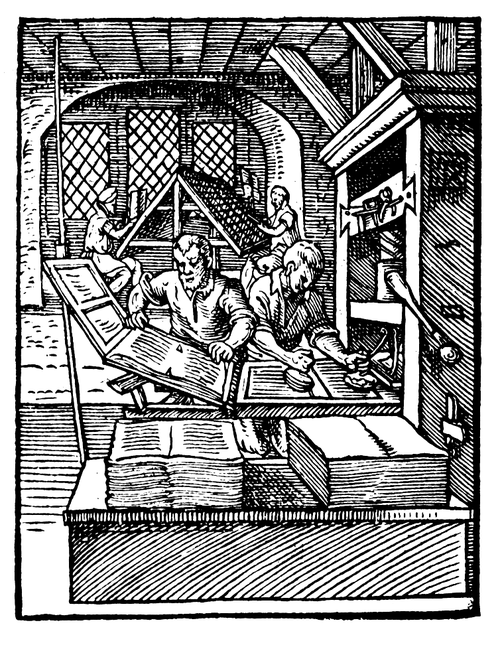
Woodcut depiction of a sixteenth-century print shop, showing the coordinated workflow of movable-type printing: compositors setting type, the forme being inked, and a printed sheet being pulled from the press. The scene helps explain why print could scale production and standardize texts more reliably than handwritten copying. It also highlights printing as an organized craft industry rather than a single-person activity. Source
Books were cheaper than hand-copied manuscripts, printers could produce many copies of a text, and major cities were connected by trade routes that helped books travel. When reform began, this existing print network gave Protestant ideas an enormous advantage.
Speed, scale, and standardization
Print helped reformers in several ways:
Speed: ideas could be circulated across towns, universities, and courts within weeks rather than years.
Scale: a single press run could reach hundreds or thousands of readers.
Standardization: printed texts preserved a more fixed version of an argument than oral rumor or handwritten copying.
Repetition: successful works could be reprinted, translated, and adapted for new audiences.
This mattered because religious controversy no longer stayed inside the universities or church hierarchy. Printed arguments turned reform into a public debate involving clergy, magistrates, merchants, artisans, and literate householders.
Vernacular Texts and a Wider Audience
A major reason Protestant reform spread so effectively was its use of the vernacular, the everyday language spoken by ordinary people rather than Latin.
Vernacular: The common spoken language of a region, used instead of Latin so that non-specialists could read or hear religious ideas more directly.
By publishing in German, English, French, Dutch, and other local languages, reformers widened their audience far beyond educated clerics.
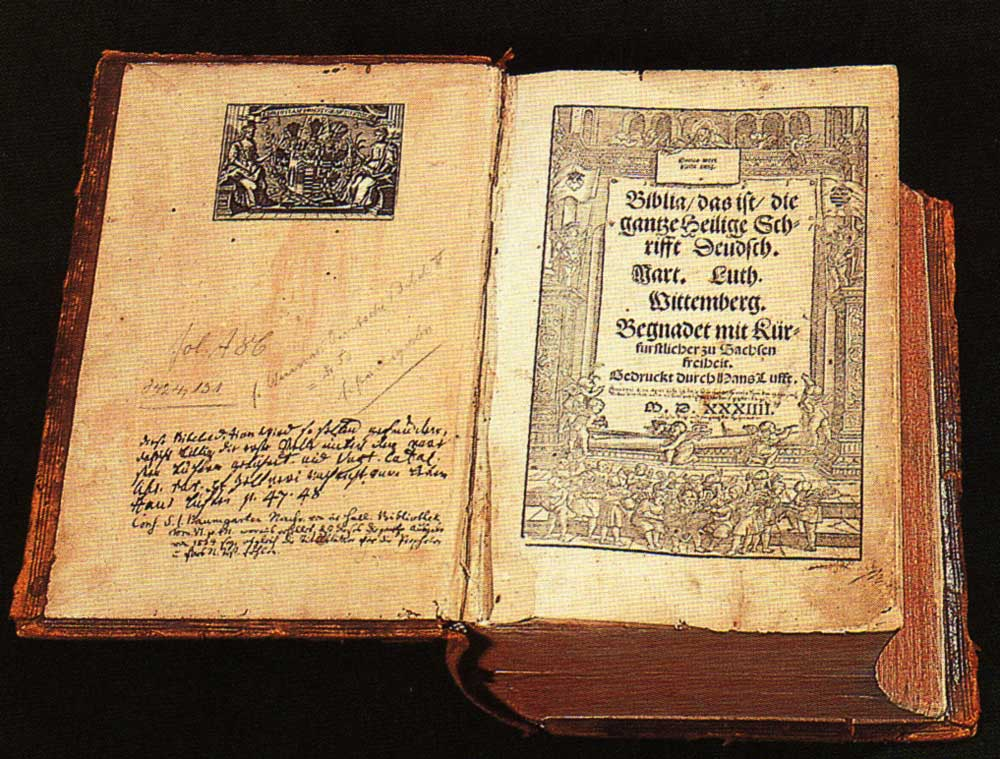
Title page from the 1534 Luther Bible, the first complete printed translation of the Bible into German associated with Martin Luther. As a vernacular printed Bible, it illustrates how reformers used accessible language and mass production to extend religious reading (and hearing, through read-aloud settings) beyond clerical circles. The elaborate printed title page also signals the prestige and permanence that print could give to reform texts. Source
They made religion feel less distant and less dependent on a learned priesthood. People who could read encountered reform directly, while those who could not often heard texts read aloud in homes, workshops, taverns, or marketplaces.
Vernacular printing appeared in many forms:
Pamphlets, which were short, cheap, and easy to circulate
Translated Bibles
Catechisms for basic instruction
Hymnals and prayer books for daily use
Sermons, letters, and polemical dialogues
These genres mattered because they did more than introduce new opinions. They helped create routine religious habits. A pamphlet could provoke interest, but a catechism or Bible translation could reshape how a family learned, read, and worshiped.
Protestant Strategies for Using Print
Protestant reformers were especially effective because they understood how print worked in practice. They wrote for different audiences and used formats suited to each one. A long theological treatise might address scholars, but a brief pamphlet or broadsheet could reach a much larger public.
Print and persuasion
Printed reform was persuasive because it was designed to be memorable:
Writers used direct, forceful language instead of highly technical Latin prose.
Printers issued small, affordable works that ordinary buyers could obtain.
Authors and publishers often released texts in rapid succession, keeping controversies in the public eye.
Some editions included woodcut illustrations, which helped communicate messages visually and made texts more appealing.
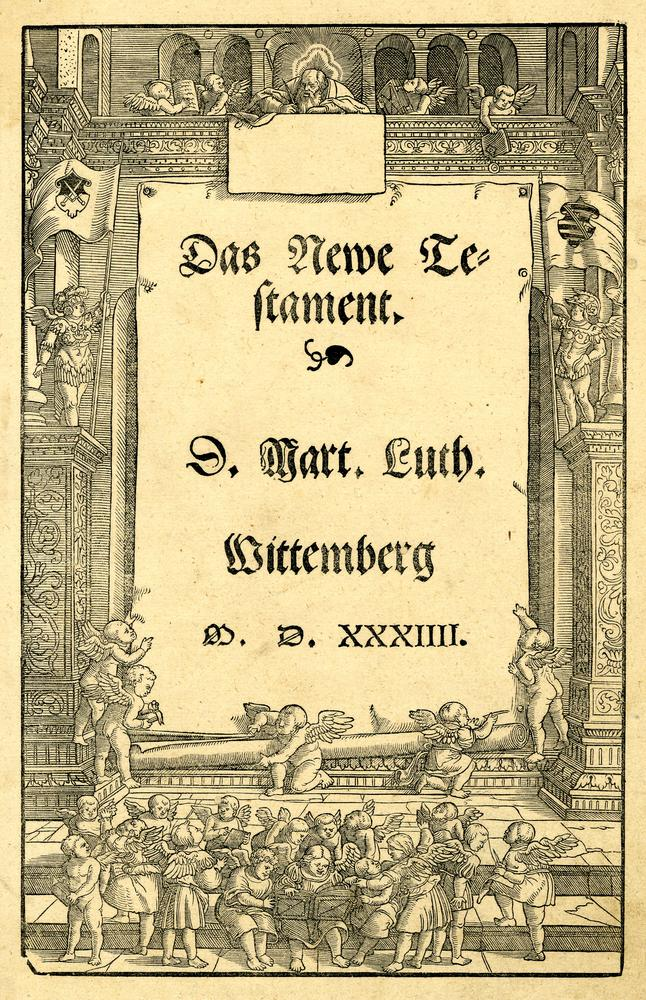
Museum-cataloged woodcut-and-letterpress title-border used for the 1534 Luther Bible printed in Wittenberg by Hans Lufft. The decorative border exemplifies how woodcuts could be integrated with text to frame religious works, add visual authority, and make printed pages more engaging for readers. Such imagery helped printed religion function as both argument and media presentation. Source
This turned religious reform into a media campaign. Reformers could answer critics quickly, restate arguments in simpler form, and keep their supporters supplied with new material. Print also allowed ideas associated with local disputes to become part of a shared Protestant movement across different regions.
Printers themselves were important partners. Many were businesspeople attracted by the strong demand for reform literature. Controversy sold well. As a result, the market often reinforced reform by rewarding works that stirred attention and debate. The alliance between authors, printers, and readers helped Protestant writing achieve a reach that older methods of communication could not match.
Making Reform Widely Established
The specification does not stop at the spread of ideas; it emphasizes how reform became widely established. Print was crucial here because it helped transform protest into durable religious communities.
Once reform gained supporters in a town or territory, printed materials helped make practice more regular and consistent. Communities could use the same Bible translation, the same catechism, the same hymns, and the same forms of instruction. This created a shared religious culture. Printed texts also helped parents teach children, ministers prepare sermons, and laypeople compare local practice with published standards.
In this sense, print supported establishment in two stages:
Initial expansion: spreading criticism of the old church and attracting new supporters
Long-term consolidation: providing the texts needed for teaching, devotion, and common identity
Print did not work alone. Literacy levels varied, and many people still received reform ideas through preaching and conversation. Yet print amplified these oral channels. A sermon could be printed, sold, read aloud, and discussed again in another setting. That cycle gave Protestant reform unusual staying power.
Opponents understood this power as well. Attempts to censor presses or restrict publication show how dangerous authorities believed printed reform to be. Even where controls existed, the combination of portable books, eager readers, and vernacular communication made suppression difficult. Protestant reformers therefore benefited not just from the existence of the press, but from using it more flexibly and effectively than their rivals during the early stages of reform.
Practice Questions
Identify two reasons why vernacular printing helped Protestant reform spread more effectively than Latin texts in the sixteenth century. (2 marks)
1 mark for identifying that vernacular texts could be understood by laypeople who did not know Latin.
1 mark for identifying that vernacular works could be read aloud in homes or communities, expanding the audience beyond individual readers.
Evaluate the importance of the printing press in making Protestant reform widely established in Europe in the first half of the sixteenth century. (6 marks)
1 mark for a defensible thesis that makes a clear judgment about the importance of print.
1 mark for relevant contextualization, such as the limits of manuscript culture or the existence of pre-Reformation print networks.
Up to 2 marks for specific evidence, such as pamphlets, vernacular Bibles, catechisms, broadsheets, or woodcut illustrations.
Up to 2 marks for analysis and reasoning:
explaining how print spread ideas rapidly and consistently
explaining how print helped turn early protest into lasting religious instruction, identity, and practice
FAQ
Wittenberg mattered because it combined a university town, a famous reforming figure, and supportive political protection in one place.
Its presses benefited from:
immediate access to new manuscripts
demand created by students and visitors
links to printers and booksellers elsewhere in the Holy Roman Empire
That made the town a powerful launch point for reform literature.
A false imprint gave misleading publication details, such as the wrong city or printer. This helped hide where a book had really been produced.
They were useful because they:
complicated censorship
protected printers and sellers
allowed controversial texts to cross borders more easily
False imprints did not make repression impossible, but they made enforcement much harder.
Translators and editors did more than convert words from one language to another. They chose tone, vocabulary, and explanatory notes.
Their decisions could:
simplify difficult theology
make a text sound more urgent or accessible
connect a work to local customs and speech
In that sense, they shaped how readers understood reform, not just how they read it.
Book fairs were major commercial gathering points where printers, booksellers, and agents exchanged stock and information.
They helped reform by:
moving titles quickly across regions
advertising what was newly available
linking local presses to wider markets
A text printed in one city could therefore become known far beyond its place of origin within a short time.
Unauthorised reprinting, sometimes called piracy, spread Protestant texts faster by producing extra copies without the original printer’s permission.
It had mixed effects:
prices often fell, helping wider circulation
authors and original printers lost control and profit
wording, layout, or illustrations could change between editions
So piracy could strengthen the spread of reform while also making texts less stable and less controllable.