AP Syllabus focus:
'Religious conflicts became a basis for challenging monarchs’ control of religious institutions in states such as France and England.'
In early modern Europe, arguments about salvation, worship, and church authority increasingly became arguments about political power, especially when monarchs tried to direct national religious life.
Why religious conflict became political
During the Reformation era, religion could not be separated from government. Church institutions controlled education, morality, law, and social discipline, so rulers who tried to shape religion were also shaping political life. As monarchs strengthened their authority, many claimed a greater role in appointing clergy, supervising worship, and enforcing religious conformity.
This created a new problem: if a ruler controlled the church, then disagreement over religion could become disagreement over the ruler’s legitimacy. Religious conflict therefore did more than divide believers. It raised urgent questions about obedience, conscience, and the limits of royal authority.
In both France and England, people who opposed official religious policy increasingly argued that monarchs should not have unchecked power over religious institutions. These challenges did not usually begin as demands for modern religious freedom. More often, they were efforts to defend what opponents believed was the true faith against improper royal interference.
France: religion as a basis for resistance
In France, religious division deeply destabilized relations between the crown and its subjects.
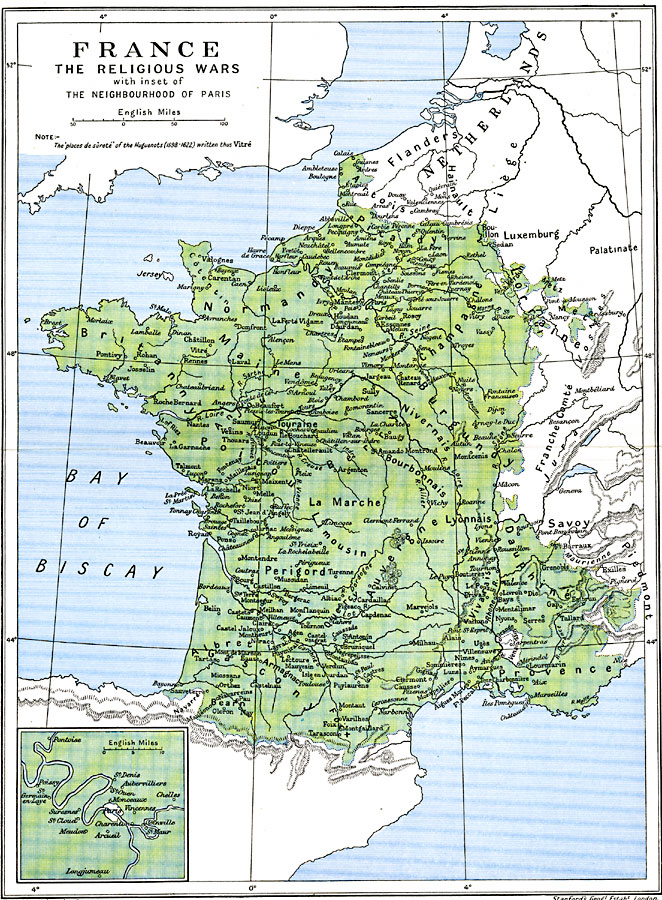
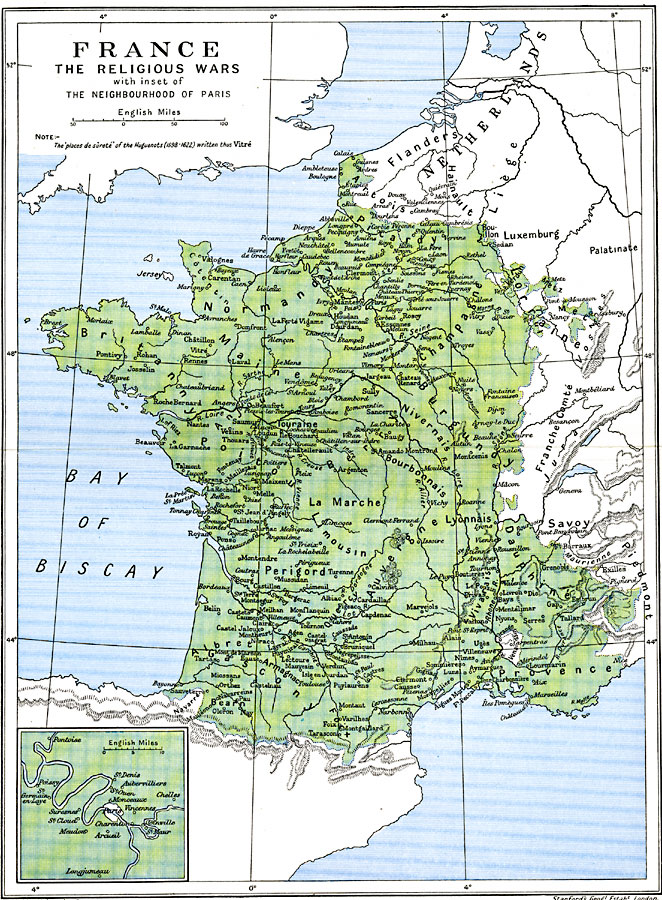
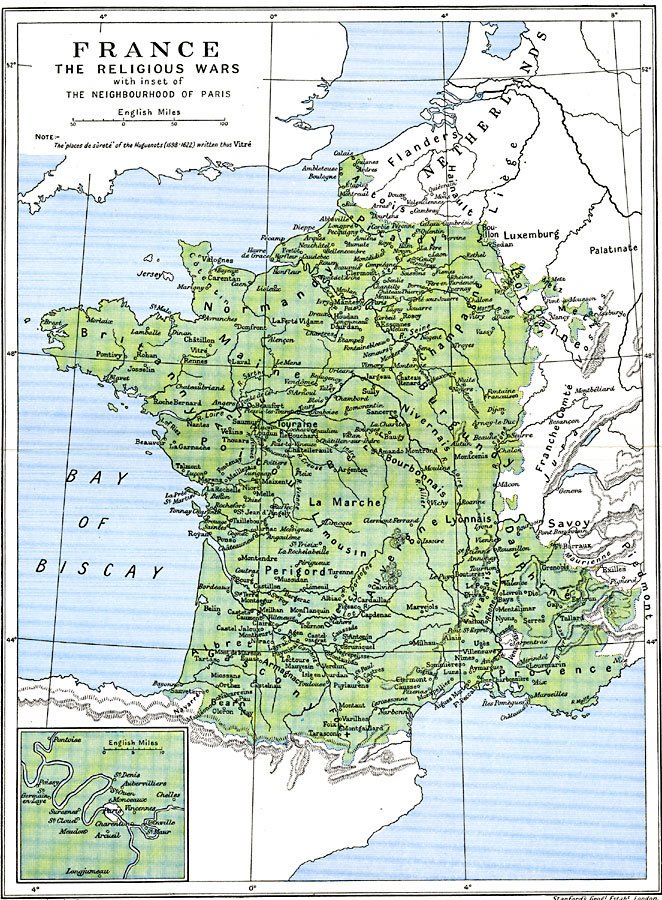
This historical map of France during the Wars of Religion highlights key cities and (notably) Huguenot “places de sûreté,” the fortified towns Protestants were permitted to hold for security. It helps students see how confessional conflict translated into territorial control and military logistics, intensifying disputes between the crown and organized religious communities. Source
The monarchy wanted to preserve order and retain influence over the church, but the spread of Protestant belief meant that royal policy could satisfy neither side for long. If the crown repressed Protestants, many subjects saw that as tyrannical persecution. If the crown appeared too moderate, militant Catholics accused it of failing to defend the faith.
As a result, religious conflict encouraged the development of a more explicit theory of resistance.
A facsimile associated with the Edict of Nantes (1598), issued under Henri IV, which sought to stabilize the kingdom after decades of religious civil war. As a royal decree negotiated amid pressure from militant Catholics and Protestants, it illustrates how the crown’s religious policy became a contested political settlement rather than a purely spiritual matter. Source
Some Protestant writers argued that a ruler who attacked true religion or violated divine law could be opposed by legitimate political authorities below the king, such as princes, nobles, or magistrates. Resistance was presented not as simple rebellion, but as a defense of godly order.
These arguments mattered because they challenged the idea that the monarch alone should direct religious institutions. If subjects could claim that the king’s religious policy was unlawful or ungodly, then control of the church was no longer an unquestioned royal privilege. Instead, it became a matter of public dispute.
French conflict also showed that resistance arguments were not limited to one confession. Catholics, too, could turn against royal religious policy when they believed the crown had compromised too much. This meant that religion gave multiple groups a language for opposing monarchy, even when they disagreed sharply with one another about doctrine.
England: challenges to royal supremacy
In England, the issue was especially sharp because the monarch claimed direct authority over the national church through royal supremacy.
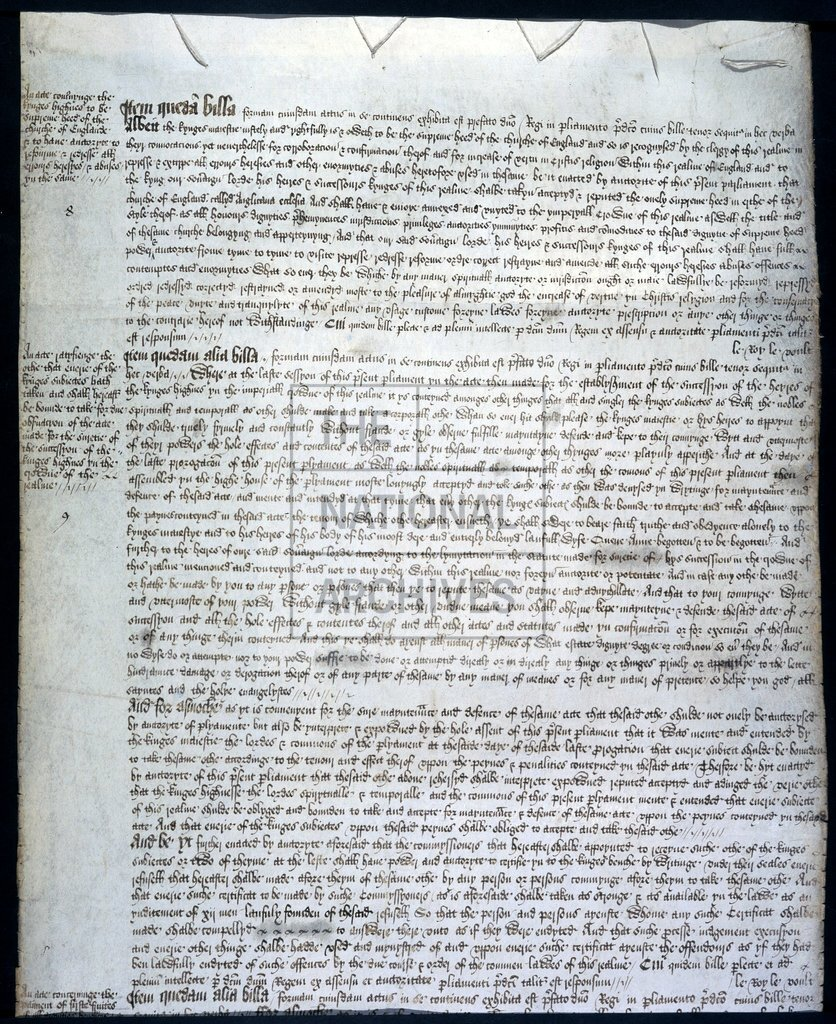
A manuscript image of the 1534 Act of Supremacy, the statute by which Parliament recognized Henry VIII as “supreme head” of the Church of England. Seeing the act as a physical legal document underscores that royal supremacy was not just a theological idea—it was a constitutional claim backed by statute and enforced through state institutions. Source
Royal supremacy: The principle that the English monarch, rather than the pope, held final authority over the governance of the national church.
Because of this system, disputes over doctrine, church structure, and worship immediately became disputes about the monarch’s power. The crown used bishops, church courts, and official liturgy to enforce conformity. Supporters of further Protestant reform increasingly questioned whether a monarch had the right to determine so much about the church’s life.
For many English critics, the key issue was not whether government had any role in religion, but whether the crown had gone too far in controlling institutions that should be governed according to scripture. When rulers defended ceremonies, episcopal authority, or policies seen as insufficiently reformed, opponents could present resistance as a defense of religion rather than an attack on order.
English Catholics challenged royal control in a different way. They rejected the claim that the monarch could replace papal authority in spiritual matters. This did not always produce open rebellion, but it clearly undermined the monarch’s claim to full control over religious institutions.
Religious conflict in England therefore made church government a constitutional issue. Opposition to official policy often moved through Parliament, clergy, and local communities, giving religious disagreement a broader political significance. Once people argued that the monarch could not command the church without limits, they were also arguing that political authority itself had limits.
Patterns of resistance in France and England
Although France and England developed differently, the pattern was similar. Religious conflict pushed subjects to challenge monarchy in several connected ways:
It linked conscience to politics. Obedience to God could be used to question obedience to a ruler.
It encouraged resistance theory. Subjects increasingly argued that authority was conditional, not absolute.
It made institutions politically sensitive. Control of clergy, worship, and discipline became central political issues.
It drew other bodies into conflict. Nobles, magistrates, parlements, and Parliament could all claim roles in defending religion.
It weakened unquestioned royal control. Monarchs still sought to dominate the church, but they faced more organized and principled opposition.
What changed most was the language of politics. Instead of treating royal religious authority as naturally legitimate, many Europeans began to ask whether rulers had exceeded their proper role. In that sense, religious conflict did not merely divide Christians; it reshaped the relationship between state power and religious institutions.
Practice Questions
Identify one way religious conflict challenged monarchical authority over religious institutions in either France or England. (2 marks)
1 mark for identifying a valid way, such as opposition to royal control of church governance, resistance to persecution, or rejection of the monarch’s spiritual authority.
1 mark for briefly explaining how that challenge limited or questioned the monarch’s control over religious institutions.
Explain how religious conflict became a basis for political resistance against monarchs’ control of religious institutions in France and England during the 16th and early 17th centuries. (6 marks)
1 mark for explaining that in France, religious division made royal policy toward the church highly controversial.
1 mark for explaining that French Protestants or other opponents developed arguments that resistance could be justified when rulers violated true religion.
1 mark for explaining that Catholics in France could also oppose the crown when they believed it failed to defend the faith.
1 mark for explaining that in England, royal supremacy made church disputes directly political.
1 mark for explaining that English critics challenged the monarch’s right to direct doctrine, worship, or church structure.
1 mark for a comparative point showing that in both states, religious conflict encouraged people to argue that obedience to monarchs had limits.
FAQ
Many resisters did not see themselves as rejecting monarchy itself.
Instead, they claimed they were defending the realm against ungodly policies, corrupt advisers, or illegal uses of power. This allowed them to present resistance as a form of loyalty to the kingdom, its laws, and the true faith rather than as simple treason.
Oaths forced individuals to state publicly where their loyalty lay.
By requiring clergy, officials, and sometimes educated subjects to recognise royal authority over the church, the crown turned a religious issue into a legal and political test. Refusing an oath could therefore become a visible act of resistance, even without armed revolt.
Exile placed religious dissenters outside the immediate reach of royal censorship and punishment.
From abroad, they could:
write more freely
compare different church systems
build networks with foreign reformers
circulate arguments back into their home country
This helped resistance theories become more systematic and more widely shared.
Nobles had resources that ordinary believers usually lacked.
They could raise armed followers, protect local congregations, influence regional government, and negotiate directly with monarchs. Their involvement meant that religious conflict quickly became political conflict, because they could turn belief into organised opposition.
Religious opponents rarely wanted to sound like revolutionaries.
By using legal and historical language, they could argue that they were defending ancient rights, local privileges, or lawful custom. This made resistance appear more legitimate and less like disorder, especially in kingdoms where open rebellion carried enormous risks.