AP Syllabus focus: ‘The PPC demonstrates efficiency, inefficiency, and underutilized resources by showing points on, inside, and outside the curve.’
The production possibilities curve (PPC) is most useful when you can interpret what different locations mean. This page focuses on productive efficiency, inefficiency, and underutilized resources using points on, inside, and outside the PPC.
Interpreting Points on, Inside, and Outside the PPC
A PPC represents the maximum feasible combinations of two categories of output an economy can produce with its current resources and technology.
A point on the PPC is feasible and uses available resources as fully as possible.
A point inside the PPC is feasible but reflects wasted potential.
A point outside the PPC is not feasible with current capacity.
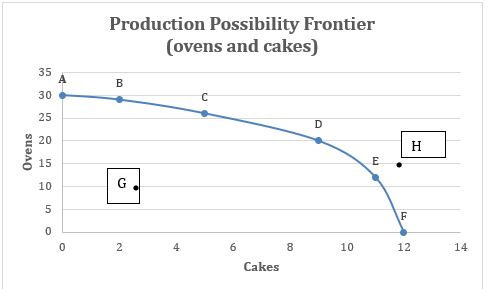
A production possibilities frontier showing three key regions: points on the curve (efficient/full employment), a point inside the curve (inefficient due to underutilized resources), and a point outside the curve (unattainable with current resources and technology). The labeled points help visually reinforce how “on vs. inside vs. outside” corresponds to productive efficiency, inefficiency, and infeasibility. Source
Points on the PPC: Efficiency
A point on the frontier indicates the economy is producing as much total output as it can, given constraints.
Productive efficiency: producing output at the lowest possible cost, meaning the economy is using its resources fully so that increasing production of one good requires decreasing production of the other.
On the PPC, productive efficiency is shown by:
Full employment of resources (especially labor) in the sense that resources are not left idle involuntarily
No avoidable waste of inputs due to mismanagement, bottlenecks, or idle capital
Maximum attainable output for the given resource base
Being on the PPC does not mean society is producing the “best” mix of goods; it means the economy cannot increase production of one good without giving up some of the other.
Points Inside the PPC: Inefficiency and Underutilization
Any point inside the PPC is attainable, but it signals that the economy is operating below its potential.
Underutilized resources: a situation where some resources (such as labor or factories) are idle or not used effectively, causing actual output to be less than potential output.
A point inside the PPC indicates inefficiency, which commonly arises from:
Unemployment above the normal/expected level, leaving labor unused
Idle capital, such as closed factories or unused machinery capacity
Misallocation of resources, where inputs are not matched well to production needs
Negative shocks that reduce actual production without changing long-run capacity (for example, disruption that temporarily prevents resources from being used)
Why Inside Points Matter
Inside points highlight a gap between:
what the economy could produce (on the PPC), and
what it is producing (inside the PPC)
Moving from an inside point to a point on the PPC represents an improvement in resource utilization and productive efficiency—more output can be produced without needing new resources or better technology.
Points Outside the PPC: Unattainable Combinations
A point outside the PPC represents output combinations that are not possible with current productive capacity.
Key implications of outside points:
They are desirable but infeasible given current constraints.
Reaching them requires changes that expand capacity, not just better use of existing resources.
The PPC serves as a boundary: current resources and technology set the limit of what can be produced.
Avoiding Common Misinterpretations
A point on the PPC is efficient, but efficiency here is specifically productive efficiency (maximum output from inputs), not necessarily the “best” outcome for society.
A point inside the PPC is not automatically permanent; it can reflect temporary underutilization rather than a reduced ability to produce.
A point outside the PPC is not “more efficient”; it is simply unattainable under current conditions.
Visual and Graphing Conventions (What to Label)
When you describe or sketch a PPC for efficiency analysis, focus on clear identification of regions:
Label the curve as the PPC (frontier).
Mark one point on the curve as efficient.
Mark one point inside the curve as inefficient/underutilization.
Mark one point outside the curve as unattainable.
Use the PPC specifically to connect the syllabus idea: efficiency, inefficiency, and underutilized resources are distinguished by whether a production point lies on, inside, or outside the curve.
Practice Questions
(1–3 marks) On a PPC diagram, what does a point inside the curve indicate about the economy?
Identifies it as attainable but inefficient (1)
Links inefficiency to underutilised/idle resources such as unemployment or idle capital (1)
States that more of one or both goods could be produced without sacrificing the other by moving towards the frontier (1)
(4–6 marks) Explain the economic meaning of points on, inside, and outside a PPC, using the terms productive efficiency and underutilised resources.
Point on PPC: identifies productive efficiency / maximum output from given resources (1)
Explains trade-off requirement on the frontier: more of one implies less of the other (1)
Point inside PPC: identifies inefficiency (1)
Connects inside point to underutilised resources (e.g., unemployment, idle capital, misallocation) (1)
Point outside PPC: identifies as unattainable with current resources/technology (1)
Clear, accurate use of PPC as a capacity boundary (1)
FAQ
Not necessarily. It implies no cyclical underutilisation of labour and capital, but some frictional/structural unemployment can coexist with productive efficiency.
By improving utilisation and coordination, for example: reducing cyclical unemployment, bringing idle machinery back online, improving logistics, or reducing mismatches between workers’ skills and jobs.
Inefficient (inside) means feasible with current capacity but not fully using it. Unattainable (outside) means not feasible with current resources and technology, even with perfect utilisation.
Yes. The PPC is an aggregate concept: waste in one area can be offset by higher utilisation elsewhere. Productive efficiency on the PPC means no overall way to raise one output without lowering the other.
Because those three locations directly map to the syllabus distinctions: underutilised resources/inefficiency (inside), productive efficiency (on), and unattainability (outside).