AP Syllabus focus: ‘The PPC shifts due to changes in factors of production, including resources, technology, and productivity improvements.’
The production possibilities curve (PPC) is not fixed. When an economy’s capacity to produce goods changes, the entire frontier moves.
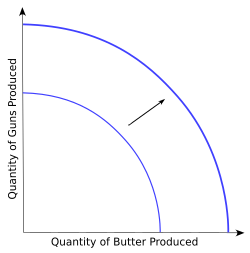
This diagram shows an economy’s production possibilities frontier shifting outward from an initial curve to a new curve. The outward shift represents an increase in productive capacity—more maximum attainable combinations of the two goods are possible with the available resources and technology. This is the classic graphical depiction of economic growth as a PPC shift (not a movement along the same PPC). Source
Understanding what causes these shifts helps you interpret changing potential output and constraints.
What a PPC shift means
A PPC shift changes the economy’s maximum attainable combinations of two goods (or categories of goods) using available resources and technology.
Shift in the PPC: a change in the entire production possibilities curve caused by changes in the economy’s productive capacity, not by choosing a different point on the same curve.
A shift is different from reallocating resources between the two goods, which would be shown as a movement from one point to another on an unchanged PPC.
Causes of PPC shifts (what the syllabus emphasises)
The AP syllabus highlights three drivers: resources, technology, and productivity improvements. Each affects the economy’s ability to produce output with given inputs.
Changes in resources (quantity or quality of inputs)
Resources are the factors of production an economy uses to make goods and services.
Factors of production: the inputs used to produce output—commonly summarised as land (natural resources), labour, capital, and entrepreneurship.
Resource changes that can shift the PPC include:
Labour: population growth, immigration, improved health, higher labour-force participation, or better education and skills.
Capital: a larger stock of machines, factories, infrastructure, and tools.
Natural resources (land): discovery of oil/minerals, improved access to water, or depletion of key resources.
Entrepreneurial capacity and institutions: stronger property rights, better contract enforcement, or reduced barriers to starting firms (these can raise effective input use).
Resource losses can shift the PPC inward:
natural disasters destroying factories
war or political instability reducing investment
emigration of skilled workers (“brain drain”)
resource depletion that lowers feasible production
Changes in technology
Technology is the set of methods and knowledge used to turn inputs into outputs. Improved technology allows more output from the same inputs, shifting the PPC outward.
Key points for AP-style interpretation:
Technology can be general (benefits many industries) or sector-specific (benefits one good more than the other).
If technological change mainly affects one good, the PPC may pivot outward more along that axis rather than shifting out evenly.
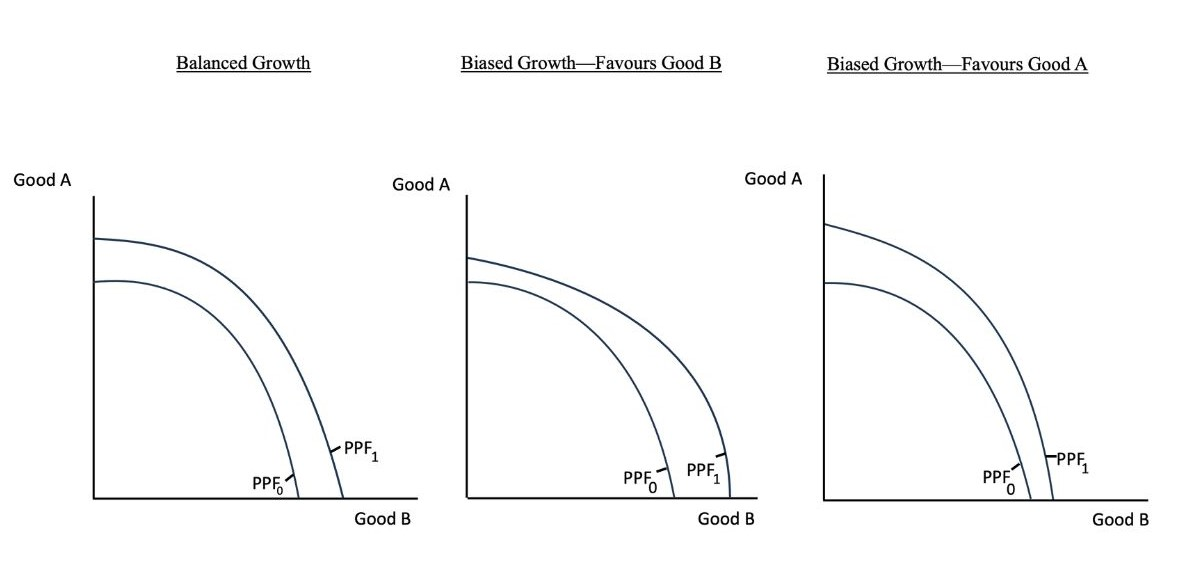
This three-panel figure contrasts a proportional (balanced) outward shift of the PPC with two biased (pivoting) outward shifts that favor one good over the other. In the biased cases, the new frontier expands more along one axis, showing how sector-specific technology or input growth can increase the maximum output of one category disproportionately. It visually reinforces that the shape and direction of a shift depend on which driver changes and which sector it affects most. Source
Examples of technology-driven shifts:
automation and AI that raise manufacturing output potential
improved agricultural techniques raising food output potential
advances in logistics reducing waste and enabling higher attainable production
Productivity improvements (more output per input)
Productivity refers to output produced per unit of input (especially labour). Improvements shift the PPC outward because the economy can produce more with the same resource base.
Productivity gains often come from:
better human capital (training, education quality, on-the-job learning)
improved management practices and organisation
specialisation within firms and industries
diffusion of existing technology (adoption across firms, not just invention)
Productivity can also fall (shifting the PPC inward) if supply chains break down, infrastructure deteriorates, or regulations significantly reduce effective production efficiency.
Direction, scope, and “how it shifts”
A PPC shift can be:
Outward: greater productive capacity (more attainable output combinations)
Inward: reduced productive capacity (fewer attainable output combinations)
Shifts can be:
Broad-based (both goods’ max outputs rise) when inputs/technology benefit the whole economy
Biased/pivoting when changes mainly affect one sector, stretching the PPC more toward one axis
When describing a shift, be precise about:
which driver changed (resources, technology, productivity)
whether capacity rose or fell (outward vs inward)
whether the impact is economy-wide or concentrated in one good (parallel-ish shift vs pivot)
Common AP pitfalls to avoid
A change in price or demand does not shift the PPC by itself; it changes desired allocation (a point on the PPC), not maximum capacity.
Producing inside the PPC reflects inefficiency/unemployment, not a shift in the frontier.
A PPC shift is about potential production; actual output can be below potential without any shift occurring.
Practice Questions
(2 marks) Identify two changes that could shift a country’s PPC outward.
1 mark: correct outward-shift factor identified (e.g., more resources, improved technology, higher productivity).
1 mark: second correct outward-shift factor identified.
(6 marks) A hurricane destroys factories and transport infrastructure in a coastal region, then the government funds rapid adoption of more efficient production technology nationwide. Using a PPC, explain the likely sequence of changes to productive capacity.
1 mark: hurricane reduces resources/capital stock.
1 mark: initial PPC shifts inward (lower maximum attainable combinations).
1 mark: technology adoption increases productive capacity/productivity.
1 mark: subsequent PPC shifts outward.
1 mark: explanation that effects may differ by sector (pivot vs broad shift) depending on where damage/technology applies.
1 mark: clear linkage to “maximum attainable output combinations” (capacity, not demand).
FAQ
Yes. Higher efficiency can shift it outward through better organisation, learning-by-doing, or improved allocation that permanently raises output per input.
If technology or resource gains are concentrated in one industry, the maximum output of that good rises more, stretching the frontier further along that axis.
Institutions can change how effectively resources are used (e.g., stronger property rights raising investment), functioning like a productivity improvement that moves the frontier.
Only if they change productive capacity. Temporary demand drops typically reduce actual output, not the frontier; destruction of capital or long-term workforce losses can shift it.
Technology is a source of productivity, but productivity can also rise via training, management, and process improvements even when the underlying technology is unchanged.