AP Syllabus focus: ‘Economic growth is represented by an outward shift of the PPC, indicating increased productive capacity.’
Economic growth in the PPC model focuses on how an economy’s maximum feasible output changes over time. This page explains what an outward shift means, what it implies about productive capacity, and how to interpret it correctly.
Economic growth in the PPC framework
Core idea: outward shift = higher capacity
The production possibilities curve (PPC) shows the maximum combinations of two categories of goods an economy can produce with its current resources and technology. In this model, economic growth is shown by an outward shift of the entire PPC, meaning the economy can produce more of both goods than before.
Economic growth: An increase in an economy’s productive capacity, shown on a PPC as an outward shift that enables higher potential output.
An outward shift is about the economy’s potential output (what it can produce), not necessarily what it is producing right now.
What “increased productive capacity” means
Productive capacity increases when the economy’s ability to transform inputs into outputs rises. On a PPC, that increase is visual: points that were previously unattainable (outside the old curve) become attainable (on or inside the new curve).
Key implications of an outward shift:
Higher maximum output of both goods is possible.
The economy’s scarcity constraint relaxes (but does not disappear).
The set of efficient production points expands.
Interpreting outward shifts accurately
Growth vs. efficiency vs. unemployment
A common interpretation error is confusing:
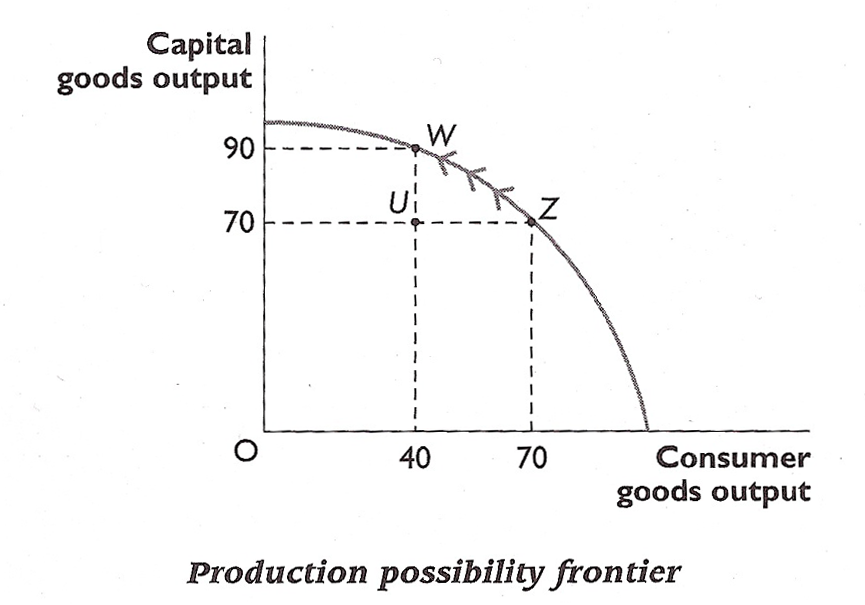
The PPC is shown with an interior point representing underutilization/inefficiency and points on the curve representing productive efficiency. This helps distinguish short-run improvements (moving from inside the curve to the frontier) from genuine economic growth (an outward shift of the frontier). Source
Economic growth (outward shift): the frontier itself moves outward.
Efficiency/inefficiency (movement to the frontier): the economy moves from inside the PPC to a point on the existing PPC.
Unattainable production: points outside the PPC remain impossible until growth occurs.
So, an outward shift is not caused by “using resources better” in the short run; it reflects a higher ceiling on what the economy can produce.
Potential output perspective
Because the PPC is a capacity model, it aligns most closely with the idea of long-run potential output. If the economy is currently operating inside the PPC, it can raise current production by reducing underutilisation, but that is not the same as shifting the PPC outward.
How growth can appear across goods
Even (parallel) shifts
If productive capacity expands in a broad way, the PPC may shift outward roughly in parallel, suggesting the economy can produce more of both goods without a major change in the trade-off structure.
Biased shifts and “more of one type”
Sometimes capacity expands more in one sector than the other, so the PPC can shift outward more on one axis than the other.
This still represents economic growth, but it indicates that the economy’s expanded capability is stronger for one category of output.
When reading a graph:
Outward movement mainly on one axis implies greater growth potential for that good.
The economy can still be productively efficient anywhere on the new frontier.
What the PPC growth story is (and is not)
What it captures well
The PPC is especially useful for showing:
Growth as an expansion of feasible choices
The idea of a changing production frontier
Why higher capacity can support higher living standards over time
What it does not claim
An outward shift alone does not guarantee:
Higher current output (the economy could remain inside the new PPC)
Higher wellbeing for everyone (distribution is not shown)
Stable prices or employment conditions (the PPC is not a business-cycle model)
Practice Questions
(2 marks) Using a PPC diagram, state how economic growth is shown and what it indicates.
1 mark: Economic growth is shown by an outward (rightward) shift of the PPC.
1 mark: It indicates increased productive capacity / higher potential output.
(6 marks) Explain why an outward shift of a PPC represents economic growth and distinguish it from moving from a point inside the PPC to a point on the PPC.
1 mark: Outward shift means the maximum feasible combinations of two goods increase.
1 mark: This reflects increased productive capacity (higher potential output).
1 mark: Points previously unattainable become attainable due to the shift.
1 mark: Moving from inside to on the PPC is improved efficiency / reduced underutilisation.
1 mark: That movement increases actual output but does not change productive capacity.
1 mark: Clear distinction that growth changes the frontier; efficiency changes the operating point.
FAQ
Yes. Rescaling axes can make the curve look “bigger,” but that is not economic growth.
Growth requires the real maximum feasible output to rise, not a change in measurement.
Rotation suggests capacity grows more in one sector than the other.
This can happen if improvements are concentrated (e.g., specialised infrastructure or sector-specific innovation), expanding feasible output mainly along one axis.
If new investment only replaces worn-out capital, productive capacity may not rise much.
Net increases in capital (investment above depreciation) are more likely to generate an outward shift over time.
No. $GDP$ can stay the same if demand is weak or resources are underutilised.
The PPC shift reflects higher potential output; actual output depends on whether the economy operates near the frontier.
It compresses a complex economy into two outputs, hiding composition changes within each category.
It also cannot show quality improvements directly, even if quality gains effectively raise living standards.