AP Syllabus focus: ‘GDP can be measured using the expenditure approach, including consumption, investment, government spending, and net exports.’
The expenditure approach measures total spending on domestically produced final goods and services in a given period. Because every purchase of output is someone else’s revenue, total expenditures align with the economy’s measured production.
What the Expenditure Approach Measures
The expenditure approach adds up spending by the major purchasing sectors on final goods and services produced within a country’s borders during the period.
Expenditure approach to GDP: A method of measuring gross domestic product by summing spending on domestically produced final goods and services by households, firms, government, and foreigners (net of imports).
A key measurement rule is to avoid double counting: only purchases of final output are included, not intermediate inputs.
The Core GDP Expenditure Identity
Economists summarize the expenditure approach with a single identity:
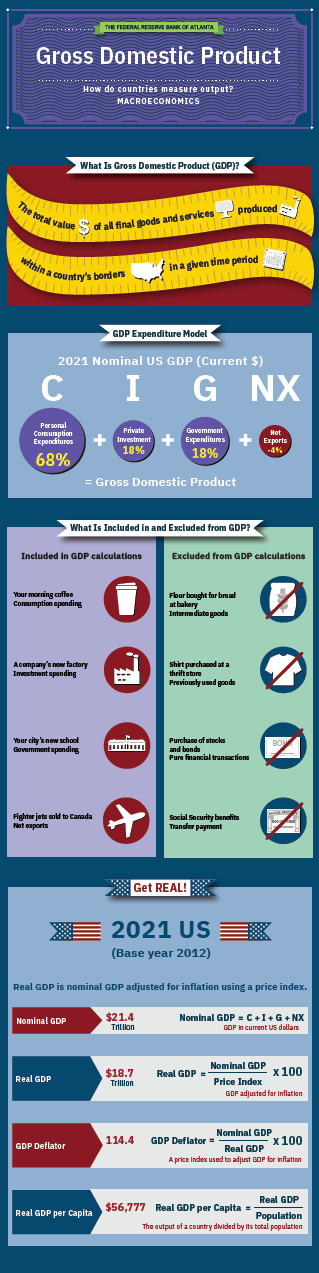
This infographic summarizes the expenditure approach by organizing GDP into the four spending components and presenting the identity . It also contrasts included vs. excluded items (e.g., intermediate goods, used goods, and purely financial transactions), which helps prevent common classification errors when applying the GDP rules. Source
= Gross domestic product, dollar value per year (or per quarter at an annual rate)
= Consumption spending by households, dollars per year
= Investment spending by firms and households on new capital, dollars per year
= Government purchases of goods and services, dollars per year
= Net exports (), dollars per year
This identity is an accounting relationship used to organize spending; it does not, by itself, explain why GDP changes.
Components of Aggregate Expenditure
Consumption (C)
Consumption is household spending on goods and services. It is typically the largest component of GDP.
Included in C:
Durable goods (long-lasting items)
Nondurable goods (short-lived items)
Services (e.g., housing services, healthcare, transport)
Excluded from C (not current production):
Purchases of existing assets (e.g., existing homes, stocks and bonds)
Investment (I)
In macroeconomics, investment means spending on newly produced capital goods and additions to inventories, not financial investing.
Investment (I): Spending on new capital goods (physical capital), new residential construction, and changes in business inventories during the period.
Included in I:
Business fixed investment (equipment, structures)
Residential investment (new housing)
Inventory investment (unsold goods added to inventories)
Common AP pitfall: buying shares of stock is a financial transaction and is not counted in GDP.
Government Purchases (G)
G includes government spending on currently produced goods and services that use resources and generate production.
Included in G:
Salaries of public employees (a government-provided service)
Infrastructure projects and defense purchases
Excluded from G:
Transfer payments (e.g., Social Security, unemployment benefits) because they are not payments for current production
Net Exports (NX)
Net exports adjust for international trade by adding spending on domestic output by foreigners and subtracting domestic spending on foreign output.
Included in NX:
Exports (X): domestically produced goods and services sold abroad (added)
Imports (M): foreign-produced goods and services purchased domestically (subtracted)
Imports are subtracted because they may be embedded in consumption, investment, or government purchases but are not produced domestically, so they must be removed to keep GDP “domestic.”
Measurement Notes Students Must Apply
Count only final goods and services: intermediate goods are excluded to prevent double counting.
Count production within the country: the expenditure approach targets domestic output, not output by domestic firms abroad.
Use consistent period measurement: GDP is a flow over time (e.g., a year), not a stock at a point in time.
Practice Questions
(2 marks) State the expenditure approach equation for GDP and identify what represents.
1 mark:
1 mark: is net exports, i.e. (exports minus imports)
(6 marks) Explain why imports are subtracted in the expenditure approach and why transfer payments are excluded from .
Up to 3 marks (imports):
1 mark: Imports are included within , , or when purchased domestically.
1 mark: Imports are not produced domestically, so they must be removed to measure domestic output.
1 mark: Subtracting prevents overstating GDP and ensures counts only domestic production.
Up to 3 marks (transfers):
1 mark: Transfer payments are not payments for currently produced goods/services.
1 mark: Transfers redistribute income rather than generate production in the period.
1 mark: Therefore transfers are excluded from in .
FAQ
GDP investment counts spending on newly produced capital (equipment, structures, inventories, new housing). Financial purchases swap ownership claims and do not directly represent current production.
They enter GDP as inventory investment: production is counted when made, and an unsold item is recorded as an increase in inventories within $I$.
No. Interest payments are not purchases of newly produced goods or services; they are financial payments, so they are excluded from $G$.
It is counted in residential investment within $I$, not in $C$, because it is treated as a durable capital asset in national income accounting.
The value of imported components is embedded in spending ($C$, $I$, or $G$), then removed when imports $M$ are subtracted as part of $NX = X - M$.