AP Syllabus focus: ‘GDP measures the final output produced within an economy over a given time period.’
Gross Domestic Product (GDP) is the headline statistic for tracking an economy’s production over time. Understanding exactly what GDP counts—and what it deliberately leaves out—is essential before learning how it is calculated.
What GDP Means
Gross Domestic Product (GDP): the market value of all final goods and services produced within a country’s borders in a specific time period (typically a year or a quarter).
GDP is designed to measure production, so it focuses on goods and services newly produced during the period. The phrase “GDP measures the final output produced within an economy over a given time period” highlights three core ideas: final output, within an economy, and over time.
“Within an economy”: the domestic principle
GDP uses a location-based rule: production counts if it occurs inside the country, regardless of who owns the resources or firms.
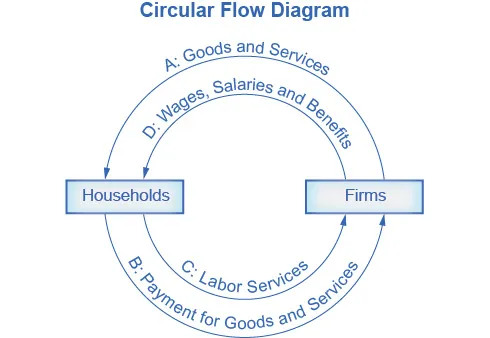
A two-sector circular-flow diagram showing households and firms interacting in the product market (goods and services) and the factor market (labor/resources). The “real flow” of goods/services and resources moves one direction, while the “money flow” (spending and income) moves the other, illustrating why total expenditure on final goods equals total income earned from production. Source
Output produced by a foreign-owned factory operating domestically is included.
Output produced by a domestically owned factory located abroad is excluded.
“Over a given time period”: a flow variable
GDP is a flow, meaning it measures activity per period, not at a point in time.
Flow variable: a measure recorded over an interval of time (for example, per year), rather than at a single moment.
Because GDP is tied to a time period, it is reported at an annual rate (even when measured quarterly).
The Importance of “Final” Output
GDP counts final goods and services to avoid double counting—adding the same production multiple times as it moves through supply chains.
Final good (or service): a product purchased for ultimate use by consumers, firms, government, or foreign buyers, not for resale or further processing in that period.
A key implication is that many business-to-business purchases are intermediate and are not counted separately in GDP if they are embodied in a final product sold that period.
What “goods and services” includes
GDP includes tangible goods (like appliances) and services (like medical care), as long as they are:
Produced during the time period
Produced within the country
Sold legally in markets (so a market value can be observed)
“Market Value”: Using Prices to Add Unlike Items
GDP aggregates thousands of different products by valuing them at market prices. Market prices act as weights that reflect how much buyers are willing to pay, allowing apples, haircuts, and airplanes to be combined in a single dollar measure.
Market value also implies GDP counts only items with observable prices. If no market transaction occurs, it is generally not included, even if it contributes to well-being.
What GDP Excludes (and Why)
GDP’s definition implies several standard exclusions that help it measure current domestic production cleanly:
Intermediate goods: excluded to prevent double counting (their value is included in the final good’s price).
Used goods: excluded because they were produced in an earlier period; only services related to the sale (like broker fees) reflect current production.
Purely financial transactions: buying stocks and bonds is an exchange of assets, not production of new goods/services.
Transfer payments (such as certain government benefits): they redistribute income but are not payment for newly produced output.
Unpaid household labour and volunteering: valuable, but typically nonmarket and thus not priced in official GDP.
These exclusions reflect GDP’s purpose: measuring market-based production within borders during a specified time frame, not measuring total welfare.
Interpreting GDP Carefully
GDP is often treated as a shorthand for “how the economy is doing,” but its meaning is narrower: it measures output, not happiness, fairness, or sustainability. For AP Macroeconomics, the priority is precision: GDP is about final domestic production over time, expressed in market value.
Practice Questions
(2 marks) Define GDP and state two key features embedded in the definition.
Correct definition of GDP as market value of final goods and services produced within a country in a given period. (1)
Any two features, e.g. “final”, “within borders”, “time period/flow”, “market value”. (1)
(6 marks) Explain why GDP includes only final goods and services and excludes used goods and transfer payments.
Explains final goods prevent double counting of intermediate inputs. (2)
Explains used goods are excluded because they are not produced in the current period (only associated services count). (2)
Explains transfer payments are not payments for current production; they redistribute income. (2)
FAQ
They estimate values using the cost of production (wages, supplies, depreciation).
This imputes a market-like value even without a direct sale.
Market prices provide a common unit to aggregate diverse outputs.
Quantities alone cannot combine different goods without weights.
Some countries attempt adjustments for hidden activity using surveys and discrepancies.
Coverage varies by statistical agency and data quality.
New construction is current production.
Most home sales are exchanges of existing assets; only agent and legal services add current output.
GDP is territory-based (domestic).
Citizenship-based production is captured by a different concept, national output measures.