AP Syllabus focus: ‘GDP can also be measured as total income earned by factors of production in the economy.’
These notes explain how GDP can be measured by adding up the incomes generated from producing final goods and services. This “income approach” links production to factor payments and clarifies common measurement adjustments.
What the Income Approach Measures
The income approach to GDP calculates total output by summing the incomes paid to factors of production (labor, land, capital, entrepreneurship) for producing goods and services within a country’s borders in a given period.
Factor income: income earned by the factors of production, such as wages to labor, rent to landowners, interest to capital owners, and profit to entrepreneurs.
Because each dollar of spending on final output becomes someone’s income, the income approach is another way to capture the same underlying economic activity measured by GDP.
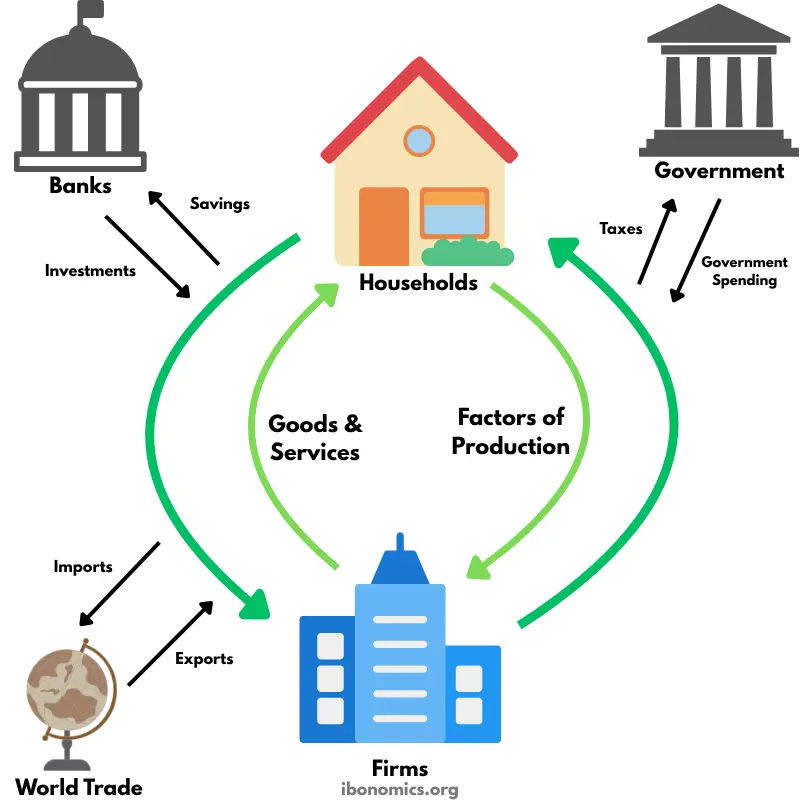
A circular-flow diagram showing households and firms linked through the product market and the factor (resource) market. The figure highlights how firms’ sales revenue is paid out as wages, rent, interest, and profit to households, which then spend that income on final goods and services. This visualization reinforces why, in aggregate, expenditure and income are two perspectives on the same GDP total. Source
Core Income Components (Factor Payments)
National accounting groups income into major categories tied to production.
Labor income
Compensation of employees: wages and salaries plus nonwage benefits (for example, employer-paid health insurance and retirement contributions).
This is typically the largest share of income in many economies.
Capital and business income
Interest income: payments for the use of financial capital (net of some financial intermediation details in official accounts).
Corporate profits: profits earned by corporations (before or after certain tax/accounting adjustments depending on the reporting concept).
Proprietors’ income / mixed income: income of unincorporated businesses (often blends labor and profit components).
Rental income: income earned by property owners from providing the use of land or structures.
Why these categories matter
They connect production to distribution: GDP is not just “how much is produced,” but also “how much income is generated.”
They help explain how changes in output may affect different groups (workers vs. owners of capital), even when total GDP moves the same way.
Adjustments Needed to Reach GDP at Market Prices
Adding factor incomes alone does not always equal GDP measured at market prices because market prices include items not paid directly to factors, and because production uses long-lived capital.
Indirect business taxes (taxes on production and imports): taxes such as sales taxes and excise taxes that raise market prices but are not paid as factor income.
Key adjustments commonly included:
Add indirect business taxes (and typically subtract subsidies, when treated explicitly) to move from factor-cost concepts toward market prices.
Add depreciation (also called consumption of fixed capital) to account for wear and tear on machines, buildings, and equipment used up in production.
A useful way to organize the calculation is:
= gross domestic product measured by income, dollars per year
= compensation of employees (wages and benefits), dollars per year
= rental income, dollars per year
= interest income, dollars per year
= profits (corporate and other business profit-type income), dollars per year
= indirect business taxes, dollars per year
= subsidies, dollars per year
= depreciation (consumption of fixed capital), dollars per year
This structure emphasizes that GDP is gross (it includes depreciation) and is valued at market prices (which incorporate indirect taxes net of subsidies).
Measurement and Data Issues to Know
Imputed income: some production does not involve a direct market payment (for example, certain housing services); statisticians may estimate values so GDP reflects production more completely.
Timing and reporting differences: income may be recorded when earned, received, or reported, creating mismatches across data sources.
Statistical discrepancy: official accounts may show a gap between income-based and expenditure-based GDP due to measurement error; agencies often publish a discrepancy to reconcile totals without changing the conceptual identity.
Practice Questions
(2 marks) State two components of GDP measured using the income approach.
1 mark for each correctly identified component (any two): wages/compensation of employees; rent; interest; profits; indirect business taxes (net of subsidies); depreciation.
(6 marks) Explain why GDP measured by the income approach requires adjustments beyond summing factor incomes, and describe two such adjustments.
1 mark: recognises that factor incomes alone may not equal GDP at market prices.
2 marks: explains indirect taxes (net of subsidies) are included in market prices but not paid to factors (1) and therefore must be added net (1).
2 marks: explains depreciation reflects capital used up in production (1) and must be added to make GDP “gross” rather than “net” (1).
1 mark: coherent linkage to measuring domestic production over a period.
FAQ
Statisticians often record a single figure because self-employed income blends wage-like labour earnings and profit-like returns.
In practice, it may be reported as proprietors’ income rather than split cleanly into wages and profits.
Some output generates value without explicit cash payments (e.g., housing services).
Imputation estimates a market-equivalent value so income-based GDP better reflects actual production.
It is the published difference between income- and expenditure-based estimates due to sampling, timing, and reporting limits.
It signals measurement uncertainty, not a failure of the underlying identity.
Subsidies reduce the market price needed for producers to supply output.
Accounts commonly use $(T_{\text{ind}} - S)$ so GDP reflects market prices net of government price support.
When analysing distributional questions (labour share vs profit share) or when spending data are noisier.
It can also help cross-check unusual movements in consumption or investment data.