AP Syllabus focus: ‘Inflation is rising prices, deflation is falling prices, and disinflation is a slowing inflation rate.’
Inflation terminology can be confusing because it describes both the direction and the pace of changes in the overall price level. This page clarifies the precise meanings of inflation, deflation, and disinflation, and how to interpret each.
Core concepts: the price level and its rate of change
Price level vs. inflation rate
A price level is an index of average prices across the economy at a point in time; inflation concerns how that level changes over time.
Inflation: A sustained increase in the overall price level (equivalently, a positive inflation rate).
Inflation means purchasing power falls over time: a unit of currency buys fewer goods and services on average.
To discuss inflation precisely, economists refer to the inflation rate (the percent change in the price level over a period).
= price index in the current period (index units)
= price index in the previous period (index units)
A positive value indicates inflation; a negative value indicates deflation; a smaller positive value than before indicates disinflation.
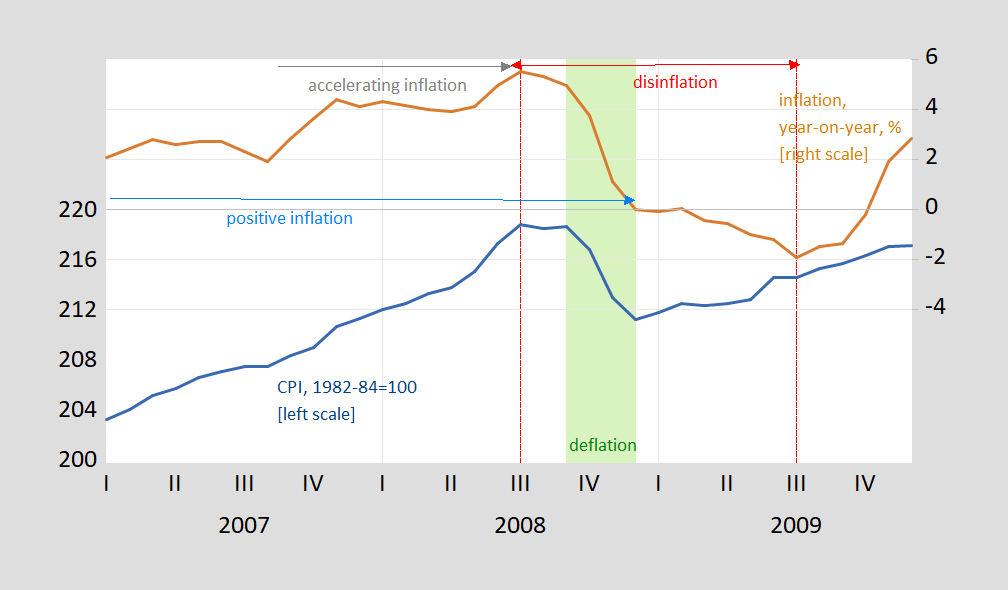
This figure plots the CPI price level (blue, left axis) alongside the year-over-year inflation rate (orange, right axis), making it clear that inflation is the rate of change of the price level, not the price level itself. The labeled regions highlight that disinflation means the inflation rate is falling while still remaining above zero, whereas deflation corresponds to a negative inflation rate and a falling price level. Source
Inflation: rising prices (positive inflation rate)
What inflation implies
Inflation occurs when the overall price level rises, not when one particular price rises. Key implications:
The general cost of living increases over time.
The real value (purchasing power) of money falls.
Many nominal variables (wages, rents, contracts) may adjust with a lag, so inflation can change real outcomes temporarily.
Interpreting inflation carefully
Inflation can coexist with falling prices in some categories. What matters is the average movement captured by a broad price index. Inflation is also distinct from a one-time increase in the price level; persistent inflation refers to an ongoing tendency for the price level to keep rising period after period.
Deflation: falling prices (negative inflation rate)
Deflation: A sustained decrease in the overall price level (a negative inflation rate).
What deflation implies
Deflation means the general cost of living is falling and the purchasing power of money is rising. However, in macroeconomic analysis, deflation can be concerning because:
It raises the real burden of nominal debts (fixed dollar repayments become “heavier” in real terms).
If households and firms expect further price declines, they may postpone spending, reducing current demand.
Downward rigidity in some wages and prices can make adjustments difficult, potentially worsening unemployment.
Deflation vs. “prices are lower”
Deflation is economy-wide and sustained. A short-lived drop in energy prices, or a permanent drop in the price of a single technology product, is not deflation unless it contributes to a broad, ongoing decline in the overall price level.
Disinflation: inflation is slowing (inflation rate is falling but still positive)
Disinflation: A decrease in the inflation rate (prices still rise, but more slowly).
What disinflation implies
Disinflation describes a change in the pace of inflation:
The price level continues to rise, but at a reduced rate.
The purchasing power of money still falls, just less rapidly.
It is common during periods when inflationary pressures ease (for example, when price-setting becomes less aggressive across the economy).
Common student confusion: disinflation is not deflation
The simplest way to distinguish:
Inflation: inflation rate
Disinflation: inflation rate falls (e.g., from 6% to 2%) but remains
Deflation: inflation rate
Disinflation can feel like “prices are coming down” because price increases become less noticeable, but the overall price level is still higher than before.
Comparing the three in terms of the price level path
Visualising the difference without a graph
Think of the price level as a path over time:
With inflation, the path slopes upward.
With disinflation, the path still slopes upward, but it becomes flatter (a smaller upward slope).
With deflation, the path slopes downward.
Why the distinction matters
These terms change how economists interpret macroeconomic conditions:
Inflation and disinflation both involve rising prices, so cost-of-living pressures persist, but at different intensities.
Deflation reverses the direction of price-level change, which can interact strongly with expectations and fixed nominal obligations.
Practice Questions
(2 marks) Define deflation and state how it differs from disinflation.
1 mark: Deflation is a sustained fall in the overall price level / negative inflation rate.
1 mark: Disinflation is a fall in the inflation rate while inflation remains positive (prices still rising).
(5 marks) Explain the difference between inflation, disinflation, and deflation using the inflation rate and the behaviour of the overall price level.
1 mark: Inflation: overall price level rising; inflation rate .
1 mark: Deflation: overall price level falling; inflation rate .
1 mark: Disinflation: inflation rate decreases but remains ; price level still rises.
1 mark: Clear comparison of “direction” (deflation vs inflation) versus “speed” (disinflation).
1 mark: Accurate statement that disinflation is not falling prices, just slower increases.
FAQ
Yes. Disinflation is about the overall inflation rate falling, not every individual price. Some categories can rise faster while others rise more slowly (or fall), pulling down the overall rate.
It means the change in the overall price level persists over multiple periods, not a one-off movement. Economists look for a continuing pattern rather than a temporary fluctuation.
If people expect prices to keep falling, delaying purchases becomes more attractive, which can reduce current spending. Disinflation still involves rising prices, so the incentive to delay purely for lower prices is weaker.
Yes. Zero inflation means the price level is roughly constant over the period (inflation rate $\approx 0$). It is neither inflation nor deflation; it can occur between disinflation and deflation if the rate falls towards zero.
Because the price level is still rising, so budgets remain under pressure. Disinflation only means the rate of increase is smaller; it does not reverse previous increases in the price level.