AP Syllabus focus: ‘Real variables adjust nominal values for changes in the price level.’
Understanding the difference between nominal and real values is essential for interpreting economic data over time. This distinction separates changes caused by actual output or purchasing power from changes caused only by rising prices.
Core Idea: Nominal vs Real
Nominal values (current-dollar measures)
Nominal value: a measured value expressed in current prices (the prices that exist in the year the value is recorded), not adjusted for inflation.
Nominal values can rise simply because the price level rises, even if the quantity of goods and services (or purchasing power) is unchanged.
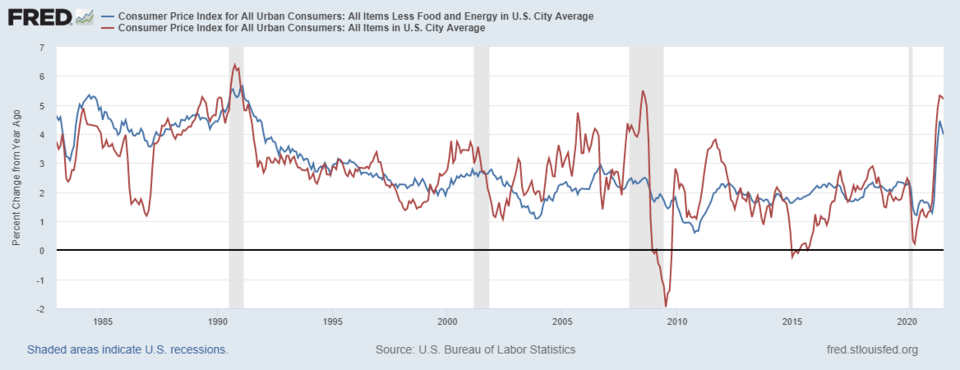
This chart plots the Consumer Price Index over time (showing both core CPI and headline CPI-U), illustrating how the overall price level typically rises across decades. Because CPI is an index (normalized to a base period), its vertical scale represents relative price levels rather than dollars. It visually motivates why nominal dollar series often trend upward even when real purchasing power is not increasing at the same pace. Source
Because most transactions are recorded in dollars, many reported series (wages, sales, GDP, income) are naturally nominal.
Real values (inflation-adjusted measures)
Real value: a measured value expressed in constant prices, adjusted for changes in the price level so it reflects purchasing power or true quantity changes.
The syllabus focus—real variables adjust nominal values for changes in the price level—means real values are constructed to remove the effects of inflation (or deflation). This makes real measures better for comparing economic performance across time.
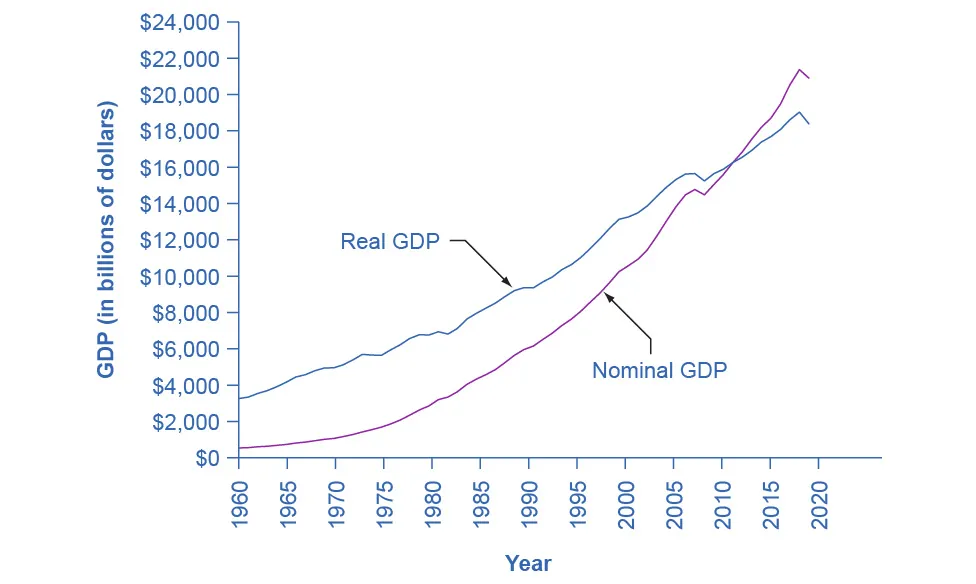
This figure shows nominal GDP and real GDP plotted over time, highlighting how the nominal series grows faster because it includes both quantity changes and price-level changes. Real GDP is expressed in constant (base-year) dollars, so its slope reflects changes in actual output rather than inflation. The visual also helps students remember that nominal and real are equal in the base year of the price index used to deflate GDP. Source
Why the Adjustment Matters
When the overall price level changes, a dollar in one year does not buy the same amount as a dollar in another year. Therefore:
Nominal changes mix together:
changes in quantities/real activity, and
changes in prices.
Real changes isolate:
changes in quantities/purchasing power, holding the price level constant.
This is why economists use real measures to answer questions like “Are people better off?” or “Did output actually grow?” rather than “Did dollar values rise?”
Converting Nominal to Real Using a Price Index
A price index (such as CPI) summarizes the price level relative to a base year. Converting nominal values into real values requires dividing by the price index (scaled appropriately). If a price index uses a base of 100, the standard adjustment is:
= inflation-adjusted amount in base-year dollars
= current-dollar amount
= index of the price level (base year = 100)
This conversion embodies the syllabus statement: the real variable “backs out” price-level changes so comparisons over time reflect purchasing power.
Interpreting Real vs Nominal in Common Macroeconomic Contexts
Income and wages
A nominal wage may rise, but if the price level rises faster, the real wage (purchasing power of earnings) can fall. Real wages are the relevant concept for living standards because they indicate what workers can actually buy.
Spending and sales
Higher nominal sales revenue can result from:
selling more goods/services (a real increase), or
charging higher prices (an inflation effect).
Using real values helps businesses and policymakers judge whether demand is truly stronger or simply inflated.
Interest rates
Loan contracts are written in nominal terms, but what matters for borrowers and lenders is the inflation-adjusted outcome.
Real interest rate: the interest rate adjusted for inflation; it reflects the real cost of borrowing and the real return to lending.
A common approximation is:
= real interest rate (percent per year)
= nominal interest rate (percent per year)
= inflation rate (percent per year)
Real vs nominal interest concepts connect directly to purchasing power: inflation erodes the value of money repaid in the future, changing the real burden of debt.
Practical Guidance for AP-Style Interpretation
If a question asks about purchasing power, standard of living, or true growth, use real values.
If a question asks about values as recorded in current dollars, or about money totals paid/received, use nominal values.
Over long periods or high inflation, nominal series can be misleading; real series are preferred for meaningful time comparisons.
Practice Questions
(2 marks) Distinguish between a nominal value and a real value.
1 mark: Nominal values are measured in current prices/current dollars and are not adjusted for inflation.
1 mark: Real values are adjusted for changes in the price level (inflation) to reflect constant purchasing power/constant prices.
(6 marks) Explain how inflation can cause nominal wages to rise while real wages fall. In your answer, refer to a price index and the concept of purchasing power.
1 mark: Nominal wage is the money wage measured in current pounds/dollars.
1 mark: Real wage reflects purchasing power and is adjusted for the price level.
1 mark: Inflation means the price level rises, captured by a price index increasing.
1 mark: If nominal wages rise by a smaller percentage than the price index (inflation rate), purchasing power falls.
1 mark: Therefore real wages can decrease even when nominal wages increase.
1 mark: Clear linkage to fewer goods/services affordable (reduced purchasing power).
FAQ
Because “real terms” removes the effect of changing prices.
This allows a like-for-like comparison of purchasing power across time, especially when inflation differs substantially between years.
It means values are expressed using the price level of the base year in the index.
The base year is assigned 100, so “base-year dollars” represent what the amount would buy at that year’s overall prices.
Yes. The same underlying concept (e.g., wages, income, sales) can be reported either way.
Nominal: current-money units
Real: adjusted using a price index to constant-money units
Because most indices are scaled so the base year equals 100.
Dividing by $(Index/100)$ converts current dollars into base-year purchasing power by stripping out the index’s measured price-level change.
If the price level falls, the price index decreases.
Holding the nominal amount constant, the real value rises because the same nominal dollars buy more goods and services when prices are lower.