AP Syllabus focus: ‘Real values are calculated by adjusting nominal values using a price index.’
Real variables let economists separate changes in quantities from changes in prices. This page explains how to convert nominal (current-dollar) measurements into real (inflation-adjusted) values using a price index, so comparisons across time are meaningful.
Core idea: deflating nominal values
A nominal variable records economic values using the prices that prevailed when the transaction occurred. A real variable removes the effects of changing prices by expressing values in the purchasing power of a chosen base year.
Key term: price index
A price index provides the scaling factor used to adjust for inflation.
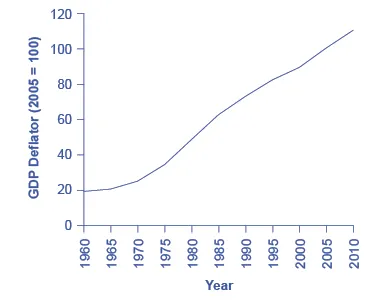
This graph plots the U.S. GDP deflator (a broad price index) over time with a base year of 2005 = 100. It provides an intuitive picture of the idea that the “price level” is an index number that changes across years, which is exactly what you divide by when converting nominal values to real values. Source
Price index: A measure of the price level relative to a base year (typically set to 100), used to compare prices across time.
In AP Macroeconomics, the calculation of real variables relies on treating the price index as the “price level” for a given year.
The main conversion formula (real = nominal adjusted by an index)
When a price index is expressed with base year = 100, convert a nominal value into real terms by dividing by the index (as a fraction of 100). This process is called deflating.
= current-dollar amount measured in that year’s prices (dollars)
= index number for the year (base year )
= inflation-adjusted amount in base-year dollars (dollars)
Deflating matters because a rising nominal figure may reflect higher prices rather than higher purchasing power or greater real output.
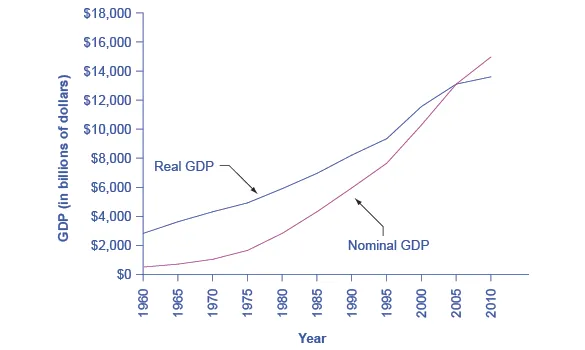
This figure compares U.S. nominal GDP (current dollars) to real GDP (inflation-adjusted dollars in a base year). The widening gap between the two lines over time visualizes how inflation inflates nominal measures, so real measures are needed to isolate changes in actual output. Source
Interpreting the formula
If the price index rises, each dollar buys less, so the same nominal value corresponds to a smaller real value.
If the price index falls (deflation), the same nominal value corresponds to a larger real value.
The “” step converts an index like 125 into a multiplier of 1.25.
Steps for calculating real variables (process)
Use this sequence whenever you’re told to “adjust for inflation” using a given price index.
Deflating a nominal value into base-year dollars
Identify the nominal value (income, wage, spending, etc.).
Identify the price index for the same period as the nominal value.
Convert the index to a price-level factor by dividing by 100.
Compute real value using the deflation formula.
State the unit correctly: base-year dollars (inflation-adjusted dollars).
Inflating a real value into nominal dollars (reverse operation)
Sometimes you are given a real value (in base-year dollars) and asked for nominal.
Multiply the real value by for the target year.
This converts purchasing-power dollars back into the dollar amounts observed at that time.
What counts as a “real variable” in AP Macroeconomics
Any nominal measure that is directly affected by the overall price level can be converted into a real measure using the same logic.
Common real-variable applications
Real income: compares purchasing power of earnings across years.
Real wage: shows what an hourly wage can actually buy over time.
Real consumption or spending: distinguishes more goods/services purchased from merely higher prices.
Real interest rate (inflation-adjusted return): connects nominal interest to purchasing-power gains (often approximated with inflation data, but the central idea is still “nominal adjusted for the price level”).
Avoiding common mistakes
Match the timing
Use the price index from the same year/period as the nominal value you are deflating.
If the data are quarterly or monthly, use the index for that same frequency.
Keep the base-year interpretation straight
Real values are always expressed in the base year’s dollars (the year where the index equals 100).
If an index is rebased, real values expressed under the new base year will have different numeric magnitudes but the same underlying comparisons.
Recognise what “real growth” implies
When real values rise over time, the increase reflects more purchasing power or more quantity, not just higher prices. When nominal values rise but real values do not, the change is mainly price-level driven.
Why AP Macroeconomics emphasises real calculations
Calculating real variables is essential for:
identifying whether living standards (purchasing power) are improving,
comparing economic performance across time without inflation distorting the picture,
interpreting reported economic series that mix quantity and price changes.
Practice Questions
Question 1 (3 marks) A worker’s nominal hourly wage is $20 in Year 1. The price index (base year = 100) is 125 in Year 1. Calculate the worker’s real hourly wage in base-year dollars.
Uses the correct deflation relationship: (1)
Correct substitution: (1)
Correct real wage result (base-year dollars): (1)
Question 2 (6 marks) Nominal income is 60{,}000 in Year B. The price index (base year = 100) is 100 in Year A and 150 in Year B. (a) Calculate real income in Year A dollars for both Year A and Year B. (4 marks) (b) Using your results, state whether purchasing power rose, fell, or stayed the same. (2 marks)
Real income in Year A: (since index = 100) (2: method + correct value)
Real income in Year B: (2: method + correct value) (b)
Correct comparison: real income decreases from to (1)
Correct statement: purchasing power fell (1)
FAQ
Most indices are scaled so the base year equals 100.
Dividing by 100 converts the index into a usable multiplier (e.g., 150 becomes 1.5), which represents how much higher the price level is relative to the base year.
You can still deflate nominal values, but you must use the index in its correct scaling.
If the base is 1.00, divide by the index directly.
If the base is 2017 = 100, treat it like the standard case.
If rebased, ensure all comparisons use the same base.
Rebasing changes the numeric size of real values (because “base-year dollars” change), but it should not change the underlying pattern of real changes.
If two series are rebased differently, convert them to a common base before comparing levels.
Yes, by using a ratio of indices, effectively applying a price-level conversion between years.
Conceptually: multiply nominal Year B by $\frac{Index_A}{Index_B}$ (with consistent scaling). This expresses Year B values in Year A purchasing power.
Small differences often come from rounding the index factor (e.g., using 1.25 vs 1.250).
Use the precision given in the question, show your setup clearly, and round only at the final step unless instructed otherwise.