AP Syllabus focus: ‘Real GDP measures output using constant prices to remove the effects of inflation.’
Real GDP is the key measure economists use to separate changes in actual production from changes in prices. It helps you interpret growth, recessions, and living standards without confusing inflation with more output.
What Real GDP Means
When an economy produces more goods and services, GDP should rise. But GDP can also rise simply because prices increased. Real GDP fixes this by valuing production at constant prices, so the number reflects changes in quantities produced rather than changes in the overall price level.
Real GDP: the value of final goods and services produced within a country’s borders, measured using constant (base-year) prices so inflation does not distort output.
Real GDP is still about domestic production and final goods and services, just like nominal GDP; the difference is the pricing rule used to value that production.
Constant Prices and the Base Year
“Constant prices” means statisticians pick a base year and use that year’s prices to value output in other years.
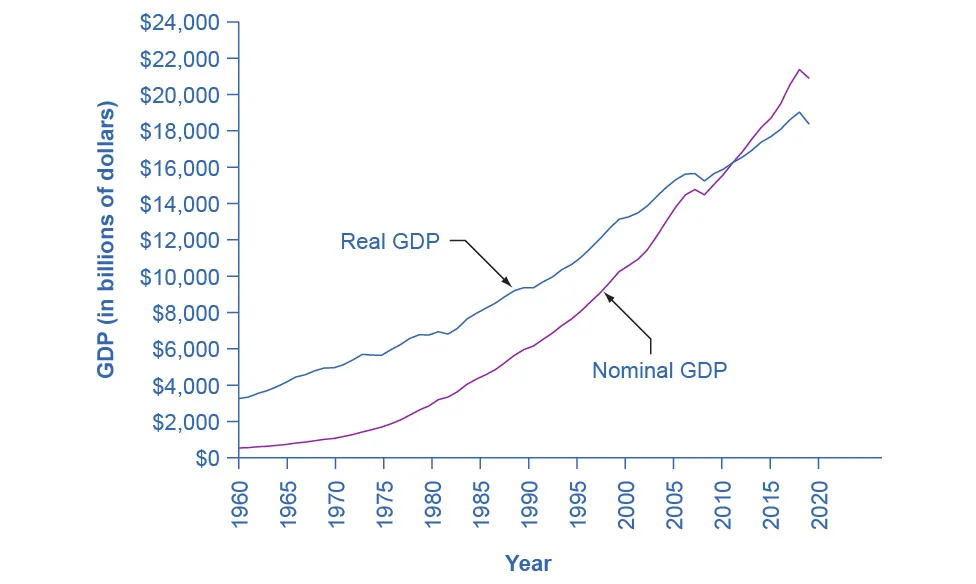
This graph shows nominal GDP measured in current dollars and real GDP measured in constant (base-year) dollars. Because the base year’s price index is set to 100, nominal and real GDP coincide in the base year, but diverge as prices change in other years. The widening gap illustrates how inflation can make nominal GDP growth look larger than growth in real production. Source
By holding prices fixed, any change in real GDP comes from changes in quantities.
Base year: the reference year whose prices are used to value output when calculating real GDP in constant dollars.
This constant-price approach is what allows real GDP to “remove the effects of inflation” as required by the syllabus.
Core Measurement Idea (No Inflation Distortion)
Real GDP can be expressed as valuing current production at base-year prices.
= Price of good/service in the base year (dollars per unit)
= Quantity of good/service produced in the current year (units)
Even if today’s prices are much higher, real GDP ignores those newer prices; it answers: “How much would this year’s output be worth at base-year prices?”
Why AP Macroeconomics Uses Real GDP
Real GDP is the standard output measure for tracking economic growth and business cycle conditions because it focuses on production, not price changes.
It is especially useful for:
Comparing output over time: separating genuine growth from inflation-driven increases in dollar values
Evaluating macro performance: judging whether the economy is expanding or contracting in real terms
Policy context: providing a cleaner signal about changes in production that fiscal and monetary policy respond to
Common Interpretation Pitfalls
Students often confuse “GDP went up” with “the economy produced more.” Real GDP avoids that confusion, but you still must interpret it carefully:
Real GDP rising suggests higher real output (more quantities of final goods/services)
Real GDP falling suggests lower real output, often associated with recessionary conditions
Real GDP does not directly measure well-being or distribution; it measures inflation-adjusted production
Practice Questions
Question 1 (1–3 marks) Define real GDP and state one reason economists prefer it to nominal GDP when assessing changes in output over time. (3 marks)
1 mark: Real GDP defined as GDP measured using constant/base-year prices.
1 mark: States it removes the effects of inflation/price-level changes.
1 mark: Explains preference: allows comparison of real output/quantities over time (not just higher prices).
Question 2 (4–6 marks) Explain how using constant prices allows real GDP to measure changes in production rather than changes in the price level. In your answer, refer to the idea of a base year. (6 marks)
1 mark: Identifies that nominal GDP uses current prices and can rise due to inflation.
1 mark: Explains constant prices hold prices fixed across years.
1 mark: Correct reference to base year as the year providing the fixed prices.
1 mark: Explains that valuing current quantities at base-year prices isolates quantity changes.
1 mark: Links this to interpreting growth/recession as changes in real output.
1 mark: Clear economic reasoning throughout (e.g., distinguishes price effects from quantity effects).
FAQ
Base years are updated periodically to keep prices relevant.
Rebasing reduces distortion from outdated relative prices, but it can revise previously published real GDP growth rates.
Chain-weighting updates the price weights more frequently and links (chains) successive years.
It reduces bias that can occur when one fixed base year becomes unrepresentative of current consumption and production patterns.
Yes. Real GDP depends on quantities valued at base-year prices.
Large current-year price movements affect nominal GDP more directly; real GDP can still rise if quantities produced increase overall.
Agencies try to adjust for quality change so that higher prices reflecting better performance are not misread as pure inflation.
These adjustments are complex and can change measured real growth.
Early estimates rely on partial data and projections.
As more complete surveys and administrative records arrive, statisticians update quantities and industry output, which can change real GDP levels and growth rates.