AP Syllabus focus: ‘Nominal GDP can be converted to real GDP using the GDP deflator.’
Converting between nominal and real GDP is mainly about separating changes in output from changes in the price level. AP Macroeconomics expects you to choose the correct measure and convert cleanly using the GDP deflator.
Core measures you are converting between
Nominal GDP vs real GDP
Nominal GDP: The value of final goods and services produced within a country measured using current-year prices (current dollars).
Nominal GDP rises when either quantities increase or prices increase, so it cannot by itself identify real growth.
Real GDP: The value of final goods and services produced within a country measured using constant prices (base-year dollars).
Real GDP isolates changes in quantities (real output) by holding prices fixed at a reference point.
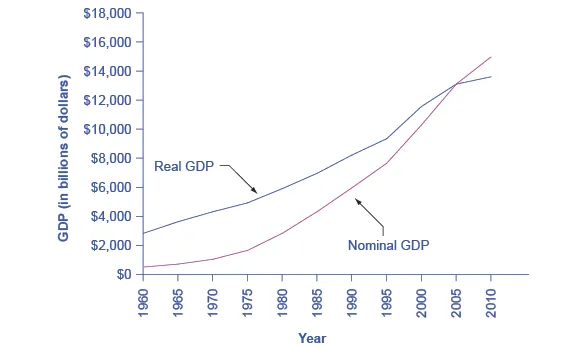
This line graph plots U.S. nominal GDP (current dollars) and real GDP (constant/base-year dollars) over time, showing how the nominal series typically rises faster when inflation is positive. The visual highlights that the gap between the two measures is driven by changes in the overall price level, not just changes in real output. Source
GDP deflator as the conversion tool
GDP deflator: A price index that measures the average price level of all final goods and services included in GDP, with the base year set to 100.
The deflator is an index number: values above 100 indicate prices are higher than in the base year; values below 100 indicate lower prices than in the base year. This “index scaling” is what makes the conversion formulas work.
Converting between nominal and real GDP
Convert nominal GDP to real GDP
Use this when you are given current-dollar GDP but need output in base-year dollars (inflation removed).
= inflation-adjusted GDP in base-year dollars
= GDP in current dollars
= price index (base year = 100)
Because the deflator is “per 100,” dividing by converts nominal dollars into base-year dollars. Conceptually, you are “deflating” nominal GDP by the amount prices have risen since the base year.
Convert real GDP to nominal GDP
Use this when you need to express real output in current dollars (adding back the current price level).
= GDP in current dollars
= GDP in base-year dollars
= price index (base year = 100)
Multiplying by “inflates” base-year-dollar production into current-dollar terms.
Process and common AP pitfalls
Quick conversion checklist
Identify what you have: nominal (current dollars) or real (base-year dollars).
Identify what you need: nominal or real.
Confirm the GDP deflator is indexed to 100 in a base year (so you must use “/100” in conversions).
Apply the appropriate formula and keep units straight: nominal is current dollars, real is base-year dollars.
Common mistakes to avoid
Forgetting to divide the deflator by 100 (treating the index as a percentage instead of an index).
Converting in the wrong direction (dividing when you should multiply, or vice versa).
Misinterpreting what “real” means: real GDP is not “more accurate,” it is specifically inflation-adjusted for comparing output across time.
Mixing years: the deflator used in the conversion must correspond to the same period as the nominal or real GDP figure you are converting.
Confusing the GDP deflator with other price indices; the conversion requires the GDP deflator when the question states it (or when working explicitly with GDP).
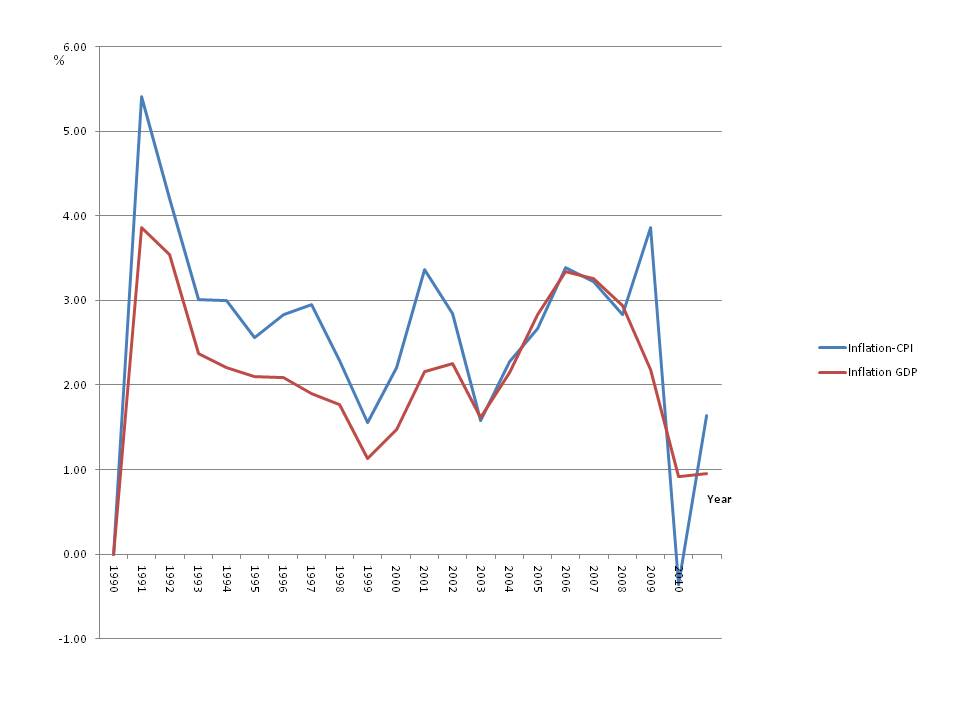
This chart compares inflation measured by the CPI and by the GDP deflator, illustrating that the two can move differently because they cover different baskets (consumer purchases vs. all domestically produced final goods and services). The comparison reinforces why AP questions that specify the GDP deflator require using that index rather than substituting CPI. Source
Practice Questions
Question 1 (1–3 marks) State the formula used to convert nominal GDP into real GDP using the GDP deflator.
(2 marks)
States that the GDP deflator is an index with base year = 100, hence “/100” (1 mark)
Question 2 (4–6 marks) Explain how the GDP deflator is used to convert between nominal GDP and real GDP, and explain what it means if the GDP deflator rises while real GDP is unchanged.
Defines nominal GDP as measured at current prices (1 mark)
Defines real GDP as measured at constant/base-year prices (1 mark)
Correct conversion direction for nominal to real: divide by (1 mark)
Correct conversion direction for real to nominal: multiply by (1 mark)
Explains that a rising deflator indicates a higher overall price level relative to the base year (1 mark)
Links given scenario: with real GDP unchanged, a higher deflator implies nominal GDP rises due to higher prices, not higher output (1 mark)
FAQ
Because it is an index number, not a decimal.
A base year is set equal to 100, so the deflator must be rescaled to “times base-year prices” by using $(GDP\ Deflator/100)$.
It means removing the portion of nominal GDP that is due purely to higher prices.
You are translating current-dollar values into base-year-dollar values so changes reflect quantities, not inflation.
A deflator below 100 indicates prices are lower than in the base year.
Dividing by $(GDP\ Deflator/100)$ (a number less than 1) increases the converted real GDP relative to nominal GDP, reflecting that current prices are “cheaper” than base-year prices.
Use direction-of-prices logic:
If the deflator is above 100 (prices higher than base year), real GDP should be lower than nominal GDP.
If the deflator is below 100, real GDP should be higher than nominal GDP.
Nominal GDP combines quantity and price effects.
If real GDP is flat, quantities are unchanged; a rising deflator indicates higher prices, so nominal GDP can still increase because the same output is valued at higher current prices.