AP Syllabus focus: ‘Real GDP is calculated by valuing output using prices from a base year.’
Real GDP is designed to measure changes in production over time without the distortion from changing prices. Calculating it requires fixing prices in a chosen base year so that only quantities drive differences in GDP.
Core idea: constant-price valuation
Real GDP is found by pricing each year’s output using base-year prices (also called constant dollars). This removes inflation’s effect so that comparisons across years reflect changes in real output.
Real GDP: The value of final goods and services produced within a country in a given period, calculated using prices from a base year to isolate changes in quantities.
Using a base year turns GDP into a “fixed price” measure, making growth rates more meaningful when the overall price level is changing.
Choosing and using a base year
What the base year does
The base year provides the set of prices used for valuation. Conceptually, you are asking: “What would this year’s output be worth if prices were the same as in the base year?”
Key implications:
Real GDP comparisons across years depend on holding prices constant.
Any change in real GDP between two years reflects changes in quantities produced (and the mix of goods and services), not price changes.
Base-year pricing logic
To compute real GDP for a given year:
Identify the quantities of each final good/service produced in that year.
Multiply each quantity by its base-year price.
Add up across all final goods and services.
This approach aligns with the AP emphasis that real GDP is calculated by valuing output using base-year prices, not current-year prices.
The calculation method (constant-price method)
Aggregate the value of final output at base-year prices
When applying the base-year method, remember:
Use final goods and services to avoid double counting.
Include only production within the country during the period.
= Real gross domestic product in year (dollars, base-year prices)
= Price of good/service in the base year (dollars per unit)
= Quantity of good/service produced in year (units)
= Number of final goods and services included (count)
In practice, statistical agencies compute these totals using very large baskets of goods and services and detailed production data, but the underlying method is the same.
Interpreting real GDP once calculated
What changes in real GDP mean
Because prices are fixed at base-year levels:
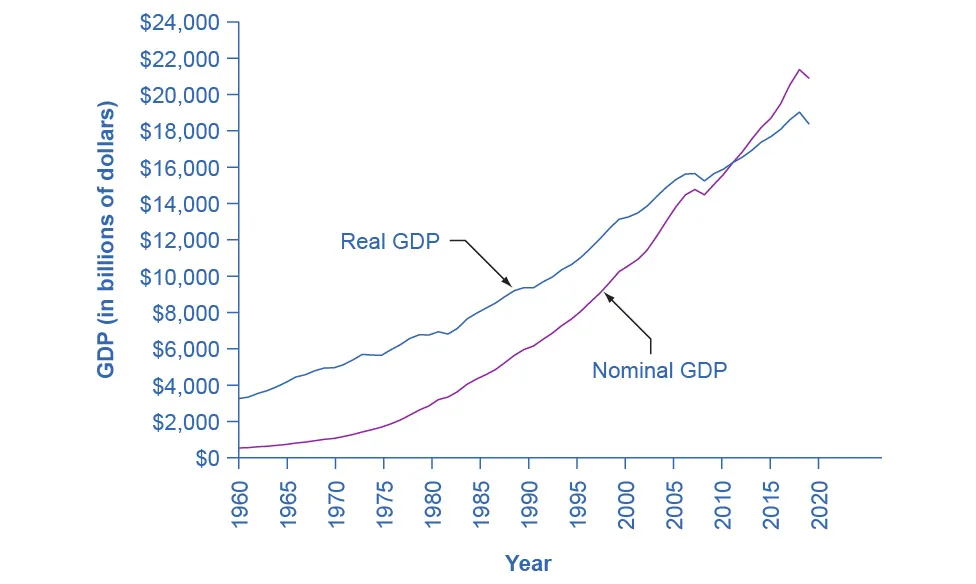
This figure plots U.S. nominal GDP and real GDP over time, showing how the two series coincide in the base/reference year and then diverge as the overall price level changes. The vertical separation between the lines illustrates why nominal GDP can rise faster than real GDP when inflation is positive. It provides an intuitive visual for “constant-dollar” valuation: real GDP tracks output changes after removing price effects. Source
Rising real GDP indicates higher total quantities of goods and services produced (more real output).
Falling real GDP indicates lower total quantities produced (less real output).
What real GDP is (and is not) capturing
Real GDP calculated with base-year prices is intended to capture:
Changes in the level of production over time.
It is not intended to capture (and will not reflect):
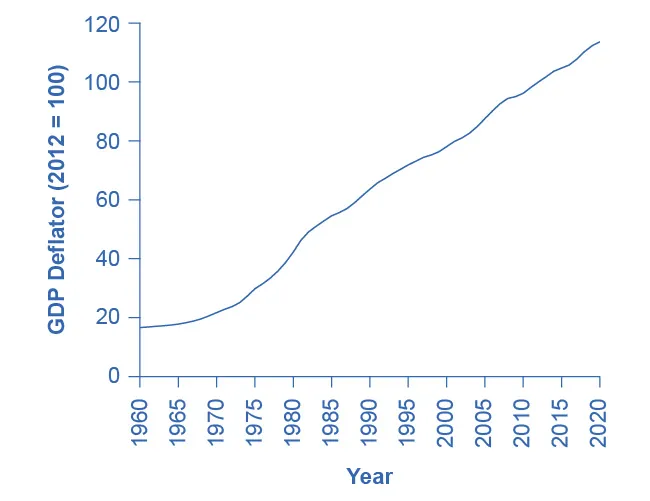
This graph shows the GDP deflator, a broad price index for domestically produced final goods and services, explicitly normalized so the base year equals 100. Because the index rises when the overall price level rises, it helps explain why constant-price (real) GDP strips out inflation while nominal GDP does not. Used alongside real GDP, the deflator clarifies the “price vs. quantity” separation central to base-year valuation. Source
Changes in the overall price level (those affect nominal measures, not constant-price valuation).
Common precision points AP expects
Consistency in pricing
To correctly calculate real GDP:
The same base-year price set must be used for each year being compared.
If base-year prices are changed, the resulting real GDP series is not directly comparable without adjustment.
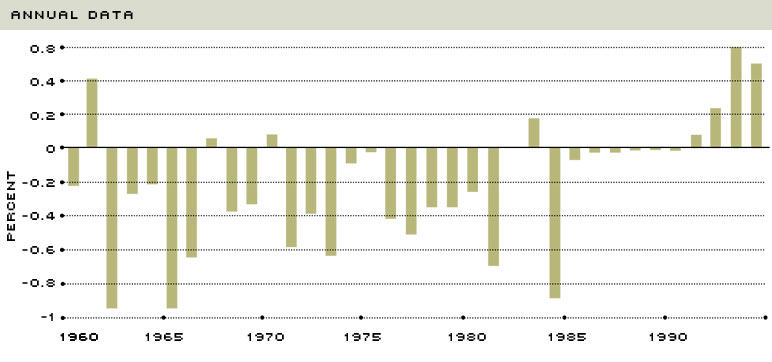
This bar chart shows the difference in measured real GDP growth when using fixed (base-year) weights versus chain weights. It illustrates the practical “base-year bias” problem: as the economy’s mix of goods and relative prices change, a fixed set of base-year prices can gradually distort measured growth. The visual helps connect the base-year idea in the notes to how official statistics handle changing economic structure. Source
Output focus
Real GDP is about current production valued at base-year prices:
It values what is produced in year , even though the prices come from the base year.
It does not value past production or purely financial transactions.
Practice Questions
(2 marks) Explain how using base-year prices helps isolate changes in real output when calculating real GDP.
1 mark: States that base-year prices are held constant (fixed).
1 mark: Explains that changes in real GDP then reflect changes in quantities/output rather than price changes (inflation/deflation).
(5 marks) Describe the steps required to calculate real GDP for a given year using the base-year method, and explain one reason why this method improves comparisons over time.
1 mark: Identify quantities of final goods/services produced in the given year.
1 mark: Use prices from the base year for each good/service.
1 mark: Multiply each base-year price by the current-year quantity for each item.
1 mark: Sum across all final goods/services to obtain real GDP.
1 mark: Explains improved comparison because it removes the effect of changing prices, so differences reflect real output changes.
FAQ
Statistical agencies choose a base year that is relatively “normal” and data-rich.
It can change through “rebasing” to keep prices relevant, especially after major shifts in consumption or production patterns.
Levels of real GDP can change because the constant-price weights change.
Growth rates for some periods may also change slightly, because different base-year prices value quantities differently.
Relative prices and the composition of output can change substantially.
A very old base year may overweight goods that are no longer important and underweight newer or rapidly expanding categories.
New goods may not exist in the base year, so assigning a base-year price requires estimation.
Quality changes (e.g., faster computers) require quality adjustment so that measured “quantity” reflects improved performance, not just higher prices.
No. Chain-weighting updates the price weights more frequently and links growth rates across adjacent years.
It reduces distortions from an outdated base year, but the conceptual goal remains valuing output in a way that isolates quantity changes.