AP Syllabus focus: ‘Differences between real and nominal GDP reflect changes in the price level.’
Comparing nominal GDP and real GDP is essential for separating true changes in production from changes in prices.
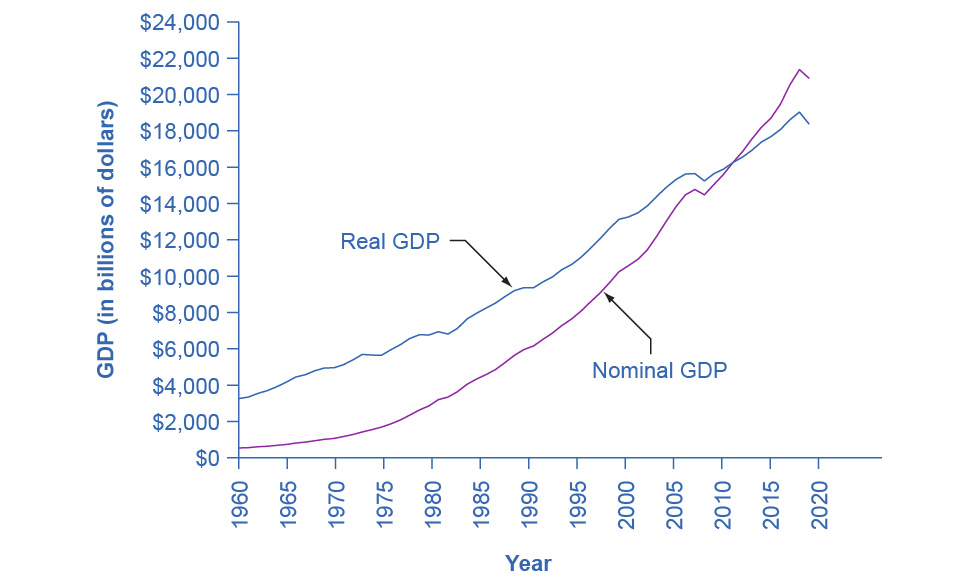
This figure plots U.S. nominal GDP (current dollars) against U.S. real GDP (inflation-adjusted dollars) over time. The fact that nominal GDP typically rises faster than real GDP illustrates how increases in the price level add to measured GDP in dollar terms, even when underlying output growth is more modest. The vertical separation between the two lines is a visual cue that price changes are contributing to nominal GDP growth. Source
The gap between them signals how the price level has shifted over time.
Core idea: what changes and what doesn’t
Nominal GDP changes for two reasons
When nominal GDP rises from one year to the next, that increase can come from:
Producing more final goods and services (higher quantities)
Charging higher prices for the same goods and services (a higher price level)
Some combination of both
Because it uses current-year prices, nominal GDP cannot, by itself, tell you whether the economy produced more output or simply experienced higher prices.
Nominal GDP: The market value of all final goods and services produced within a country in a given period, measured using current prices.
A key comparison skill is recognising that nominal GDP is a “mixed” measure: it blends quantity and price movements.
Real GDP isolates quantity (output) changes
Real GDP adjusts for changes in the price level, aiming to reflect only changes in the quantity of final goods and services produced. When economists discuss “economic growth” across years, they typically mean growth in real GDP because it better captures changes in actual production.
Real GDP: The market value of all final goods and services produced within a country in a given period, measured using constant (base-year) prices.
Comparing real and nominal GDP therefore directly implements the syllabus statement: differences between real and nominal GDP reflect changes in the price level.
Interpreting the gap: what it tells you about the price level
If nominal GDP grows faster than real GDP
This pattern indicates that, in addition to changes in output, the price level increased over the period. In other words, part of nominal GDP growth is due to higher prices rather than higher quantities.
If nominal GDP and real GDP grow at the same rate
This suggests little to no change in the overall price level over the period (prices are roughly stable), so nominal growth mostly reflects changes in real output.
If nominal GDP grows more slowly than real GDP
This suggests the price level fell over the period. Real output may be rising, but declining prices pull down nominal GDP relative to real GDP.
A compact relationship used in comparisons
When comparing nominal and real measures, students should recognise that a price index converts one to the other by accounting for the overall price level (with a base year typically set to 100).
= inflation-adjusted value of final output, measured in base-year dollars
= value of final output at current-year prices, measured in current dollars
= measure of the overall price level, with base year
This relationship reinforces the interpretation rule: holding output constant, a higher price level raises nominal GDP relative to real GDP; holding prices constant, higher output raises both.
Common interpretation pitfalls (and how to avoid them)
Confusing “more dollars” with “more output”
A larger nominal GDP can simply mean higher prices. To avoid this mistake:
Use real GDP to compare output across time
Use the nominal–real gap to infer what happened to the price level
Overreading year-to-year changes
Small differences between nominal and real GDP can occur even when the price level changes modestly. Focus on the general pattern:
Widening gap (nominal pulling away) aligns with rising price level
Narrowing gap aligns with falling price level or disinflationary conditions
Keeping the syllabus focus in mind
The required takeaway is not a long procedure but a clean interpretation: nominal GDP reflects prices and quantities; real GDP reflects quantities; the difference reflects the price level.
Practice Questions
(2 marks) Explain what it implies about the price level if nominal GDP increases by a larger percentage than real GDP over the same period.
Identifies that the overall price level has risen (1)
Links the larger nominal increase to prices increasing beyond the change in output/quantities (1)
(6 marks) A country reports that nominal GDP grew strongly while real GDP grew only slightly. Using economic reasoning, analyse what this comparison suggests about changes in output and the price level.
States nominal GDP reflects both prices and quantities (1)
States real GDP reflects quantities/output adjusted for price changes (1)
Infers that output/quantity increased only slightly (1)
Infers that the price level increased substantially (1)
Explains that much of nominal GDP growth is attributable to higher prices rather than higher production (1)
Uses correct comparative language tying “difference between nominal and real” to “change in the price level” (1)
FAQ
Because nominal GDP values output at current prices. If quantities are unchanged but prices rise, the money value of the same production increases.
Yes. This can happen if output increases but the price level falls enough that the current-price value of output declines.
Real GDP removes price-level changes, so it better tracks changes in production capacity and available goods and services, which are more closely related to material well-being.
It suggests the price level is rising more slowly, is stable, or is falling. The key idea is that a smaller gap indicates a weaker price-level effect relative to output.
Changing the base year changes the set of constant prices used to value output. Levels of real GDP can shift, but the goal is still the same: separate quantity changes from price-level changes.