AP Syllabus focus: ‘Nominal GDP measures output using current prices without adjusting for inflation.’
Nominal GDP is the headline measure of an economy’s total production valued in today’s dollars.
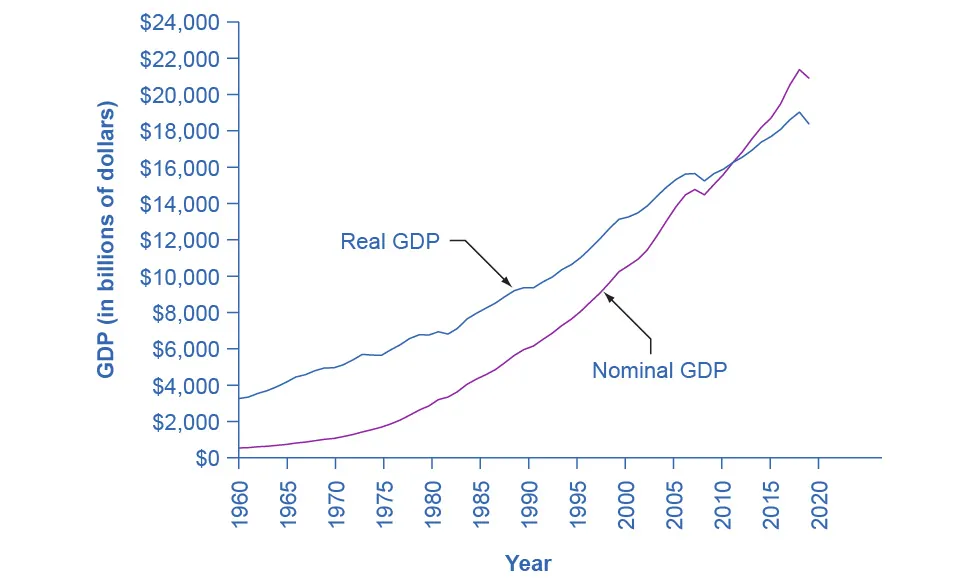
Nominal GDP (current dollars) and real GDP (constant dollars) are plotted over time to show how inflation drives a wedge between the two measures. The growing gap illustrates why nominal GDP mixes price-level changes with changes in real output when comparing different years. Source
It is widely reported because it is straightforward to compute, but interpreting changes requires care because prices and output are mixed together.
What nominal GDP measures
Core idea: current-dollar value of production
Nominal GDP: The market value of all final goods and services produced within a country’s borders in a given period, measured using current prices (prices from that same period).
Nominal GDP answers: “How much is this year’s production worth at this year’s prices?” Because it uses current prices, it reflects both:
Changes in quantities produced (real output changes)
Changes in the price level (inflation or deflation)
“Market value” and “final” are essential
Nominal GDP is a market value concept: goods and services are valued at prices observed in markets. It also focuses on final output to avoid counting the same production multiple times.
Final good (or service): A good or service purchased for end use and not intended for resale or further production within the accounting period.
A practical implication is that intermediate inputs (like steel sold to a carmaker) are excluded from GDP if the final car is included, because the final price already embodies the value of those inputs.
How nominal GDP is constructed (conceptually)
Aggregation across goods and services
Statistical agencies total up spending on final goods and services produced domestically during the period and value each item using its current-period price. Conceptually, this is a price-times-quantity aggregation across many items.
A common way to express the idea is:
= Current-period price of good/service (dollars per unit)
= Current-period quantity of good/service (units per period)
= Index for each final good/service included in GDP
= Number of included final goods/services
This expression highlights that nominal GDP can rise because rises, rises, or both.
Time period matters
Nominal GDP is measured over a specific time span (typically quarterly and annually). Because it is tied to a period’s prices, nominal GDP from different years is not directly comparable as “more production” without separating out the effect of changing prices.
Interpreting changes in nominal GDP
Why nominal GDP can change even if production does not
Because nominal GDP uses current prices, an increase in nominal GDP can occur when:
The economy produces more goods and services (higher quantities)
The same output sells for higher prices (inflation)
Output composition shifts toward goods and services with higher prices
This is why nominal GDP is often described as current-dollar GDP: it measures the dollar value of output in the dollars of that period.
What “without adjusting for inflation” means in practice
Nominal GDP does not remove the effect of changes in the overall price level. Therefore:
In periods of high inflation, nominal GDP growth may overstate improvements in actual production.
In periods of falling prices, nominal GDP growth may understate improvements in actual production.
For many macroeconomic questions—especially those about living standards or true growth in production—economists prefer an inflation-adjusted measure, but nominal GDP remains the fundamental starting point because it is directly observed in current prices.
What is included (and not included) in nominal GDP
Included: domestic production of final output
Nominal GDP includes final goods and services:
Produced within national borders during the period
Sold through markets (with measured prices)
Counted once as final output
Not included: non-production and double counting
Nominal GDP excludes:
Intermediate goods (to prevent double counting)
Purely financial transactions (like buying stocks or bonds), since they do not represent new production
Second-hand sales, because the production occurred in an earlier period (though associated services like dealer fees can count if they represent current production)
These boundaries help nominal GDP track current-period domestic production valued at current-period prices, consistent with the syllabus emphasis that it does not adjust for inflation.
Practice Questions
Question 1 (3 marks) Define nominal GDP and state what is meant by “current prices”.
1 mark: Correct definition of nominal GDP as the market value of final goods and services produced within a country in a given period.
1 mark: Identifies that nominal GDP uses prices from the same period the output is produced (current-year/period prices).
1 mark: States that nominal GDP is not adjusted for inflation / includes both price and quantity changes.
Question 2 (6 marks) Explain why nominal GDP can increase from one year to the next even if the quantity of output produced does not change. Use an aggregate expression such as to support your answer.
1 mark: States that nominal GDP depends on both prices and quantities.
1 mark: Uses or references appropriately.
2 marks: Explains that if is unchanged, an increase in (inflation) increases nominal GDP.
1 mark: Notes that nominal GDP therefore mixes price-level changes with output changes.
1 mark: Applies the reasoning clearly to a year-to-year comparison (nominal GDP rises despite unchanged real production).
FAQ
If a tax increases the market price paid for a domestically produced final good, nominal GDP measured at market prices can rise even if physical output is unchanged.
If a subsidy reduces the market price, nominal GDP can be lower even when quantities are the same.
Early estimates rely on incomplete surveys and partial administrative data.
Revisions occur as more comprehensive information arrives (e.g., fuller business reports), improving accuracy while keeping the same “current-price” concept.
Many national accounts include an imputed market value for owner-occupied housing services to better reflect total current production of housing services.
This raises nominal GDP even though no rent is paid in a market transaction.
If quality rises and the observed market price rises (or consumers pay more for improved versions), nominal GDP can increase via higher measured prices.
If agencies apply quality adjustments in price measurement, the observed price change used for nominal GDP may differ from the sticker price change.
Nominal GDP is measured in domestic currency.
When converted to another currency, the converted figure changes with the exchange rate even if domestic prices and quantities are unchanged, affecting international comparisons.