AP Syllabus focus: ‘The GDP deflator measures the overall price level and converts nominal GDP into real GDP.’
The GDP deflator is a macroeconomic price index used to translate measured output into inflation-adjusted terms. Understanding what it captures, how it is constructed, and how to interpret changes helps clarify whether GDP changes reflect prices or production.
What the GDP Deflator Measures
Core idea: an economy-wide price level
The GDP deflator summarizes the overall price level for goods and services included in GDP for a specific time period. It is “implicit” because it is derived from GDP measures rather than priced directly from a fixed basket.
GDP deflator: A price index that measures the average price of final goods and services produced domestically, computed from the relationship between nominal GDP and real GDP.
Because it is tied to domestic production, it reflects prices for what is produced within a country’s borders, regardless of who buys it.
What is included (and excluded)
The GDP deflator covers:
All final goods and services in GDP (consumption goods, capital goods, government services, and exports)
Goods and services produced domestically in that period
It excludes:
Imports (since they are not domestically produced)
Intermediate goods (to avoid double counting, consistent with how GDP is defined)
How the GDP Deflator Is Calculated
The key relationship
The deflator comes from comparing GDP measured at current prices to GDP measured at base-year prices.
= Index number (base year typically equals 100)
= Value of final output at current-year prices (dollars)
= Value of final output at base-year prices (dollars)
This construction is why the GDP deflator is often described as the tool that converts nominal GDP into real GDP: it provides the price-level adjustment embedded in the nominal-to-real comparison.
Interpreting the index value
Interpret the deflator as a price-level indicator relative to the base year:
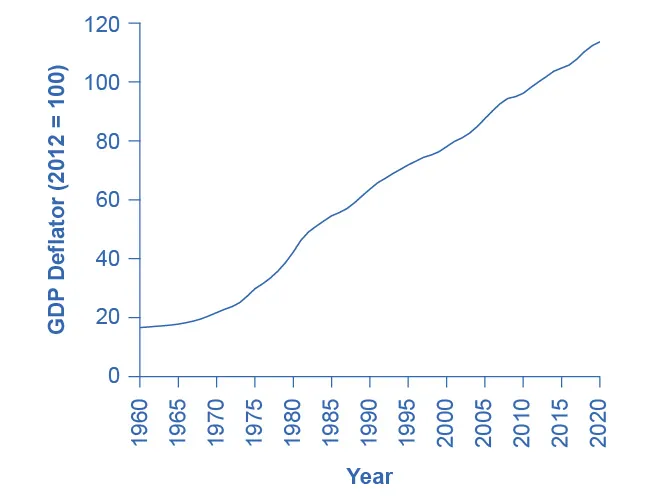
This line graph plots the GDP deflator as an index (2012 = 100) over time. It highlights how the index is interpreted: values above 100 indicate a higher overall price level for domestically produced final goods and services than in the base year, while values below 100 indicate a lower price level. Source
GDP deflator = 100: the average price level is the same as in the base year
GDP deflator > 100: the average price level is higher than in the base year
GDP deflator < 100: the average price level is lower than in the base year
How and Why It Changes Over Time
A “current basket” that evolves
Unlike fixed-basket indices, the GDP deflator reflects the current composition of GDP. If the mix of goods and services produced changes (for example, toward services or new technologies), the deflator’s underlying weights change as well. This can make it a more flexible economy-wide measure of price change, but it also means it is not tracking the cost of a constant basket.
Domestic production focus
Because imports are excluded, the deflator may move differently from consumer-focused price indices when import prices swing.
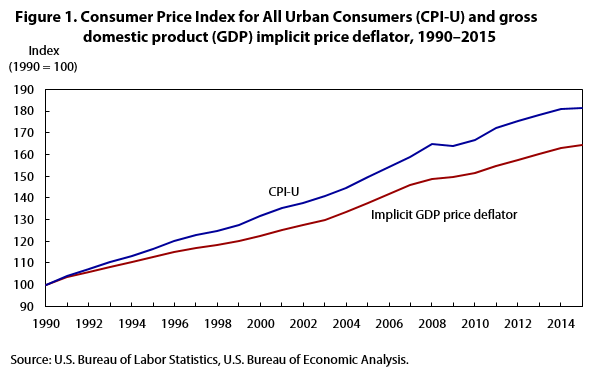
This figure compares the GDP implicit price deflator with CPI-U (both indexed to 1990 = 100) over time. Seeing the two indexes diverge illustrates that the GDP deflator tracks prices of domestically produced final goods and services in GDP, while CPI-U reflects prices paid by urban consumers (including many imported consumer goods). Source
For example, higher import prices can raise consumers’ cost of living without directly raising the GDP deflator, unless domestic prices also change.
Common Uses in AP Macroeconomics Context
Separating price effects from output effects
When nominal GDP rises, the deflator helps determine whether the increase is mainly:
Higher prices (a higher deflator), or
More real output (a larger quantity of goods and services produced)
Measuring broad inflation for domestically produced output
The GDP deflator is often used as a broad gauge of inflation for the entire economy’s production side, aligning with the idea that it measures the overall price level relevant to GDP.
Practice Questions
Question 1 (3 marks) Define the GDP deflator and state what a value of 125 implies about the price level relative to the base year.
1 mark: Correct definition: a price index measuring prices of domestically produced final goods and services, derived from nominal and real GDP.
1 mark: Correct implication: prices are higher than in the base year.
1 mark: Correct magnitude interpretation: about 25% higher than the base-year price level.
Question 2 (6 marks) Explain two reasons why the GDP deflator may change from one year to the next, and explain one reason it may move differently from a consumer price index.
2 marks (1+1): Explains deflator can rise/fall due to changes in prices of domestically produced final goods and services.
2 marks (1+1): Explains composition/weights change because the mix of output in GDP changes over time (current-year basket effect).
2 marks (1+1): Explains difference from CPI due to treatment of imports: deflator excludes imports (CPI includes imported consumer goods), so import price swings can create divergence.
FAQ
It is “implicit” because it is inferred from the ratio of nominal GDP to real GDP rather than built by pricing a pre-set basket.
That means it automatically reflects what is produced in that year, including new or disappearing products.
Imports are subtracted in GDP accounting, so imported goods are not part of domestic production.
As a result, a sharp rise in import prices can increase households’ expenses without necessarily raising the GDP deflator.
Not well. The deflator reflects the prices of what the economy produces, not what a particular group buys.
Groups with spending patterns unlike overall production can experience inflation that differs from the deflator.
It suggests upward pressure on the measured price level of domestic output while the dollar value of total production is unchanged.
In such a case, the quantity of output implied by the nominal–real relationship would tend to be weaker.
It is tied to all components of GDP, not just consumer purchases.
So prices of capital goods and government-provided services (as counted in GDP) influence the deflator alongside consumer goods prices.