AP Syllabus focus: ‘Economies experience short-run fluctuations but can grow over the long run.’
Economic performance has two distinct movements: a long-run upward trend in real GDP driven by rising productive capacity, and short-run up-and-down swings around that trend caused by shocks and changing spending conditions.
Long-Run Growth: The Upward Trend
Long-run economic growth refers to sustained increases in an economy’s ability to produce goods and services over time. In AP Macroeconomics, long-run growth is about expanding the economy’s productive capacity, not temporary booms.
Long-run economic growth: A persistent increase in real output over time caused by an expansion of the economy’s productive capacity (often measured by the long-run rise in real GDP).
Long-run growth is typically shown as:
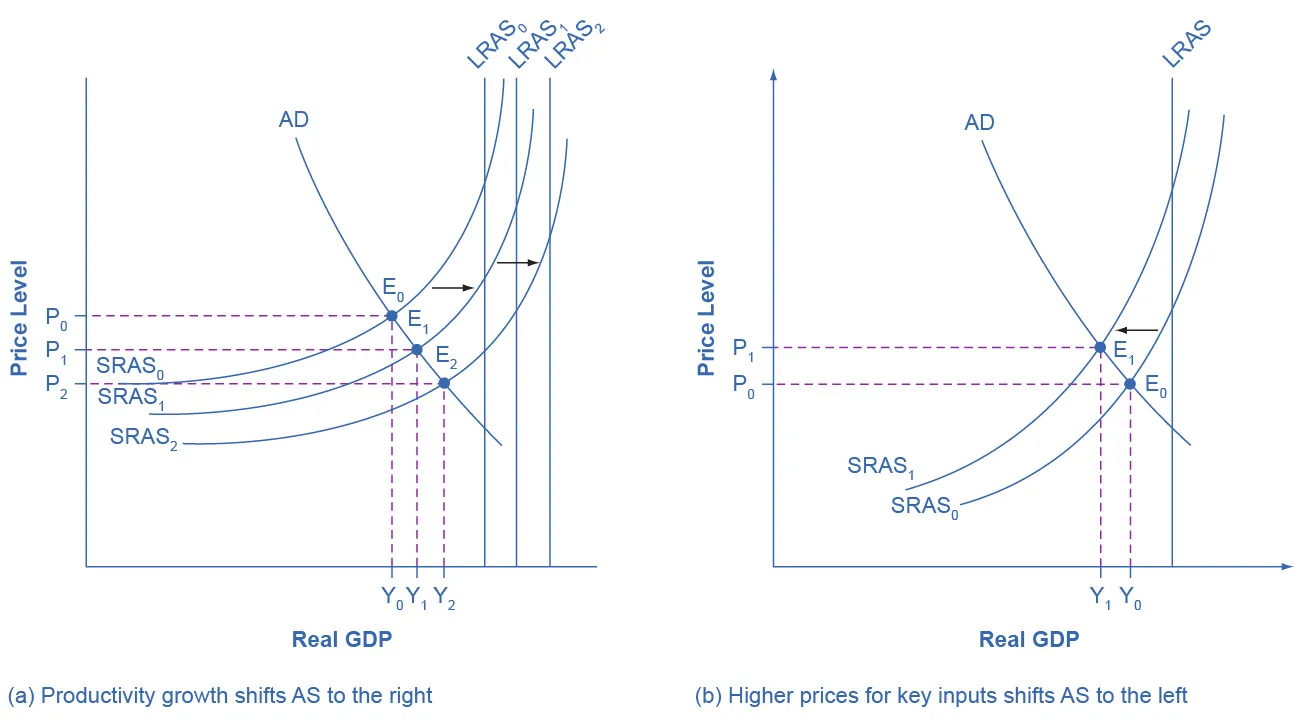
AD–AS diagrams illustrating aggregate supply shifts. Panel (a) shows productivity gains shifting SRAS right over time and moving LRAS (potential output) rightward, consistent with long-run growth in productive capacity. Panel (b) contrasts this with a negative supply shock (higher input prices) that shifts SRAS left in the short run, reducing real GDP and raising the price level. Source
An upward-sloping trend line on a real GDP-over-time graph
A rightward shift of LRAS (long-run aggregate supply) on an AD–AS diagram
An outward shift of the PPC (production possibilities curve)
Key drivers of long-run growth (all increase capacity rather than just spending):
Productivity growth (more output per worker), often from technology and better organisation
Capital accumulation (more and better machinery, factories, infrastructure)
Human capital improvements (education, training, health)
Labour force growth (population growth, participation, immigration)
Institutions and incentives (property rights, stable rules, effective finance)
Trend Growth Rate vs One-Time Level Changes
Long-run growth concerns the growth rate of output over many years. Some events raise the level of output once (a one-time jump), while others raise the economy’s underlying growth rate (a steeper trend).
Short-Run Fluctuations: The Business Cycle Around the Trend
Short-run fluctuations are the recurring deviations of real GDP from its long-run trend.
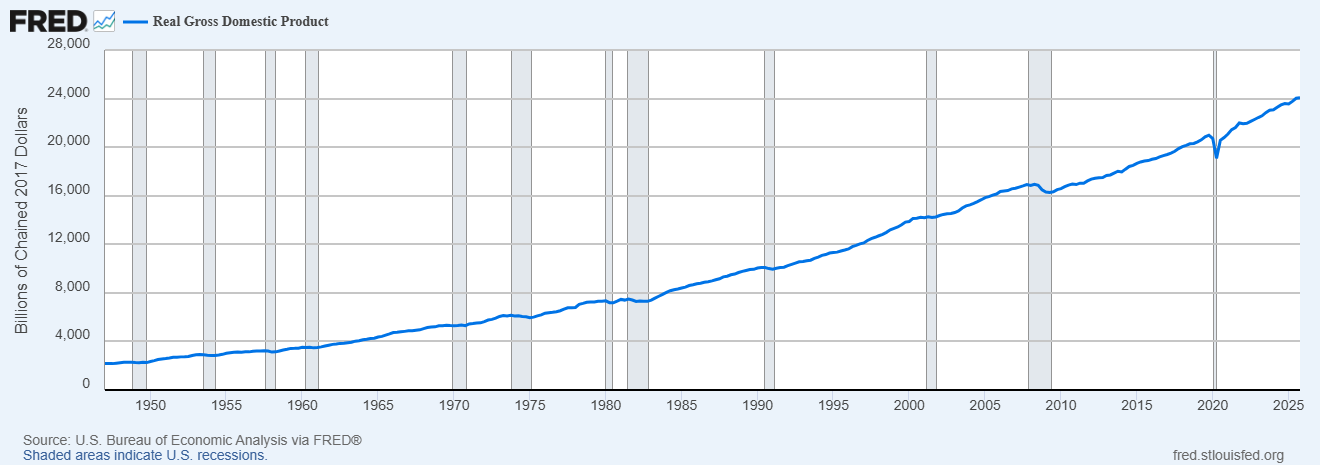
Time-series plot of real GDP growth with U.S. recessions shaded. The alternating shaded (recession) and unshaded (expansion) periods provide a concrete way to visualize short-run fluctuations in economic activity. This kind of evidence supports the idea that economies can experience downturns even while long-run growth continues. Source
These swings are driven mainly by changes in aggregate demand and short-run aggregate supply conditions, so output can temporarily rise above or fall below its long-run path.
Short-run fluctuations: Temporary rises and falls in real GDP around its long-run growth trend, typically associated with expansions and recessions.
Common sources of short-run fluctuations include:
Demand shocks: changes in consumer confidence, investment spending, fiscal policy, monetary policy, or net exports
Supply shocks: energy/commodity price spikes, supply chain disruptions, weather events, sudden changes in production costs
Financial shocks: credit tightening, asset price busts, banking stress
Short-run movements matter because they affect:
Employment and unemployment (jobs rise in expansions, fall in recessions)
Inflation pressure (booms can raise inflation; recessions can reduce it)
Resource utilisation (factories and workers may be underused in downturns)
Why Output Can Fall Even When the Economy “Grows” Long-Run
An economy can have positive long-run growth (upward trend) while still experiencing recessions. The trend reflects rising capacity over time; recessions reflect temporary reductions in actual spending and production.
Measuring Growth Over Time (What to Look For)
Long-run growth and short-run fluctuations are usually discussed using real GDP, because it removes the effects of changing prices. Growth is commonly summarised using a percentage change.
= real GDP in the current period (index, dollars, or other real units)
= real GDP in the previous period (same units as above)
Because the economy is rarely exactly on its trend line, students should distinguish:
The direction of the trend (long-run growth) from
The current position relative to trend (short-run conditions)
Interpreting Graphs and Language Precisely
When describing a scenario, use language that signals the time horizon:
Long run: “LRAS shifts right,” “capacity expands,” “trend growth increases”
Short run: “AD changes,” “real GDP falls below trend,” “a recessionary period occurs”
Policy discussions often focus on stabilising short-run swings, but sustained increases in living standards require long-run growth in productivity and capacity.
Practice Questions
(2 marks) Distinguish between long-run economic growth and short-run fluctuations in real GDP.
1 mark: Long-run growth is a sustained rise in productive capacity/real GDP trend over time.
1 mark: Short-run fluctuations are temporary deviations of real GDP around the trend (expansions/recessions).
(6 marks) Explain how an economy can experience a recession while still having positive long-run economic growth. In your answer, refer to the role of aggregate demand and productive capacity.
1 mark: States that long-run growth means the trend level of real GDP rises over time (capacity increasing).
1 mark: States that a recession is a short-run fall in real GDP (or output below trend).
2 marks: Explains recession via a fall in aggregate demand (e.g., lower consumption/investment/net exports), reducing short-run output and employment.
1 mark: Explains productive capacity can still be rising (e.g., technology/capital/human capital), so the long-run trend continues upward.
1 mark: Clear link that short-run demand-driven movements can occur around a rising long-run trend.
FAQ
Differences often come from sustained productivity improvements rather than short-term demand.
Key influences include:
innovation and diffusion of technology
quality of education and health
savings/investment rates and financial development
political stability and rule of law
Yes. If productive capacity rises (for example, from productivity gains), output can increase without putting upward pressure on prices.
Inflation is more likely when spending rises faster than capacity, which is a short-run demand condition.
Output can rebound before the labour market fully improves.
Reasons include:
firms raising hours/productivity before hiring
mismatch between workers’ skills and available jobs
cautious investment after financial stress
Some supply shocks are temporary, affecting only short-run output. Others can reduce investment, damage capital, or slow innovation, which can lower the level of the long-run path (and possibly the growth rate if the damage persists).
Higher productivity means more output per worker, allowing wages and consumption possibilities to rise without requiring proportionally more labour hours.
Over decades, small differences in productivity growth compound into large differences in income per person.